Cerebrospinal Fluid Has Many Functions
To work properly, the CNS needs protection not only from physical injury but also from significant variation in the local environment of its neurons. A buildup of toxins or a significant change in ionic concentration in this neuronal microenvironment could result in pathological changes in neuronal physiology.
One of the most important functions of CSF is to cushion the brain, protecting it against blows to the head. Because the specific gravities of the brain and CSF are similar, the brain floats in the fluid. Thus the force of a blow to the head is buffered by the CSF instead of being transferred directly to brain tissue.
Because the composition of the CSF is tightly controlled and it is in equilibrium with the extracellular fluid of the brain and spinal cord, the CSF also helps maintain a consistent
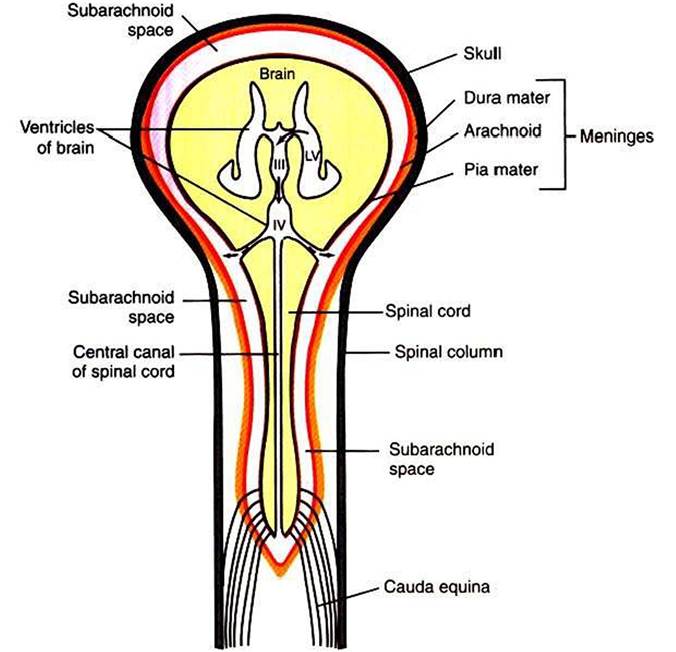
FIGURE 15-1 Schematic diagram of the relationships among the central nervous system, ventricles, cerebrospinal fluid (CSF), and meninges. The CSF is colored pink. LI/, Lateral ventricle; Illf third ventricle; IV, fourth ventricle; solid curved arrow, interventricular foramen; solid straight arrow, cerebral aqueduct; dashed curved arrow, lateral aperture of the fourth ventricle. (Modified from Behan M: Organization of the nervous system. In Reece WO, editor: Duke's physiology of domestic animals, ed 12, Ithaca, NY, 2004, Comstock Cornell University Press.)
extracellular microenvironment for the neurons and glia of the CNS. This diffusions! equilibrium between the CSF and the extracellular fluid, in conjunction with the flow and multiple daily turnover of the CSF, also makes the CSF an effective waste control system that can remove potentially harmful cellular metabolites. Evidence indicates that these properties may also allow the CSF to function as a brain distribution system for some polypeptide hormones and growth factors that are secreted into the CSE