Most Cerebrospinal Fluid Is Formed at the ChoroidPlexus of the Ventricles
The ventricles are a series of interconnected cavities in the core of the brain that have an ependymal cell lining and are filled with CSF (Figure 15-2). The lateral ventricles are respectively located in the two cerebral hemispheres, the third ventricle is found at the midline of the diencephalon, and the fourth ventricle is located between the cerebellum and the dorsal surface of the hindbrain (pons and medulla) (Figure 15-3).
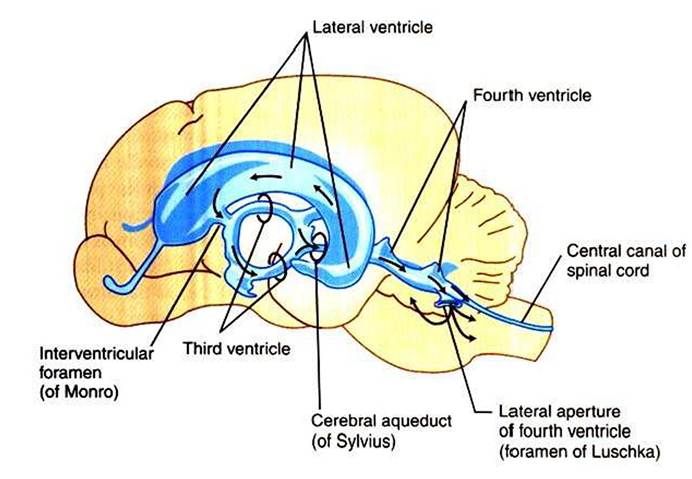
FIGURE 15-2 Lateral view of the ventricular cavities and their approximate spatial position within the brain.
(Modified fron∩ FIetcherTF: Spinal cord and meninges. In Evans HE, editor: Miller's anatomy of the dog, ed 3, Philadelphia, 1993, Saunders.)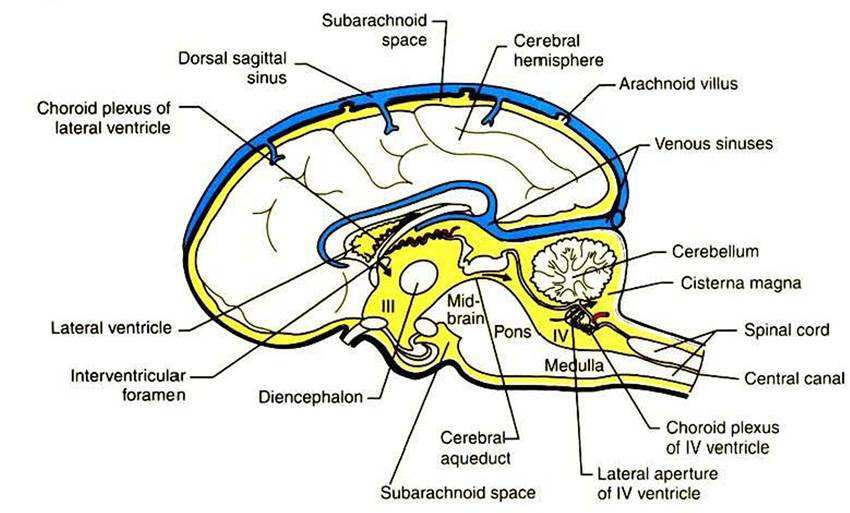
FIGURE 15-3 Midsagittal section of the brain showing portions of the ventricles and subarachnoid space, the choroid plexuses that produce CSF, and the dorsal sagittal sinus into which CSF is absorbed.The cisterna magna is a common location for the sampling of CSEThe CSF is colored light orange. Illf Third ventricle; IV, fourth ventricle. (Modified from FIetcherTF: Spinal cord and meninges. In Evans HE, editor: Miller's anatomy of the dog, ed 3, Philadelphia, 1993, Saunders.)
'I he majority of CSF is formed by a choroid plexus located in each of the four ventricles. These are small, cauliflower-like growths of clustered villi that form a portion of the floor or roof of each ventricle (Figure 15-3). 'I he plexuses consist of tufts of capillaries covered by a layer of ependymal cells. These ependymal cells, unlike the cells lining the rest of the ventricle, form a selective, tight-junction barrier to the secretions of the leaky capillaries and to other surrounding fluids (e.g., CSE extracellular Iluid). Membrane transporters and selective channels regulate the passage of ions and molecules across the ependymal cell barrier, effectively controlling the composition of the CSF being synthesized in the ventricle. The active transport of sodium ions (Na*) contributes to a net movement of sodium chloride (NaCl) into the ventricles. This osmotic gradient regulates the water content of the CSF as water follows the NaCl passively into the ventricle. There is evidence that some potentially harmful metabolic waste products deposited in the CSF can actually be absorbed and removed by the choroid plexus.
It is important to note that CSF is formed at an almost constant rate, independent of either CSF pressure or blood pressure. Therefore, if CSF pressure or general intracranial pressure were to rise as a result of an obstruction to CSF flow or a space-occupying mass, CSF formation would continue.