Collection of clinical material and identification of yeasts
6.1 Material collection
The collection of the oral cavity of dogs is performed with the aid of a sterile, alginate swab, moistened with sterile saline solution. The swab is introduced,
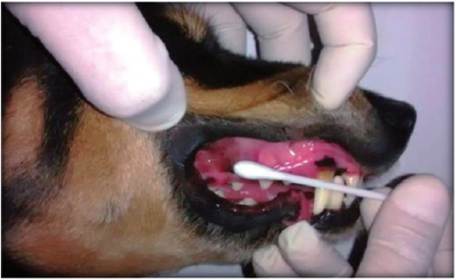
Figure 10.
Collection with sterile swab of the oral mucosa of a mixed breed dog - City of Campinas, Sdo Paulo - Brazil.
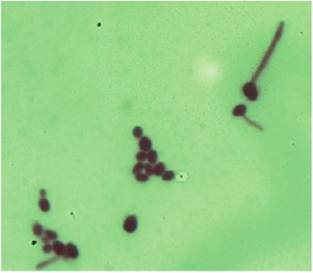
Figure 11.
Yeasts of Genus Candida in an abdominal dog fluid sample - Fuchsin, 1000x.
carefully, in the oral cavity, in circular movements, passing through the entire oral mucosa [19] (Figure 10).
After this procedure, the collected samples must be sent to the laboratory and sown in Petri dishescontaining basic mycology medium (Sabouraud dextrose agar), plus antibiotics (chloramphenicol - 0.05 g/L concentration). Incubation at 25°C for up to two weeks [19].
There are several procedures that can be used to identify yeasts. Direct examination (fresh), or with Gram stain is also highlighted (Figure 11).
6.2 Yeast identification
The identification of yeasts can be performed by means of macro and micro- morphological, biochemical, proteome (MALDI-TOF) and molecular tests. In macromorphological characterization, we studied color, texture and edges (Figure 12).
In the more specific micro morphological identification, we must observe the characteristics of the cells (oval, round, unipolar bud, or multiple buds), pseudohyphae, hyphae and structures characteristic of C. albicans, such as chlamydoconidia (Figure 13).
The formation of a germ tube, another important characteristic of C. albicans, originates from blastoconidium when the yeast is sown in fetal bovine serum (Figure 14).
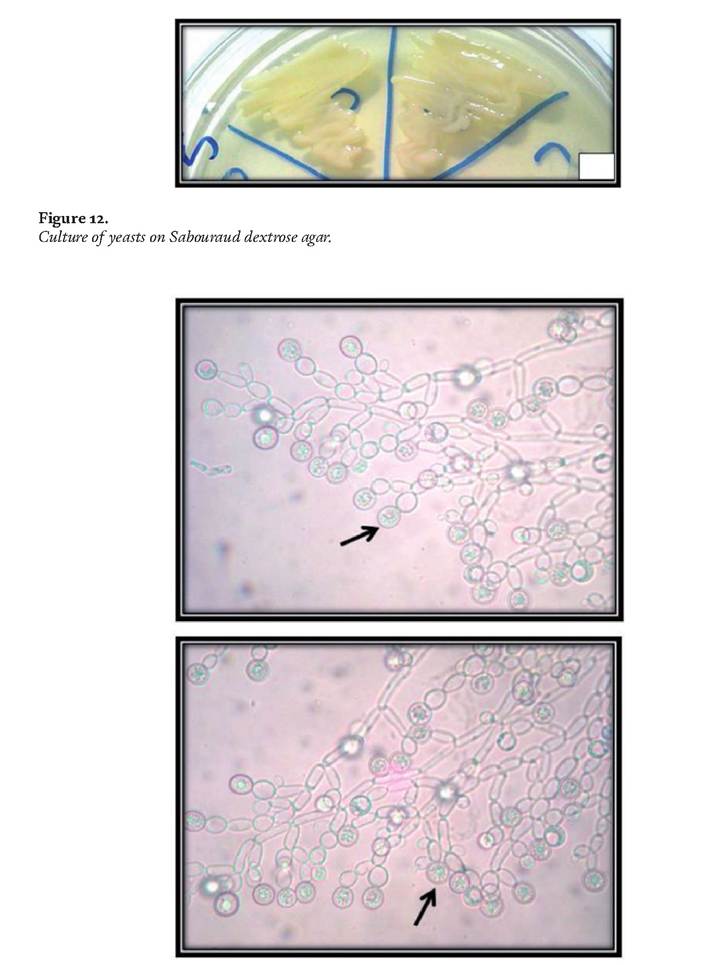
Figure 13.
Candida albicans in culture broth. Globose, or elongated cells, pseudohyphae, hyphae, Hastoconidia and characteristic Chlamydoeonidia, 1000x.
Tests of assimilation of sources of nitrogen and carbohydrates can be performed (auxanogram), as well as fermentation tests (zymogram). The protocol followed for these methods is from the manual “The Yeasts: a taxonomic study” (volumes 1, 2 and 3). The MALDI-TOF technique is a mass spectrometry, which determines the protein profile (proteome) of the yeast under study. It is a fast technique (15-20), simple, excellent cost-benefit, however, there are limitations to the use of the laboratory routine, as the device is expensive and requires specialists to use it, as well as a robust base of standard strains.
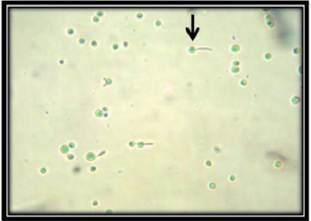
Figure 14.
Germ tube on bovine serum - Candida albicans, 400x.
For the identification of yeasts, we also count on molecular biology techniques, which are sensitive and specific. For the differentiation, for example, of C. albicans and C. dubliniensis is the most accurate technique. There are several methods such as PCR (Polymerase chain reaction), RFLP (Restriction fragment length polymorphism) and RAPD (Random amplified polymorphic DNA). One of the most used is PCR, which detects minimal amounts of DNA, or RNA. But not all laboratories can use these methods, due to the higher costs and the needs of specialized laboratories [33].
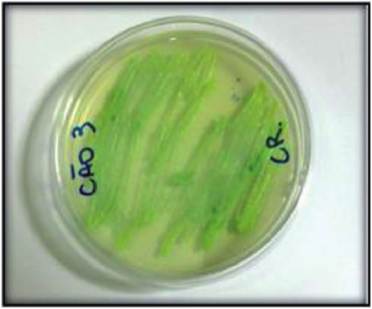
Figure 15.
Yeasts of genus Candida on CHROMAGAR Candida® - Candida albicans with green color
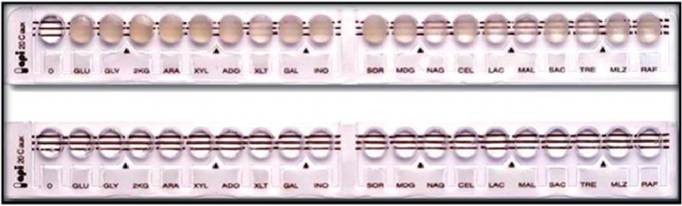
Figure 16.
API20CAUX method (bioMerieux®) -profile of carbohydrates assimilation.
6.3 Chromogenic medium: CHROMagarCandidaS
Sowing in chromogenic media, such as CHROMagarCandidaS, can provide presumptive identification according to the color developed by the yeast. In this medium, the specie Candida albicans develops a light green color; C. tropicalis it is blue/green and C. krusei light pink, for example (Figure 15).
In addition to these identification methods, there are several automated and manual systems that facilitate the laboratory routine, such as Vitek and API20C, as examples (Figure 16).
7.