COMPOSITION OF FOODSTUFFS
1. From a diet standpoint, what is the difference between roughages and concentrates?
2. How are carbohydrates classified?
3. What are the principal monosaccharides and disaccharides?
4.
What are the polysaccharides that are important to animals? How do they differ?5. What are the products of complete protein hydrolysis?
6. How are amino acids linked to form a protein? Differentiate among dipeptides, oligopeptides, polypeptides, and proteins.
7. Differentiate among neutral fats, phospholipids, and cholesterol. What happens to most of the cholesterol formed in the body?
8. Are water, minerals, and vitamins proper foods or accessory foods? What distinguishes proper foods from accessory foods?
The six basic foodstuffs are classified chemically as carbohydrates, proteins, lipids, water, inorganic salts, and vitamins. These are found in varying amounts in the foods that are ingested; a balanced diet must contain some proportion of each. Herbivorous animals can have a diet consisting of roughages and concentrates. Roughages are foods that contain a high percentage of cellulose; they generally have a low digestibility. Concentrates are composed of seeds from plants and most of their byproducts, and are more digestible than roughages. Feeding practices help dictate whether animals receive a high-roughage or a high-concentrate diet.
Carbohydrates
Carbohydrates are classified as monosaccharides, disaccharides, or polysaccharides, depending on the number of five-carbon (pentose) or six-carbon (hexose) units they contain. The monosaccharides include ribose (a five-carbon sugar), glucose, fructose, and galactose (Figure 1222). The disaccharides are chemical combinations of two molecules of monosaccharides and include sucrose, maltose, and lactose (Figure 12-23). Disaccharides are degraded (broken down) to monosaccharides through the process of hydrolysis.
Hydrolysis involves the cleavage of a compound by the addition of water, the hydroxyl group being incorporated in one fragment and the hydrogen atom in the other. The hydrolysis of sucrose yields one molecule each of glucose and fructose; the hydrolysis of maltose yields two molecules of glucose; and the hydrolysis of lactose yields one molecule each of glucose and galactose. The polysaccharides are molecules that contain multiple (more than two) numbers of simple sugars, most of which are hexoses. Polysaccharides important to animals are starch, glycogen, and cellulose. Starch is a food reserve of most plants; when eaten it serves as an excellent source of energy. Starch is degraded through hydrolysis to maltose, a disaccharide, and finally to glucose, a monosaccharide, so it can be absorbed. Glycogen represents the principal carbohydrate reserve in animals; it is stored in the liver and in muscles. It is a highly branched molecule of glucose units (Figure 12-24) and can be degraded as needed to glucose, and thereby used for energy. Cellulose is the structural component of plants. It can be digested only by enzymes of cellulose-splitting microorganisms that function mainly in herbivorous animals (forestomachs of ruminants, cecum and colon of simple herbivores). Cellulose is similarly hydrolyzed to glucose.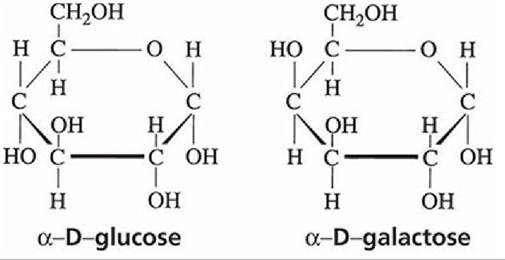
■ FIGURE 12-22 Chemical structure of monosaccharides are represented by glucose and galactose.
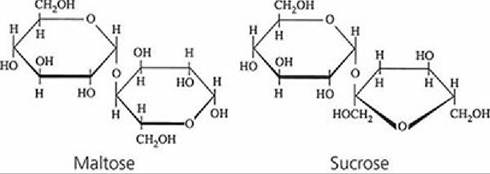
■ FIGURE 12-23 Chemical structure of disaccharides as represented by maltose and sucrose.
Proteins
Proteins are complex, high-molecular-weight, large, colloidal molecules that contain a high percentage of amino acids. In addition to carbon, hydrogen, and oxygen, proteins also contain nitrogen. Hydrolysis of proteins yields amino acids, the building blocks of protein.
The coupling of amino acids to form proteins occurs at the carboxyl group of one amino acid with the amino group of another, accompanied by the loss of a water molecule. The degradation of proteins involves the addition of water and the reforming of the amino acids (hydrolysis).The linkage of amino acids (called the peptide bond) to form a protein is shown in Figure 12-25. Dipeptides consist of two amino acids. Oligopeptides consist of more than two, but not more than 10, amino acids. Polypeptides consist of more than 10, but not more than 100, amino acids. Polypeptides are classified as proteins when they contain more than 100 amino acids. The essential amino acids are those that cannot be synthesized either at all or rapidly enough to permit normal growth; they must therefore be provided for in the diet. The nonessential amino acids are those that can be synthesized by the animal in sufficient quantities to ensure normal growth. Protein quality is important; the highest-quality protein is one that provides all of the essential amino acids in the exact proportions required. A lower-quality protein either lacks essential amino acids or does not supply them in proper proportions. Manufacturing processes can change a high-quality protein to one of lower quality.
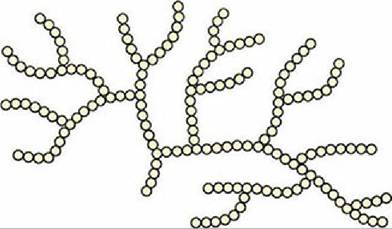
■ FIGURE 12-24 Schematic representation of the highly branched glycogen molecule. Each bead of the chain represents a glucose molecule. (From Conn EE, Stumpf PK. Outlines of Biochemistry. New York: John Wiley & Sons, 1963.)
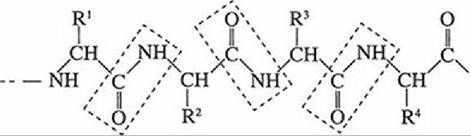
■ FIGURE 12-25 A polypeptide chain, the basic primary structure of a protein. The peptide bonds are shown by the areas boxed by dashed lines.
Lipids
The lipids include fats and related substances. Neutral fats (triglycerides) are esters (formed by the reaction between an acid and an alcohol) produced by three molecules of fatty acids combining with one molecule of glycerol (Figure 12-26).
Phospholipids are complex lipids that contain phosphate (Figure 12-27); in addition, they usually contain glycerol, fatty acids, and a nitrogenous base. Phospholipids are important structural elements of cell membranes and of sphingomyelin (a phospholipid), which occurs in myelin sheaths of nerves. Thromboplastin, another phospholipid, is involved in blood coagulation.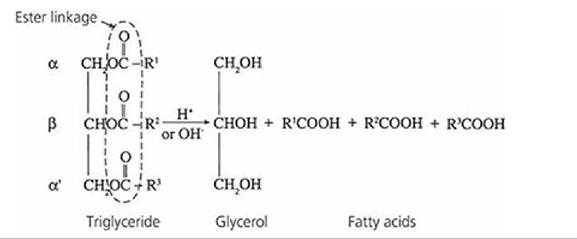
■ FIGURE 12-26 Hydrolysis of a simple lipid. Three molecules of long-chain fatty acids and one molecule of glycerol are released when a triglyceride molecule is hydrolyzed. The great majority of lipids are triglycerides. Lipids are esters of glycerol and fatty acids. The ester linkages are shown within the area circumscribed by the dashed lines.
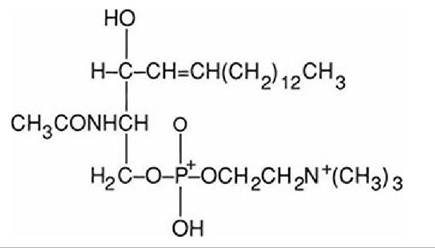
■ FIGURE 12-27 Sphingomyelin. This phospholipid is common to myelin sheaths of nerve fibers.
Cholesterol (Figure 12-28) is a fatty substance derived from triglycerides. It is a high-molecular- weight alcohol; its sterol nucleus is synthesized from degradation products of fatty acid molecules. Approximately 80% of all cholesterol formed in the body is conjugated in the liver to form bile salts, which are then transported to the intestine for use in digestion. Cholesterol is also an important structural component of cell membranes.
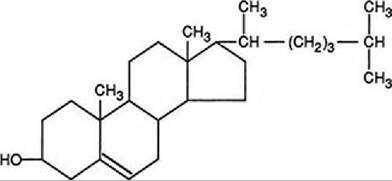
■ FIGURE 12-28 Chemical structure of cholesterol.
Accessory Foods
Minerals, vitamins, and water are considered to be accessory foods; carbohydrates, fats, and proteins are called proper foods. The principal distinction is that proper foods supply energy whereas accessory foods are essential for life but do not supply energy. The role of water as an accessory food has been described (Chapter 2).
Minerals
Minerals are inorganic foodstuffs.
The combined amount in a diet can be determined by burning; when this is done, the mineral is referred to as ash. Minerals are essential for normal growth and reproduction of animals. Those required in greater quantities are referred to as macrominerals, and this group includes calcium, phosphorus, sodium, chlorine, potassium, magnesium, and sulfur. These elements are important structural components of bone and other tissues and serve as important constituents of body fluids. As noted in earlier chapters, they play vital roles in the maintenance of acid-base balance, osmotic pressure, membrane electrical potential, and nerve transmission. The elements required in much smaller amounts are referred to as trace minerals. This group includes cobalt, copper, iodine, iron, manganese, molybdenum, selenium, zinc, chromium, and fluorine. Macrominerals (e.g., calcium and phosphorus) might be required for diets in substantial amounts, but trace minerals (e.g., cobalt and manganese) might be required only in minute amounts. Minerals can be actual components of body chemicals or act as catalysts for chemical reactions. Their presence in plasma is only a reflection of their presence in cells and other body fluids. It is beyond the scope of this book to discuss mineral functions, deficiencies, toxicities, and interrelationships.Vitamins
The vitamins are a group of chemically unrelated organic compounds essential for life. They function as metabolic catalysts or regulators, and can be classified on the basis of their solubility as fat-soluble vitamins (A, D, E, and K) or water-soluble vitamins (B and C vitamins). All of the vitamins are required for normal function in all animals and, for most, the diet must supply them if the animal is to function normally. In some animals, there is no dietary requirement for some vitamins because they are synthesized within that animal’s body, e.g., in ruminants, microbes are capable of producing many of the water-soluble B vitamins needed to support their needs.
■