Pregastric mechanical functions
1. What is meant by prehension? What are the principal prehensile structures?
2. Why are cattle prone to tongue injuries? What assists sheep in their ability to graze close to the ground?
3.
Observe how different animals drink water. What is an important prehensile organ in the horse?4. What is accomplished by mastication?
5. Is there a voluntary phase to deglutition? Can an anesthetized or sleeping animal swallow?
6. Study Figure 12-29 in order to visualize the swallowing reflexes better. Talk through the events of swallowing.
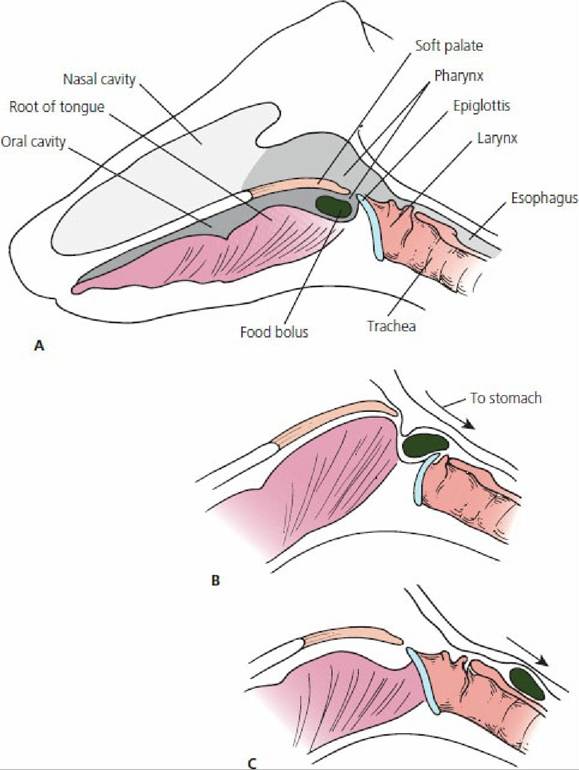
■ FIGURE 12-29 Displacement of structures associated with swallowing a food bolus. A. A food bolus is moved through the oral cavity and plunged into the pharynx near the root of the tongue during the voluntary stage of swallowing. This begins the reflex stages. B. Pharyngeal stimulation leads to inhibition of respiration and closing of the glottis (opening to the larynx and trachea). The caudal direction of the root of the tongue elevates the soft palate, closing off the nasal cavity, and the epiglottis, further sealing the glottis. Pharyngeal contraction forces the food bolus into the esophagus. C. A peristaltic reflex is initiated by the presence of the food bolus in the esophagus; the bolus is transported to the stomach by peristalsis; pharyngeal structures return to the normal position.
The stomach is the first major organ associated with digestion. Before food can be received by the stomach, important pregastric functions are performed to receive, prepare, and deliver a bolus to the stomach. Performance of these functions varies among the animals and depends mostly on adaptations associated with their diet.
Prehension
The first mechanical function necessary for the digestive process is prehension, the seizing and conveying of food into the mouth.
The lips, teeth, and tongue are the principal prehensile structures in domestic animals. The highly mobile upper lip is a useful prehensile organ in the horse, especially when eating from a feedbox containing grain. When pasturing, the horse draws the lips back and uses the incisor teeth to sever grass.The upper lip of cattle is rather immobile and the tongue is used as a prehensile organ. The tongue is highly mobile and can grasp grass (aided by the papillae), bringing it to the mouth between the lower incisors and upper dental pad. An upward movement of the head accomplishes shearing of the grass. Because of its use as a prehensile organ, the tongue is vulnerable to injury by sharp or pointed objects that might be in the way of the grasping movement. “Wooden tongue” in cattle is a chronic inflammation caused by an organism introduced through an eating-associated injury.
The tongue is also an active prehensile organ in sheep. The cleft upper lip of sheep facilitates grazing close to the ground. Close shearing is particularly useful when grass is in short supply.
The heavy snout and pointed lower jaw of pigs are adaptations for rooting. Characteristic head movements of rooting are retained by pigs when grain is eaten from a feeder.
Dogs and cats convey liquids to the mouth with the tongue, whereby the free end is contracted to form a ladle. Other domestic animals drink water by suction. Most birds fill the beak with water by dipping and then lifting the head to allow the water to enter the esophagus by gravity. The pigeon, however, drinks by suction.
Mastication
Mastication refers to the mechanical breakdown of food in the mouth. It is commonly called chewing and is carried out to varying degrees by different animals. The fibrous nature of the diet of herbivores requires more chewing than the meat diet of carnivores. In the latter, chewing is of short duration; the teeth are used mostly for tearing and for gnawing on bones in a more leisurely fashion.
The table surfaces of the cheek teeth of herbivores wear unevenly, which facilitates more efficient mastication of their diet.A bolus of food (rounded or oblong) is formed by the mastication process. The bolus might be imperfectly formed by animals that gulp their food. The food material of the bolus is mixed with saliva. The mucous secretion of saliva provides a certain adhesiveness and, coupled with its serous secretion, lubricates the food mass for easier transport through the esophagus.
Deglutition
Deglutition is the act of swallowing or conveying the food mass from the mouth to the stomach. This complex process involves a number of reflexes that are coordinated by a swallowing center in the brain. There are three stages of swallowing: (1) through the mouth (voluntary), (2) through the pharynx (reflex), and (3) through the esophagus (reflex). Swallowing begins as a voluntary activity and is followed by reflex activity. Some degree of consciousness is required for swallowing because of the voluntary stage. Unconscious animals can inhale vomitus because they lack the voluntary state and because the reflex centers are depressed and do not respond to receptor stimulation in the mouth and pharynx. The reflexes move the food and close the glottis and nasal cavity, thereby preventing food from entering these parts. The sequence of reflexes is as follows:
1. Respiration is inhibited and the danger of inhaling food is minimized.
2. The glottis (opening to the larynx) is closed.
3. The larynx is pulled upward and forward.
4. The root of the tongue can now fold the epiglottis (forward projection from the glottis) over the glottis as the tongue plunges the bolus from the mouth into the pharynx.
5. The soft palate is elevated, which closes the nasal cavity from the pharynx.
6. A peristaltic contraction of the pharynx directs food into the esophagus.
7. A reflex peristaltic wave in the esophagus is initiated, which transports the bolus into the stomach.
A representation of food about to be forced into the esophagus and the associated displacement of the soft palate, epiglottis, pharynx, and tongue is shown in Figure 12-29.
■