Cyclin-Dependent Kinases Are the "Engines" Driving the Cell Cycle
Recall from Chapter 1 that protein kinases, which are enzymes that phosphorylate other proteins, are important as elements of signaling pathways. For example, the second messenger cyclic adenosine monophosphate (cAMP) acts by activating protein kinase A (see Figure 1-18), and di acylglycerol as a second messenger activates protein kinase C (see Figure 1-19).
Protein kinases play a major role in many aspects of control of the cell cycle; most importantly, CDKs, when activated, can directly cause a cell to enter either S phase or mitosis, whether the cell is ready or not.Active CDKs are composed of two different types of protein subunits (Figure 2-3). 'Γhe catalytic subunits (numbered, CDKl, CDK2, etc.) are the subunits that have enzymatic activity for hydrolyzing adenosine triphosphate (ATP) and transferring the phosphate group to a protein substrate. The other subunit is an activator of the catalytic subunit and is called a cyclin; the abundance of this protein increases and decreases during the cell cycle (i.e., the protein concentration cycles up and down during the cell cycle). Different cyclins are specific for various CDKs and for the different phases of the cell cycle. The various cyclins are identified by letters, such as cyclin A and cyclin B. Cyclins must reach a threshold concentration to activate the catalytic subunit, and the threshold is achieved as a result of protein accumulation from new synthesis during the G phases.
Once the cyclins have bound to their appropriate catalytic subunit, the cyclin-CDK complex as a whole is activated by achieving a particular state of phosphorylation. There are inhibitory sites of phosphorylation around amino acid 15 of the catalytic subunit» and these must be dephosphorylated. There is also a stimulatory phosphorylation site at amino acid 167, and this must be phosphorylated for cyclin-CDK activity.
Once activated, the CDK phosphorylates various substrates associated with either S phase or mitosis. For example, the cyclin-CDK complex responsible for mitosis directly phosphorylates the protein filaments that strengthen the nuclear membrane (lamins). This phosphorylation causes the filaments to disassemble, in turn allowing the nuclear membrane to dissolve, which is an early event of mitosis.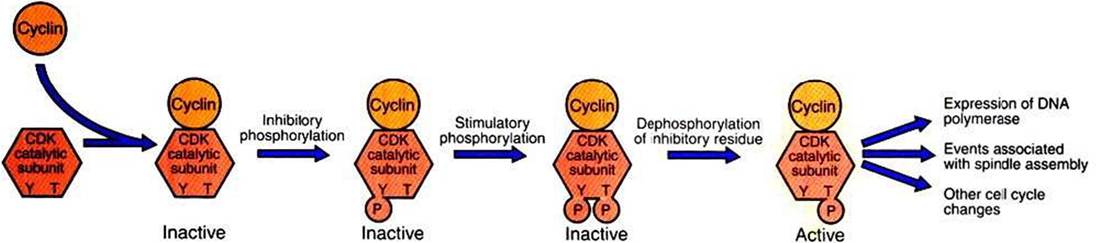
FIGURE 2-3 Activation of the cyclin-CDK "engines" of the cell cycle. Activation of cyclin-dependent kinases depends on the association of a cyclin with a catalytic subunit and then an appropriate pattern of inhibitory and stimulatory phosphorylations on the catalytic subunit.
The different phases of the cell cycle are controlled by different cyclin-CDK pairs, as shown in Figure 2-4. Thus the complex of CDKl with either cyclin B or cyclin A is the particular CDK pair responsible for driving the cell into mitosis. Cyclins E and Λ interacting with CDK2 play important roles in initiating and maintaining DNA synthesis in S phase. Cyclin D interacting with either CDK4 or CDK6 functions in late Gl in a “decision” by the cell to commit to DNA synthesis. This decision is called the R (restriction) point and is discussed in the later section on tumor suppressors.
Given the importance of cyclins and CDKs in driving the cell cycle, one would expect they would have some connection to cancer. Overexpression of cyclin D is associated with human and mouse breast cancer, and ablation of cyclin D provides some protection against breast cancer in mice. Virtually all multiple myelomas, a type of leukemia, show overexpression of cyclin D. Overexpression of cyclin A is strongly associated with some lung cancers and with testicular cancer of humans, and overexpression of cyclin E is associated
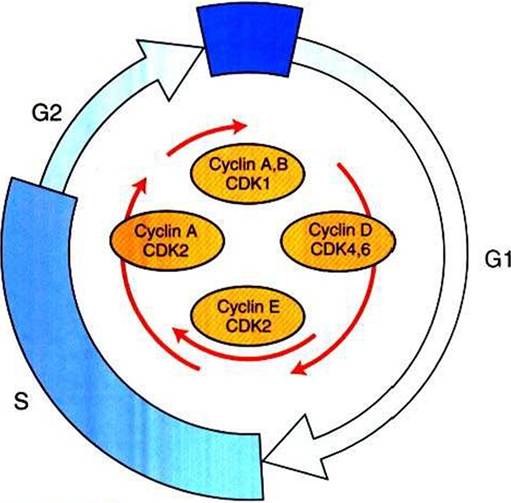
FIGURE 2-4 Cyclins and CDKs around the cell cycle. Different phases of the cell cycle are associated with and driven by different cyclin-CDK pairs, as shown here.
with certain human leukemias. Curiously, in contrast to the cyclin subunit, the CDK enzymatic subunit is not known to be mutant in any common cancer.