Descriptive Terms Useful in the Study of Anatomy
When giving geographic locations, we make use of certain arbitrary frames of reference known as meridians of latitude and longitude. However, since an animal is rarely oriented exactly with a line on the earth’s surface, our frames of reference must be in relation to the animal itself and must apply regardless of the position or direction of the animal (Fig.
1-1). Many terms of direction differ significantly between human and domestic animal anatomy because of the orientation of bipedal versus quadrupedal stance. Although use of human anatomical nomenclature in quadrupeds usually leads to confusion, the terms anterior, posterior, superior, and inferior are frequently used to describe the eye and aspects of dental anatomy of both human beings and domestic animals (see Chapters 11 and 12).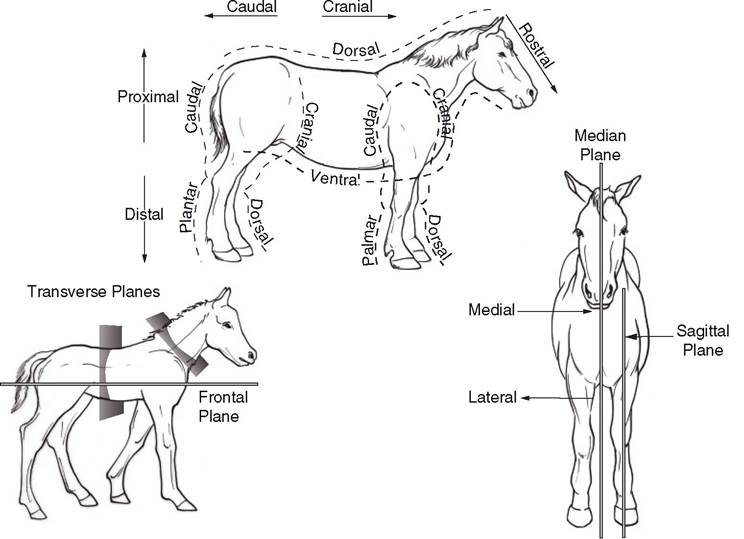
Figure 1-1. Directional terms and planes of the animal body.
Cranial is a directional term meaning toward the head. The shoulder is cranial to the hip; it is closer to the head than is the hip.
Caudal means toward the tail. The rump is caudal to the loin.
Rostral and caudal are directional terms used in reference to features of the head to mean toward the nose (rostral) or toward the tail (caudal).
The median plane is an imaginary plane passing through the body so as to divide the body into equal right and left halves. A beef carcass is split into two halves on the median plane.
A sagittal plane is any plane parallel to the median plane. The median plane is sometimes called the midsagittal plane.
A transverse plane is at right angles to the median plane and divides the body into cranial and caudal segments. A cross-section of the body would be made on a transverse plane. The cinch of a saddle defines a transverse plane through the thorax of a horse.
A horizontal plane is at right angles to both the median plane and transverse planes. The horizontal plane divides the body into dorsal (upper) and ventral (lower) segments. if a cow walks into a lake until the water comes above the chest, the surface of the water is in a horizontal plane in relation to the cow.
in addition to the planes of reference, other descriptive terms are valuable in defining an area we wish to discuss.
Medial is an adjective meaning close to or toward the median plane. The heart is medial to the lungs; it is closer to the median plane than are the lungs. The chestnut is on the medial aspect (inside) of a horse’s limb; it is on the side closest to the median plane.
Lateral is the antonym of medial; it means away from the median plane. The ribs are lateral to the lungs, that is, farther from the median plane.
Dorsal means toward or beyond the backbone or vertebral column. The kidneys are dorsal to the intestines; they are closer to the vertebral column. Dorsum is the noun referring to the dorsal portion or back. A saddle is placed on the dorsum of a horse.
Ventral means away from the vertebral column or toward the midabdominal wall. The udder is the most ventral part of the body of a cow, the part of the body farthest from the vertebral column.
Deep and internal indicate proximity to the center of an anatomical structure. The humerus (arm bone) is deep in relation to all other structures in the arm.
Superficial and external refer to proximity to the surface of the body. Hair is superficial to all other structures of the body.
Proximal means relatively close to a given part, usually the vertebral column, body, or center of gravity. Proximal is generally used in reference to an extremity or limb. The carpus or knee is proximal to the foot.
Distal means farther from the vertebral column, and like proximal, it is generally used in reference to portions of an extremity. The hoof is distal to the carpus or knee.
The suffix -ad is used to form an adverb from any of the above-named directional terms, indicating movement in the direction of or toward, as in dorsad, ventrad, caudad, and craniad, that is, respectively, toward the dorsum, toward the belly, toward the tail, and toward the head. For example, the superficial digital flexor tendon inserts on the distal limb (the adjective distal describes noun limb), but it passes distad as it runs along the palmar aspect of the manus (the adverb distad describes the verb passes).
in describing the thoracic limb (forelimb) distal to (below) the carpus, palmar refers to the flexor or caudal surface. Dorsal is used in this region to refer to the opposite (cranial) side. in describing the pelvic limb (hindlimb) distal to the hock, plantar refers to the caudal surface, and dorsal here, too, refers to the side directly opposite (the cranial side).
Prone refers to a position in which the dorsal aspect of the body or any extremity is uppermost. Pronation refers to the act of turning toward a prone position.
Supine refers to the position in which the ventral aspect of the body or palmar or plantar aspect of an extremity is uppermost. Supination refers to the act of turning toward a supine position.
The term median is often confused with medial. Both words are used as adjectives when describing anatomical structures. Median means on the midline (as in the median plane, or the median artery). Medial is subtly different, as it means toward the midline and is a term of relativity (as it implies that there is a lateral).