DEVELOPMENT to give a general account of this before proceeding further; additional details will be mentioned later.
The nervous system makes a very early appearance, becoming evident at the embryonic disk stage as an elongated thickening (neural plate) of the ectoderm that overlies the notochord and paraxial mesoderm.
The lateral parts of the neural plate are soon raised above the surrounding surface by growth of the underlying mesoderm and form bilateral neural folds that slope toward an axial crease, the neural groove. As the process continues, the edges of the folds become increasingly prominent and then bend inward toward each other; eventually they meet and fuse, which converts the neural groove into a neural tube (Figure 8-8). The tube, which is the primordium of the brain and spinal cord, then sinks below the surface, which is simultaneously closed above it by the fusion of the nonneural ectoderm to each side. At the same time, cells within the margins of the folds break away to form continuous cords, the neural crests, that run almost the whole length of the tube at its dorsolateral aspects. The neural crests contribute to peripheral ganglia, both somatic (dorsal root) and visceral, to the enteric nervous system, to the medullary parts of the adrenal glands, to glia, to skin melanocytes, and to a variety of craniofacial connective tissues. The sympathetic ganglia develop in the mid trunk of the embryo while neural crest cells from more cranial and more caudal regions migrate into the gut to form the enteric nervous system.Closure of the neural tube is initially limited to the presumptive occipital region but soon spreads rostrally and caudally until only two small openings (neuropores; Figure 8-9/5,5) remain to provide communication at the surface of the embryo between the lumen of the tube and the amniotic cavity. These openings do not persist long: the rostral neuropore closes first, and the caudal one remains open for another day or two while the tube continues to lengthen at its caudal extremity by exten-
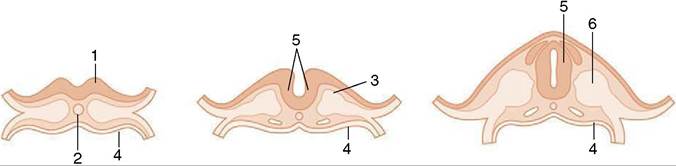
Figure 8-8 Three stages in the closure of the neural plate.
1, Neural plate; 2, notochord; 3, paraxial mesoderm; 4, endoderm; 5, neural tube; 6, somite.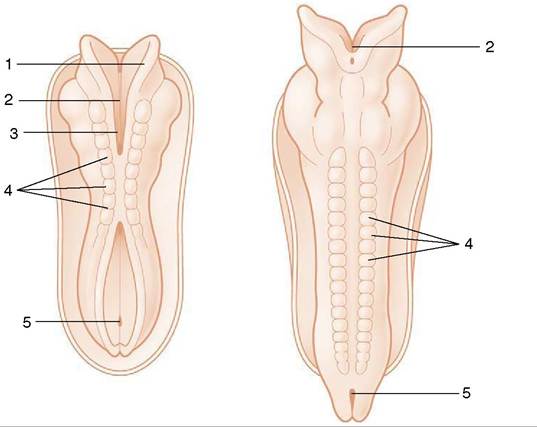
Figure 8-9 Dorsal views of developing embryos. Two stages in the formation and fusion of the neural folds are illustrated. 1, Neural fold; 2, neural groove; 3, rostral neuropore; 4, somites; 5, caudal neuropore.
sion and subsequent infolding of the neural plate. The abnormal persistence of these openings produces relatively common defects of the brain and spinal cord in which nerve tissue may be exposed on the surface of the body. Failure at the rostral extremity leads to malformation of the forebrain and midbrain with accompanying anomalies of the skull; it is known as anencephaly and, although the term implies complete failure of brain development, it can show considerable variation in severity. Most forms are incompatible with life after birth. Failure at the caudal extremity is more common and is known as spina bifida. It is associated with defective closure of the vertebral arches. Children and young animals with this malformation may live after birth, though with severe functional disturbance; affected animals are not usually permitted to survive.
The part of the neural tube that forms the brain is wider from the outset and shows localized expansions even before the tube is completely closed. These define three primary brain vesicles: prosencephalon (forebrain), mesencephalon (midbrain), and rhombencephalon (hindbrain). The remaining, more uniform part of the tube becomes the spinal cord. The differentiation of the wall is initially similar along the length of the tube but becomes modified later in the part that becomes the brain, increasingly so toward its rostral extremity. It is convenient to consider first the differentiation of the spinal cord.
A transverse section of the tube at its formation reveals three concentric layers in its structure (Figure 8-10).
These are unequally developed around the circumference, which is divisible into thick lateral parts connected by thinner roof and floor plates. The innermost layer bounding the lumen is provided by a sheet of neuroepithelial cells that persists as the ependyma lining the central canal and ventricular system of the adult cord and brain. These cells proliferate rapidly, and although some daughter cells remain as a surface lining, most migrate outward into the middle (mantle) layer of the lateral wall. These immigrant cells are neuroblasts,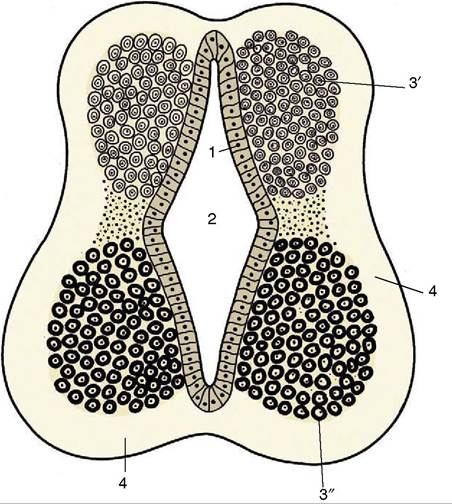
Figure 8-10 Differentiation of the neural tube. 1, Neuroepithelial (ependymal) layer; 2, central canal; 3', 3", mantle layer; 3', dorsal column (alar lamina); 3", ventral column (basal lamina); 4, marginal layer.
precursors of neurons and glia. The mantle layer itself becomes the gray substance to which the bodies of the neurons are confined. The processes from the cells within the mantle layer extend outward and form the outer (marginal) layer consisting of dendrites and axons. The marginal layer becomes the white substance of the cord in which fibers descend or ascend for various distances.
The cells of the mantle layer now become arranged in dorsal and ventral columns that bulge into the lumen of the tube, where they are separated by a longitudinal limiting groove (Figure 8-11Z√). The dorsal bulge (alar plate) provides the dorsal horn or column of the gray substance of the cord; its constituent neurons are those of the afferent systems. The ventral bulge (basal plate) becomes the ventral horn or column, which is the location of the efferent neurons; both horns also contain many interneurons. Neurons with somatic functions segregate from those with visceral functions, and four groups of neurons are then arranged in dorsoventral sequence: somatic afferent, visceral afferent, visceral efferent, and somatic efferent (Figure 8-12).
The roof and floor plates provide commissures through which nerve fibers pass from one side of the cord to the other.Further growth of the alar and basal plates causes the lateral parts of the tube wall to expand outward in all directions, submerging the roof and floor plates and
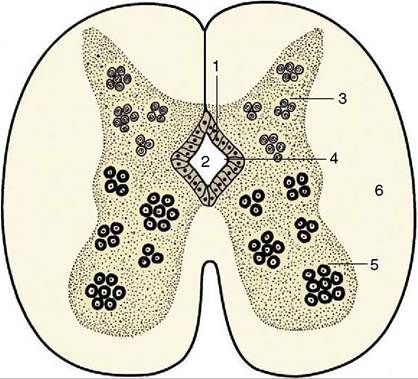
Figure 8-11 Further differentiation of the neural tube (spinal cord). 1, Neuroepithelial layer, 2, central canal; 3, dorsal column of mantle layer; 4, longitudinal limiting groove; 5, ventral column of mantle layer; 6, marginal layer.
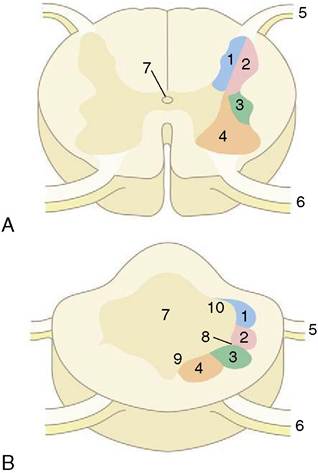
Figure 8-12 Organization of the gray substance of the spinal cord (A) and medulla oblongata (B). 1, Somatic afferent column; 2, visceral afferent column; 3, visceral efferent column; 4, somatic efferent column (lower motor neurons); 5, dorsal root; 6, ventral root; 7, central canal or fourth ventricle; 8, sulcus limitans; 9, basal lamina; 10, alar lamina.
creating the dorsal sulcus and the ventral fissure that divide the adult cord into its right and left halves. A serial segmentation is created by the appearance of the roots of the spinal nerves. The dorsal roots are provided by neurons within the dorsal root ganglia, local condensations of neural crest cells. The axon processes of these cells extend medially to reach and penetrate the marginal layer, where they divide. Branches of these axons diffuse over several segments before entering the mantle layer to terminate on dorsal column cells; some of greater length extend to reach higher levels within the central nervous system (see Figure 8-6). The ventral roots are formed by axons of efferent neurons within the ventral column, which grow through the marginal layer to emerge on the surface of the cord, where they converge. The appearance of the roots divides the white substance into the dorsal, lateral, and ventral funiculi (Figure 8-13/7,8,9).
Although the histogenesis of the nervous system will not be described, two points must be made. In most parts of the brain the full complement of neurons is established shortly after, if not before, birth. However, contrary to former beliefs, in some regions there is a significant, more protracted postnatal recruitment in areas such as the cerebellum and hippocampus that continues into later life. Adult life is marked by a slight depletion of their number. Different authors provide very different estimates of neuronal loss in the human brain, in which the phenomenon is of the most obvious interest. The second point relates to the process of myelinization of the fibers within the central nervous system. Different tracts within the brain and cord acquire adequate insulation (essential to their function) at different stages of development. There are important species differences in this process.
The three primary brain vesicles are evident before closure of the neural tube. At this time the prosencephalon has already extended the evaginations that become the optic cups. The brain grows more rapidly than the tissues that enclose it, and the constraint that this exercises enforces a remodeling of its form. Flexures appear at three locations. The most caudal flexure is more marked in ourselves than in quadrupeds. It bends the brain ventrally at its junction with the cord. A second flexure at midbrain level is almost simultaneous and is sufficiently pronounced to bring the ventral surfaces of the forebrains and hindbrains close together; this relationship is later reversed by the third flexure, which folds the hindbrain dorsally on itself (Figure 8-14). The plan of the chief parts is completed by the appearance of paired lateral evaginations from the alar plates of the prosencephalon, directly behind the rostral limit of this part. These outgrowths, the future cerebral hemispheres, constitute the telencephalon; the unpaired median portion of the prosencephalon, hereafter known as the diencephalon, differentiates as the thalamus and related structures. The telencephalic vesicles expand in all directions but chiefly in a curve that extends dorsally and caudally to overlap the diencephalon, to which they make secondary fusions at the apposed surfaces (see Figure 8-33).
The development of the cerebellum is initially by bilateral formations in the alar plates of the metencephalon; these later extend to a median fusion.
The origin of the major components and cavities of the brain may be conveniently summarized in tabular form (Table 8-1).
The neural tube receives an early direct envelopment provided by mesodermal cells; the forebrain region is supplemented somewhat from cells that migrate from the neural crests. They form two sheets (pia mater and arachnoid). An outer covering (dura mater) is provided by condensation from the surrounding mesoderm; it is separated from the arachnoid by a narrow space.