INTRODUCTORY SURVEY
The brain* and spinal cord* are continuous without any clear demarcation. The brain is a very irregular organ whose shape conforms very approximately to the cranial cavity in which it is lodged, whereas the slender elongated cord has a more regular and uniform appearance.
The size of the brain bears no linear relationship to that of the animal from which it came but is relatively smaller in large species and is certainly proportionately greater in more advanced mammals. It is the relative weights that signify. The ratio of brain weight to body weight is of the order of 1 : 50, 1 : 200, and 1 : 800 in human, dog, and horse, respectively. As a rule domestication leads to reduction in weight; the process cannot be reversed by putting domesticated animals back into the wild. A more clear significance attaches to the relative development of particular parts of the brain; there is a relative preponderance of “newer” parts (in the phylogenetic sense), particularly in the cerebrum in mammals generally and in “higher” mammals specifically, when comparison is made with lower forms. The great size and complexity of the human cerebral hemispheres provide the extreme example of this evolutionary trend (Figure 8-7).
More detailed descriptions of the parts of the central nervous system are given shortly, but a first appreciation of these will be facilitated by an initial survey of the brain as a whole followed by an account of its development. Repeated references should be made to the figures so that the structures named can be located and identified.
When viewed from the dorsal direction the dominant features of the brain are the cerebral hemispheres and cerebellum; only a small part of the medulla oblongata is visible in continuity with the spinal cord (see Figure 8-20). The semiovoid cerebral hemispheres are divided from each other by a deep longitudinal fissure and from the cerebellum by a transverse fissure; when the brain is in situ, both fissures are occupied by folds of the tough dural membrane that lines the cranial cavity.
Each hemi-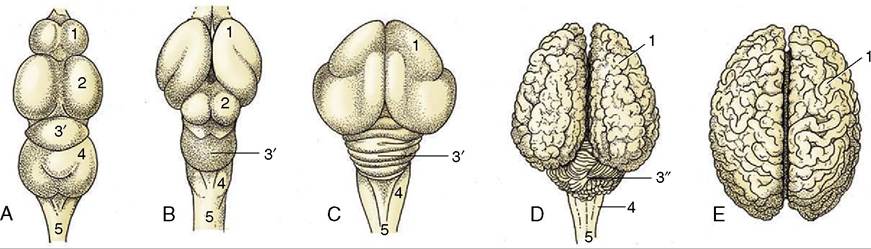
Figure 8-7 Vertebrate brains illustrating the phylogenetic development. The increase in volume and complexity of the telencephalon and cerebellum is most striking. A, fish (carp); B, reptile (python); C, bird (duck); D, mammal (cattle); E, mammal (human). 1,Telencephalon; 2, mesencephalon; 3', 3", metencephalon; 3', archicerebellum; 3", neocerebellum; 4, myelencephalon; 5, spinal cord.
sphere is molded to display ridges (gyri) and grooves (sulci) in patterns that differ significantly among the various species. The cerebellum has an even more pronounced surface marking.
The ventral aspect of the brain is flatter overall and reveals the subdivisions of the brain more clearly. The caudal part is provided by the medulla oblongata, which expands when followed forward until it terminates behind a prominent transverse ridge, the pons, which can be traced over the lateral aspect to join the cerebellum (see Figure 8-19). The midbrain in front of this, hidden in dorsal view, appears as two divergent columns, the crura cerebri (see Figure 8-19/72), which continue rostrally to disappear into the depths of the hemispheres. They are separated by the interpeduncular fossa (see Figure 8-19/75). The forebrain lies in front of this; its most prominent ventral median features are the hypothalamus (to which the hypophysis [pituitary gland] is attached by a stalk) and the crossing or chiasm formed by the optic nerves. The larger part of the forebrain is provided by the paired cerebral hemispheres, which have as their most prominent ventral features the rounded piriform lobes (see Figure 8-19/5), flanking the crura cerebri, and the olfactory tracts (see Figure 8-19/2), which originate in the olfactory bulbs that project at the rostral extremity. The superficial origins of the cranial nerves, all except the trochlear (IV) pair, are also visible on the ventral surface.
The cerebral hemispheres and cerebellum develop dorsal to the other parts, and when they are removed, all that remains is referred to as the brainstem (see Figure 8-23). This is a direct, though highly modified, continuation of the spinal cord.