Diarrhea refers to an increase in frequency of defecation or fecal volume.
Volume often increases in diarrhea primarily because of increased water content. The amount of water passed in feces is the algebraic sum of GI water input and water absorption. As discussed earlier, water in the gut results from (1) ingested water, (2) water secreted by glands of the GI system, and (3) water secreted or lost directly through the mucosal epithelium.
Under most circumstances the amount of water secreted into the gut greatly exceeds the amount ingested. Normally, the amount absorbed is just slightly less than the sum of the amounts secreted and ingested, leaving a small remainder for passage in the feces (Figure 30-29, A).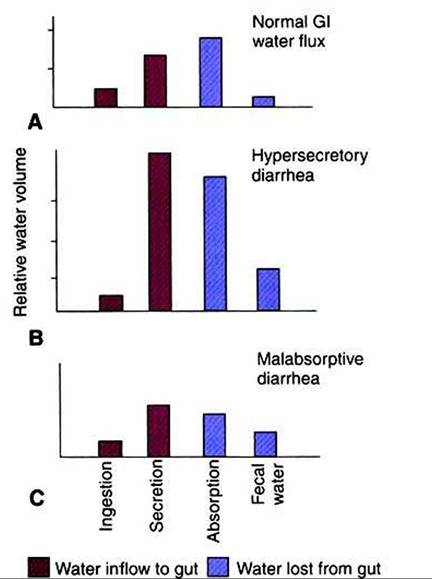
FIGURE 30-29 Pathophysiology of diarrhea.The bars represent the relative amounts of water entering or leaving the gut. Fecal volume is the sum of the water ingested and the water secreted minus the water absorbed. Therefore, fecal volume depends not on the amount of water entering the gut, but rather on the balance between water influx and efflux.
More on the topic Diarrhea refers to an increase in frequency of defecation or fecal volume.:
-
Veterinarian -