DIGESTION AND ABSORPTION
1. Is hydrolysis of disaccharides to monosaccharides required for their absorption?
2. Define the absorption of glucose, galactose, and fructose.
3. What is the limit of peptide size for its absorption? What electrolyte is involved?
4.
What are the products of triglyceride digestion?5. What composes a chylomicron?
6. What is the relationship among water insoluble triglycerides, chylomicrons, and central lacteals?
7. Is there enzymatic digestion in the large intestine of mammals? What accounts for the digestion that does occur in the large intestine?
8. What are the end products of microbial digestion?
9. What happens to the microorganisms associated with large intestine digestion?
0. What is the importance of large intestine microbial digestion in dogs and cats?
Most of the digestion and absorption of the soluble carbohydrates, proteins, and fats occurs in the small intestine (except in ruminants). Only minimal hydrolysis of starches is thought to occur in the stomach (in pigs from salivary amylase), where the digestion of protein begins through the activity of pepsin. The intestinal phases of digestion for the nonruminant consist of those processes that occur in the lumen and on the brush border of the epithelial cells.
Carbohydrates
The only carbohydrate enzyme secreted by the pancreas that is present in the lumen of the intestine is amylase. Amylase hydrolyzes starch to maltose. Further degradation of starch occurs at the brush border surface under the influence of maltase and the resulting glucose is absorbed by active transport into the epithelial cells. Sucrose and lactose (disaccharides) do not have a luminal phase of digestion and their hydrolysis occurs at the brush border under the influence of sucrase and lactase. Glucose and fructose from sucrose, and glucose and galactose from lactose, are then absorbed, glucose and galactose by active transport and fructose by facilitated diffusion.
Fructose is converted to glucose inside the epithelial cell and enters the portal vein blood in that form. Because the intracellular concentration of fructose is kept low, nearly all of the fructose in the intestine can be absorbed by facilitated diffusion. Glucose and galactose require the presence of Na+ for their active transport (cotransport) into the cell. This is similar to the process in which glucose and amino acids are transported from the tubular lumen of the kidney nephron into the tubular epithelial cell (see Chapter 11).Proteins
The pancreatic proteases are commonly categorized as exopeptidases (carboxypeptidases A and B) and endopeptidases (trypsin, chymotrypsin, and elastase). The exopeptidases hydrolyze proteins into smaller units and the endopeptidases hydrolyze the smaller units into oligopeptides (fewer than 10 amino acids) and amino acids. Many oligopeptides must be degraded further because peptides with more than three amino acids cannot be absorbed. Further hydrolysis occurs at the brush border under the influence of oligopeptidases. The amino acids, dipeptides, and tripeptides are absorbed by active transport. Further degradation of dipeptides and tripeptides occurs within the cytoplasm of the,epithelial cells.
The active transport of amino acids and peptides requires the presence of Na+, as for glucose and galactose.
Fats
Dietary triglycerides are coarsely emulsified in the stomach as a result of stomach motility, whereby they are mixed with phospholipids and other chyme (a mixture of food with gastric secretions) components. Further emulsification occurs on entering the small intestine because of the presence of bile salts and lecithin. Further mixing with pancreatic lipase results in the formation of free fatty acids, monoglycerides, and glycerol. Micellar solutions (microemulsions) are formed with bile salts to provide for their ready transport to the brush border. Glycerol, fatty acids, and monoglycerides are absorbed by simple diffusion.
The fatty acids and monoglycerides are resynthesized to triglycerides inside the epithelial cell. The triglycerides are grouped with cholesterol and phospholipids and given a protein covering to form a chylomicron. Chylomicrons are similar to micelles in that they are water soluble and thus facilitate the transport of the water-insoluble triglycerides. The water solubility conferred by the protein coat permits exit from the cell so that the chylomicron can enter the central lacteal (lymphatic capillary) of the villus (see Figure 12-13) for delivery to the blood.
Microbial Digestion in the Large Intestine
No enzymatic digestion occurs in the large intestine of mammals. The digestion that occurs results from microbial digestion, which is significant for the nonruminant herbivores and omnivores. The end products of digestion are volatile fatty acids (VFAs), mainly acetic, propionic, and butyric acids (Figure 12-36). VFAs are important energy sources after absorption. The microorganisms associated with ruminant digestion are subsequently digested to provide amino acids, but the microorganisms involved with large intestine digestion in mammals are not digested and are voided with the feces. Some species, such as the rabbit, practice coprophagy (eating their feces) so that the microorganism protein is then subjected to small intestine enzymatic degradation.
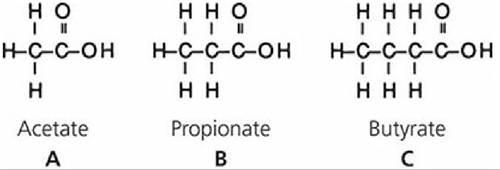
■ FIGURE 12-36 Chemical structure of principal volatile fatty acids derived from fermentation in the rumen and large intestine. A. Two carbon atoms. B. Three carbon atoms. C. Four carbon atoms.
An animal such as the horse obtains as much as 75% of its energy requirement from large intestinal absorption of VFAs. Although dogs and cats have little need for microbial fermentation as a source of energy from VFAs, it is an important mechanism from a water conservation standpoint. Any nutrients that escape enzymatic degradation or absorption contribute to an effective osmotic pressure (because the nutrients would not be absorbed) and retain water. Thus, large intestine fermentation not only salvages otherwise lost calories in the form of VFAs but also, because the VFAs are absorbed, the effective osmotic pressure of large intestine contents is decreased so that water can be reabsorbed. This is an important mechanism from a water conservation standpoint.
■