Extension of the Life Span of the Corpus Luteum in Large Domestic Species and Cats Is Essential for Pregnancy Maintenance
For those domestic animals (cattle, goals, horses, pigs, sheep) whose luteal activity is controlled by the uterus, modification of uterine prostaglandin F2a (PGF2u) synthesis and release is critical for the establishment of pregnancy.
The embryo apparently produces substances that modify uterine production of PGF2α. Estrogen synthesis by the embryo is one way the endometrium may be informed regarding the presence of an embryo. A specific protein of embryonic origin called trophoblastin, produced before day 14 of pregnancy (or postovulation) in both sheep and cattle, is of immunological interest for the establishment of pregnancy; it has a close structural relationship to the molecule interferon. Movement of the embryo(s) in the tract is also important for pregnancy recognition. In the mare the embryo moves throughout both horns before being fixed at day 16. In pigs a minimal number of embryos need to be present (about four), presumably to occupy a sufficiently large area of the endometrium. Litter-bearing animals also use transuterine migration to maximize the opportunity for fetal development, a procedure that aids the recognition of pregnancy process. The end result is either suppression of PGF2u synthesis, as seen in the cow (Figure 38-1), or modification of the secretion mode (continuous instead of pulsatile), as seen in sheep. The absence of pulsatile secretion of PGF2u seems to be critical for the extension of the life span of the CL and the establishment of pregnancy in large domestic species.In the cat the CL lasts for 35 to 40 days after ovulation regardless of the presence of pregnancy, and thus early modification ofluteal activity is not essential for the establishment
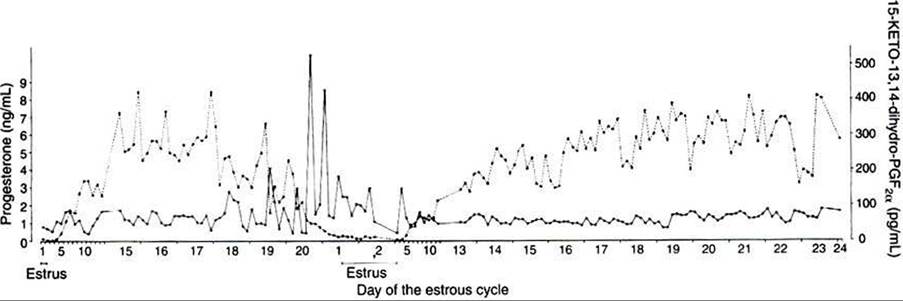
FIGURE 38-1 Relationship between prostaglandin release, as indicated by the measurement of 15-keto-13,14-dihydroprostaglandin F2α, and progesterone production by the corpus Iuteum during a nonfertile cycle and after a conception in the same cow.
(From Kindahl H, Edqvist LE, Bane A: Blood levels of progesterone and 15-keto-13,14-dihydroprostaglandin F-2α during the normal oestrous cycle and early pregnancy of heifers, Acta Endocrinol 82:134, 1976.)of pregnancy. Implantation occurs at about day 13» which allows the fetoplacental unit to influence and extend luteal activity that is compatible with pregnancy maintenance. The Iuteotropic hormone that is responsible for luteal maintenance in the cat is not known. One hormone that likely syner- gizes with progesterone for the support of pregnancy is relaxin» a placental hormone produced in the cat beginning at about day 20 of gestation (see later discussion).
The dog does not extend its luteal phase during pregnancy; the luteal phase in the nonpregnant animal is often slightly longer (70 days) than in pregnant animals. Nevertheless, enhancement of luteal activity occurs through a placental Iuteotropin, likely relaxin, with progesterone secretion enhanced beginning at about day 20 of gestation or a few days after implantation. Early in the luteal phase, luteal function in the bitch is likely autonomous. During the second half of the luteal phase, luteinizing hormone (LH) and prolactin are likely Iuteotrophs (Figure 38-2).
The rescue of the CL at the onset of pregnancy in primates inv0ives the production of a Iutcotropin called diorionk gonadotropin (CG; for humans, hCG), which is produced by trophoblastic cells (Syncytiotrophoblasts) of the embryo (Figure 38-3). In order for trophoblast tissue to produce CG, it must have intimate contact with the interstitium of the endometrium. This contact occurs by a type of implantation called interstitial, in which the embryo penetrates the endometrium at about 8 to 9 days after fertilization in humans and nonhuman primates. Secretion of CG begins 24 to 48 hours after implantation, with immediate enhancement of luteal progesterone production. Rescue of the CL in human pregnancy occurs as late as 4 to 5 days before the end of the luteal phase.
As indicated, interstitial implantation is essential to the development of pregnancy in primates. Implantation is less invasive in the dog and cal, with the type termed eccentric. In the large domestic species, “invasion” of the endometrium is minimal; implantation occurs within special endometrial protrusions called caruncles in ruminants and by relatively minor villus invasion of the endometrium in horses and pigs. Domestic animals depend more on uterine secretions for the support of pregnancy than do primates. For cattle and horses
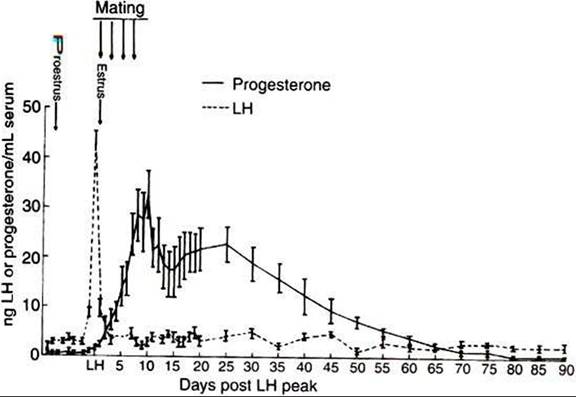
FIGURE 38-2 Luteinizing hormone (LH) and progesterone concentrations during pregnancy in nine dogs. Vertical bars represent the standard error of the mean. (From Smith MS, McDonald LE: Serum levels of luteinizing hormone and progesterone during the estrous cycle, pseudopregnancy and pregnancy in the dog, Endocrinology 94:404, 1974. Copyright © by The Endocrine Society.)
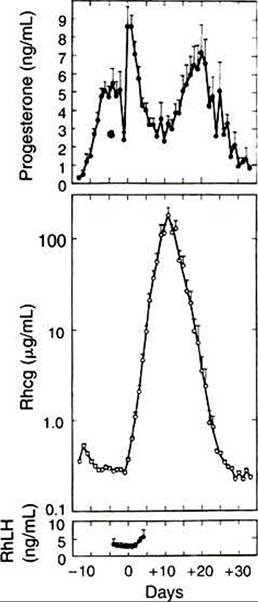
AGURE 38-3 Summarization of 15 early pregnancies in normal rhesus monkeys normalized to the day of corpus Iuteum rescue (day 0). Points are means plus or minus standard error. Note the temporal relationship between luteal progesterone production (before day +10) and chorionic gonadotropin output. RhCG, Rhesus chorionic gonadotropin; RhLH, rhesus luteinizing hormone. (From Knobil E: On the regulation of the primate corpus Iuteum, Biol Reprod 8:246, 1973.)
the first indications Ofimplantation begin about days 25 to 30, and another week to IO days likely passes before a significant amount of embryonic nutrition is obtained through the implantation site. Subclinical uterine infections, or an inadequate number of endometrial glands, can interfere with the establishment of pregnancy in the species in which a long interval exists from fertilization to implantation. The cervix forms an important barrier to contamination of the uterine lumen in both the nonpregnant and the pregnant animal; in the latter the cervix becomes sealed.