Fermentative Digestion of Protein Results in the Deamination of a Large Portion of Amino Acids
To this point, the discussion of fermentative digestion has centered primarily on carbohydrates, but as previously mentioned, other energy-yielding substrates are subject to microbial attack as well.
Proteins are particularly vulnerable because they are composed of carbon compounds that can be further reduced to provide energy for anaerobic microbes. As proteins enter fermentative areas of the gut, they are attacked by extracellular microbial proteases. The majority of these enzymes are “trypsin-like” endopeptidases that form short-chain peptides as end products. These peptides are formed extracellularly and are absorbed into the microbial cell bodies, much as glucose is formed from carbohydrate and then absorbed. Within the microbial cells, the peptides can be used to form microbial protein or can be further degraded for the production of energy through the VFA pathways (Figure 31-4).To enter the VFA pathways, the individual amino acids are first deaminated to yield ammonia (NH3) and a carbon skeleton. The carbon structures of many of the amino acids can fit directly into various steps of the pathways leading to the production of the three major VFAs. The three branch-chain amino acids (BCAAs) are exceptions, however, and lead to the production of branch-chain VFAs by the following reactions:

These branch-chain VFAs are important growth factors for several species of bacteria, as described later.
Although many species of rumen microbes appear capable of using preformed amino acids for the synthesis of protein, several species cannot do so. These species must synthesize amino acids from ammonia and the various carbon metabolites of the VFA pathways. For synthesis of the BCAAs, the branch-chain VFAs are required. Among the microbial species that require ammonia and branch-chain fatty acids are some of the important Cellulose digesting bacteria.
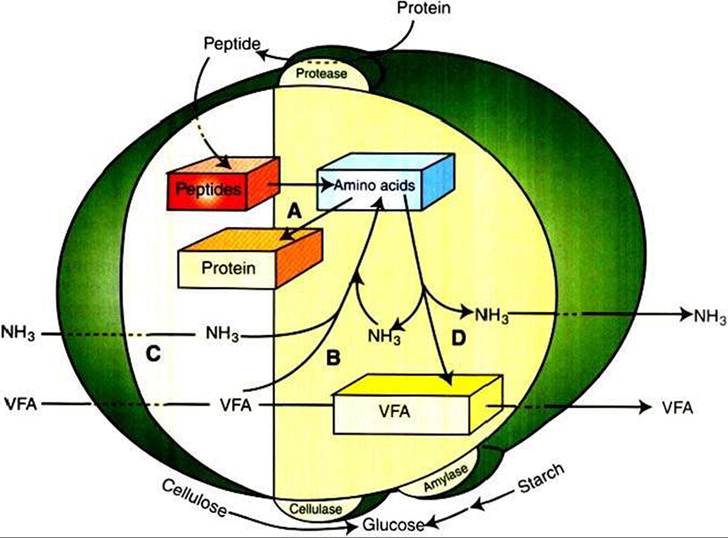
FIGURE 31-4 ■ Protein metabolism by rumen microbes. Protease enzymes on the microbe surfaces generate peptides that are then taken up by many types of organisms. Absorbed peptides contribute to an intracellular pool of amino acids from which microbial proteins are synthesized (A). Another source of amino acids is from intracellular synthesis (B), using ammonia (NH3) and volatile fatty acid (VFA). Many microbes appear capable of deriving their amino acids from either extracellular peptides or intracellular synthesis; however, several types of bacteria seem incapable of using peptides for an amino acid source and are thus dependent on an extracellular source of ammonia (C) for amino acid synthesis. Amino acids not used for protein synthesis can be metabolized to VFA and ammonia (D).