Fetal Cortisol Initiates Delivery Through Increased Secretion of Estrogen and Thus Prostaglandin F2α
During pregnancy the uterus progressively enlarges and stretches because of the growing fetus. Progesterone plays an important role in maintaining the quiescence of the myometrium as well as promoting a tightly contracted cervix.
During the latter part of gestation, estrogen begins to influence uterine muscle by stimulating the production of contractile protein and the formation of gap junctions; the former increases the contractile potential of the uterus, and the latter facilitates the contractile process through increased communication among smooth muscle cells. Thus, important changes that set the stage for parturition begin weeks before the actual process begins. In the end, the uterus is converted from a quiescent to a contractile organ, and importantly, the cervix relaxes and opens to allow the fetus to be delivered.The most important question about parturition concerns what initiates the process. In domestic animals, maturation of the fetus eventually brings about changes that initiate the delivery process. The key organ system of the fetus responsible for initiating the process is the fetal adrenal cortex, with the hypothalamus and adenohypophysis playing important supporting roles. This concept came from the work at the University of California (UC)-Davis by Liggins and Kennedy, who showed that destruction of the anterior pituitary of the sheep fetus resulted in prolongation of gestation; Drost subsequently found the same results after fetal adrenalectomy. Critical changes in cortisol secretion by the fetus eventually result in the synthesis and release of PGF2tt from the uterus, which produces muscle contraction and relaxation of the cervix. The following details of the initiation of parturition emphasize ruminants. It is unclear if elevated cortisol levels contribute to the initiation of parturition in the dog.
The maturation of the fetal adrenal cortex is of critical importance in the initiation of parturition. The adrenal cortex likely becomes progressively sensitive to fetal adrenocorticotropic hormone (ACTH, corticotropin) (Figure 38-5). The time of adrenal maturation is under fetal genetic control, as shown by studies conducted on fetal lambs of different breeds in the same uterus (produced by embryo transfer) in which the prepartum initiation of cortisol production occurred at times that were characteristic (and different) for the breed. Fetal cortisol induces placental enzymes (17-hydroxylase and C17-20 lyase) that direct steroid synthesis away from progesterone to estrogen. This process occurs at different times prepartum in domestic species, beginning at prepartum days 25 to 30 in cattle, 7 to IO in pigs, and 2 to 3 in sheep. The end result of increased estrogen secretion is the secretion of prostaglandins, particularly PGF2tt. PGF2tt is the pivotal hormone for the initiation of parturition; once its secretion begins» the acute phase of delivery is activated. The role of oxytocin in the initiation of delivery is not certain; it likely complements PGF2tt once the delivery process has started.
The synthesis of PGF2tt is thought to come about through increased availability of the substrate arachidonic acid, which is the main rale-limiting step in the synthesis of PGF2tt. Estrogens are proposed to influence the system by making available the enzyme phospholipase A, a membrane-bound lysosomal enzyme that initiates the subsequent hydrolysis of phospholipids and release of arachidonic acid. This likely results from an increasing estrogen/progesterone ratio, with progesterone initially stabilizing, then estrogens destabilizing, lysosomal
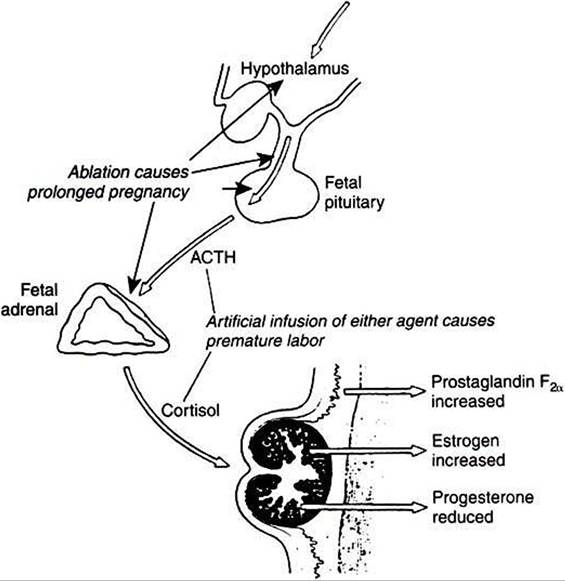
FIGURE 38-5 Diagrammatic summary explaining how the fetal lamb controls the onset of labor.
Experimental procedures that lengthen or shorten pregnancy are shown. ACTH1 Adrenocorticotropic hormone (corticotropin). (Redrawn from Liggins CG: The foetal role in the initiation of parturition in the ewe. InWoIstenhoIme GEW, O'Connor M, editors: Foetal autonomy, London, 1969, Churchill Livingstone.)membranes. The end result is increased availability of arachidonic acid for the synthesis of PGF2rt. The onset of PGF2rt synthesis results in the immediate release of the hormone because PGF2rt is not synthesized and stored. The critical effect of PGF2α on the myometrium is to release intracellular calcium ion, which binds to actin and myosin to initiate the contractile process. Prostaglandins, both PGE and PGF2rt, also have important effects on the cervix, which allow it to relax and dilate, permitting the passage of the fetus. The end result is a direct effect of PGF2rt on the intracellular matrix of the cervix in which there is a loss of collagen with a concomitant increase in glycosaminoglycans, the latter affecting the aggregation of collagen fibers.
In some animals, such as the cow, goat, dog, and cat, PGF2rt synthesis and release initiate regression of the CL beginning 24 to 36 hours before delivery, with complete withdrawal of progesterone occurring 12 to 24 hours before delivery. Although essential for delivery in these species, progesterone withdrawal per se does not initiate delivery; it is the release of PGF2rt that both causes Iuteolysis and drives myometrial contractions.
In the mare, as in primates, delivery occurs even though progesterone concentrations remain elevated during the process. In this situation, PGF2rt is able to overcome the suppressive effects of progesterone on myometrial activity. For animals dependent on placental production of progesterone for pregnancy maintenance, it is not possible to turn off one function (i.e., steroid synthesis) and still continue with other functions that are necessary for the support of the fetus through the time of delivery.
Oxytocin is also important to the delivery process (Figure 38-6). Estrogen induces oxytocin receptor formation in the myometrium. Recent information indicates that significant amounts of oxytocin are released only with the entry of the fetus into the birth canal. Oxytocin release occurs through the Ferguson reflex. The afferent arm of the reflex involves passage of impulses through sensory nerves in the spinal cord to the appropriate nuclei in the hypothalamus; the efferent arm involves transport of oxytocin from the neurohypophysis by the vascular system. Oxytocin is synergistic with PGF2rt in promoting contraction of the uterus.
As noted earlier, a hormone important for the preparation of parturition is relaxin. This hormone was first identified as responsible for the separation of the pubic symphysis through relaxation of the interpubic ligament. Relaxin causes the ligaments and associated muscles surrounding the pelvic canal to relax, which allows the fetus to expand the pelvic canal to its fullest potential. In the mare, a well-defined area of muscle softening can be discerned on the midline from the top of the croup through the ventral commissure of the vulva. In the cow, muscles posterior to the hip become relaxed to the point that they undulate as the animal walks in the final 24 hours before parturition. In the cow and pig, the CL is the source of relaxin. In both these species the prepartum release of PGF2α causes Iuteolysis, with a concomitant decline in progesterone production and the release of preformed relaxin. In other domestic species, such as cats, dogs, and horses, the source of relaxin is the placenta. In these species, significant relaxin production begins during the first part of gestation, with values sustained through parturition. A relaxin assay has been
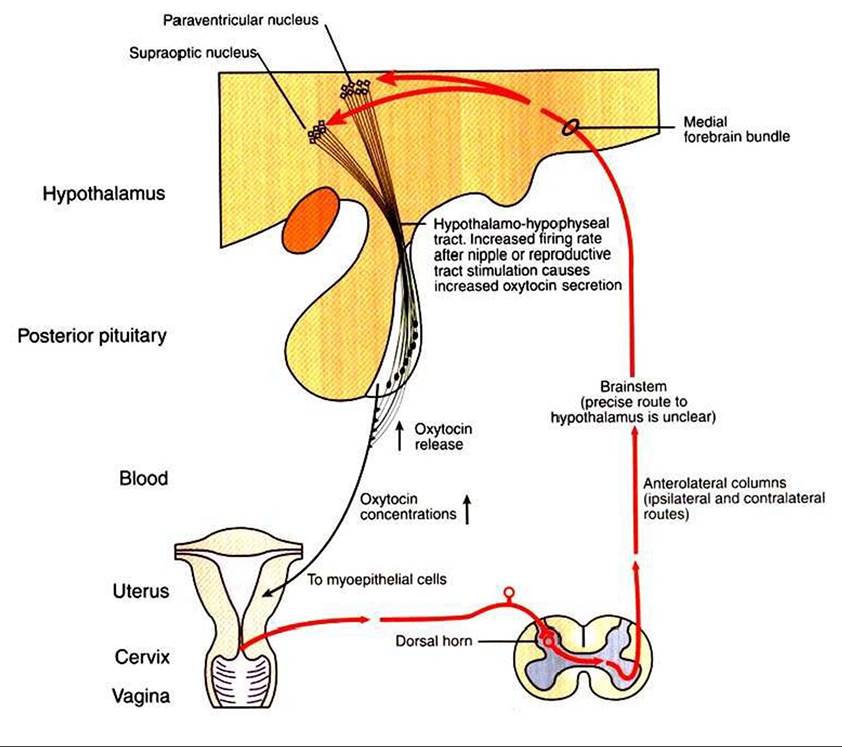
FIGURE 38-6 The neuroendocrine reflex (Ferguson reflex) underlying oxytocin synthesis and secretion.
(From Johnson M, Everitt B, editors: Essential reproduction, ed 3, London, 1988, Blackwell Scientific.)developed for the diagnosis of pregnancy in the dog, with good accuracy after 25 days of gestation. Relaxin may be important in these species for the maintenance of pregnancy in synergism with progesterone (see Figure 38-2).
The first stage of parturition involves presentation of the fetus at the internal os of the cervix. This likely results from increased myomet rial activity caused by PGF2α release. Once the cervix opens and the fetus passes into the pelvic canal, myometrial contractions become less important for delivery of the fetus; abdominal press, accomplished by closure of the epiglottis and contraction of maternal abdominal muscles, becomes the main force involved in the delivery process. The actual delivery process is called the second stage of parturition.
The third stage of parturition involves the delivery of the fetal membranes. In litter-bearing animals, such as the cat, dog, and pig, the placental membranes are delivered often with, or immediately after, the appearance of each fetus. In single-bearing species, the placenta may be delivered immediately or within a few hours. From studies done on the mare at UC-Davis, we know that major, sustained surges of PGF2α occur in the immediate postpartum period and are important for expulsion of placental membranes and reduction of uterine size through myometrial contraction. PGF2o is likely the most important component of uterine size reduction in the immediate postpartum period for all domestic species. This can be inferred from the episodes of discomfort that parturient animals undergo during the hours immediately after delivery.
The neonate must make a major physiological adjustment to life on the outside. The major change involves the vascular system, in particular the respiratory system. During fetal life, blood bypasses the lungs (except for the perfusion of lung tissue in support of development) by two routes: through the ventricles by way of the foramen ovale, and from the pulmonary artery to the aorta by the ductus arteriosus. The foramen ovale is closed functionally at birth by a flap of tissue in the left ventricle through the development of higher pressures within the left versus the right ventricle. Although the ductus arteriosus immediately constricts at birth, it requires months before it is completely closed. This course of closure is also true for the ductus venosus, which serves as a hepatic shunt during fetal life. The rapid conversion from a fluid to a gaseous environment, as occurs at birth, is a truly remarkable adaptation.