Fetal Oxygen Transport Is Assisted by Fetal HemogIobinrWhich Has a High Affinity for Oxygen
Fetal arterial blood has a low Po2 because the placenta is not a highly efficient gas exchanger and because oxygenated blood and venous blood mix at several points in the fetal circulation.
The fetus is adapted to this state of chronic hypoxia in two ways. First, it has a high cardiac output that delivers a large volume of blood per minute to the tissues. Second, the fetus produces erythrocytes containing hemoglobin with a high affinity for oxygen.The production of erythrocytes initially occurs in the yolk sac and in other tissues such as endothelium. These embryonic erythrocytes are nucleated and contain embryonic hemoglobin, the oxygen affinity of which has not been clearly defined. At the termination of the embryonic period,
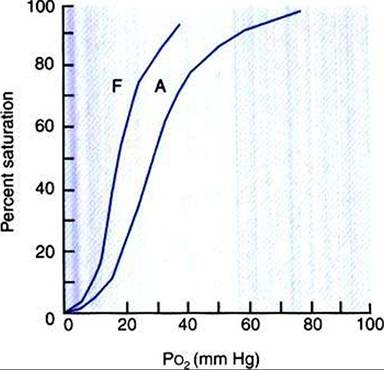
FIGURE 51-5 Oxyhemoglobin dissociation curves of fetal (F) and adult (A) sheep. Po2t Oxygen tension.
erythrocyte production shifts to the liver and spleen. Depending on the species, fetal erythrocytes contain either fetal or adult hemoglobin (see later discussion). Simultaneously, there are changes in glycolytic enzymes to provide the fetal concentrations of 2,3-diphosphoglycerate (2,3-DPG). Fetal erythrocytes have a higher affinity for oxygen (lower partial pressure [tension] at which hemoglobin is 50% saturated with oxygen [P50]) than do maternal erythrocytes; that is, the fetal blood oxyhemoglobin dissociation curve lies to the left of the adult curve (Figure 51-5). In some species, such as the cat, the difference in the P50 between fetus and adult is small, whereas in ruminants the difference is 10 to 20 mm Hg.
Three mechanisms account for the position of the fetal oxyhemoglobin dissociation curve. In ruminants, the higher oxygen affinity results from the synthesis of fetal hemoglobin with a high intrinsic oxygen affinity.
Fetal hemoglobin of these species is unresponsive to 2,3-DPG. After birth there is gradual replacement of fetal hemoglobin by adult hemoglobin. In primates, there is little intrinsic difference in the oxygen affinity of fetal and maternal hemoglobin, but fetal hemoglobin has a decreased interaction with 2,3-DPG. In horses and pigs there is no fetal hemoglobin; embryonic hemoglobin is replaced immediately by adult hemoglobin. The fetal erythrocytes of these species have a low concentration of 2,3-DPG. After birth there is an increase in the concentration of 2,3-DPG, which gives the hemoglobin its adult dissociation curve.The high affinity of fetal hemoglobin for oxygen allows the hemoglobin in the umbilical veins, with a Po2 of 30 mm Hg, to be 80% saturated with oxygen and allows the hemoglobin in the aorta, with a Po2 of 22 mm Hg, to be 56% saturated. The high affinity of fetal hemoglobin for oxygen not only allows oxygen transport at the low Po2 in fetal arteries, but also makes it necessary for fetal tissues to have an extremely low Po2. The low tissue Po2 provides an oxygen concentration gradient to unload oxygen from the fetal hemoglobin. Therefore the fetus exists in a state of tissue hypoxia compared with the adult.