Fick's Law of Diffusion Is a Simple Mathematical Accounting of the Physical FactorsThat Affect the Rate of Diffusion
Most of the factors that affect the rate of diffusional exchange between capillary blood and interstitial fluid have been mentioned. These factors include the distance involved, the size of the capillary pores, and the properties of the diffusing substance (i.e., lipid soluble vs.
lipid insoluble). The German physiologist Adoph Fick incorporated all these factors into an equation: Fick's law of diffusion. Figure 23-3 shows how Fick’s law applies to the diffusional exchange between capillary fluid and interstitial fluid. The rate of diffusion of any substance S depends, first, on the concentration difference, that is, the difference between the concentration of the substance in capillary fluid and its concentration in interstitial fluid. Diffusion is driven by this concentration difference, and diffusion always proceeds from the area of higher concentration toward the area of lower concentration. Next, the rate of diffusion is determined by the area available for diffusion, the term A in the equation. For lipid-soluble substances, this area is equivalent to the total surface area of the capillaries. For lipid-insoluble substances, this area is much smaller, being equal to the area of the capillary pores or clefts.The term ∆x in the equation represents the distance over which diffusion must occur (Figure 23-3). Functionally, ∆x equals the distance from a tissue cell to the nearest capillary that is carrying blood by bulk flow. The greater the distance from the tissue cells to the capillaries, the slower is the rate of diffusional exchange of substances between that cell and the capillary blood; therefore, ∆x appears in the denominator in the equation.
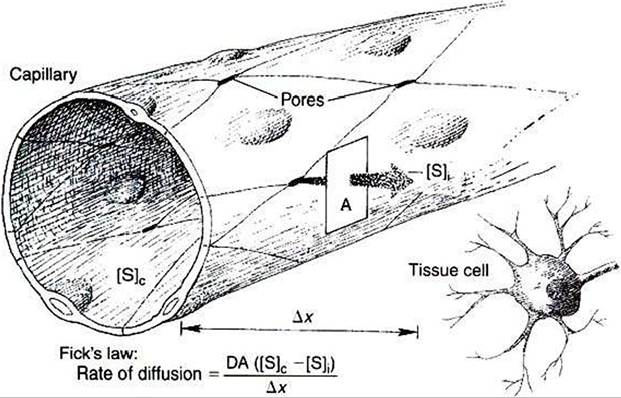
FIGURE 23-3 According to Fick's law, the four factors that affect the rate of diffusion of a substance S from the capillary plasma to the interstitial fluid next to a tissue cell are [S]c - [S)i, the concentration difference between the capillary plasma and interstitial fluid.
Af Area available for diffusion; ∆xz distance involved; Df diffusion coefficient.The term D in the equation is a diffusion coefficient. The value of D increases with temperature because diffusion depends on the random brownian motion of particles in solution, and the velocity of that motion increases with temperature. D is different for different substances. For example, D for carbon dioxide is about 20 times greater than D for oxygen. As a result, carbon dioxide diffuses much more rapidly than does oxygen for a given concentration difference, area, and diffusion distance. This difference is inconsequential under normal physiological conditions. In certain disease states, however, the area available for diffusion decreases, and the diffusion distance increases. Under these conditions, the delivery of oxygen to the metabolizing cells of a tissue generally becomes critically impaired before the removal of carbon dioxide from the cells becomes inadequate. In other words, physiological diffusion limitations generally cause bodily tissues to become hypoxic (inadequate oxygen) before they become hypercapnic (excess carbon dioxide).
Several of the factors that affect the rate of diffusion are physiologically adjustable. For example, in skeletal muscle at rest, the arterioles cycle between open and closed, and even when open, their diameter is small. Consequently, at any one moment, blood flows through only about one fourth of the skeletal muscle capillaries. Blood sits still in the remainder of them. Nevertheless, this low and “part-time” blood flow through capillaries is adequate to deliver oxygen and nutrients to the resting skeletal muscle cells and to remove the small amounts of carbon dioxide and other waste products being produced by those cells. In contrast, during exercise, the metabolic rate of the skeletal muscle cells increases several- fold, as does their need for blood flow. During exercise, skeletal muscle arterioles dilate.
Increasingly more of them remain open on a “full-time” basis as the level of exercise increases. Consequently, blood flow through the capillaries increases and becomes more continuous.These changes act in three ways to speed the delivery of oxygen and metabolic substrates to the exercising muscle cells and to facilitate the removal of carbon dioxide and other metabolic waste products. First, when more capillaries carry blood, the area available for diffusion (A in Fick’s diffusion equation) is increased. Second, because more capillaries carry blood, the distance between each exercising skeletal muscle cell and the nearest open capillary (∆x in the diffusion equation) is decreased. Third, the driving force for diffusion of oxygen (the oxygen concentration difference between the capillary blood and the interstitial fluid) is increased. The concentration difference is increased because (1) the greater blood flow brings more freshly oxygenated blood into the capillaries, and (2) the rapid utilization of oxygen by the exercising skeletal muscle cells decreases the concentration of oxygen within these cells and therefore within the surrounding interstitial fluid.
The same factors that increase the rate of oxygen diffusion during exercise increase the rate of delivery of glucose and other nutrients. Furthermore, the same factors act to increase the rate at which carbon dioxide and other metabolic products are removed from the tissue cells and into the bloodstream. In the case of carbon dioxide and other metabolic products, the concentration is highest in the cells and lowest in the capillary plasma, so diffusional movement is from the cells toward the bloodstream.