FORMATION OF URINE
1. What is the difference between plasma, glomerular filtrate, tubular fluid, and urine?
2. Be able to follow fluid from plasma in the afferent arteriole through the several components of the nephron to its final discharge from the urethra.
3. Define RBF, RPF, GFR, and FF. Which variable (RBF, RPF, or GFR) represents the largest volume? What is an approximate value for the percentage of glomerular filtrate that is excreted as urine?
4. What are the three processes associated with urine formation?
The three processes involving the nephrons and their blood supply in urine formation are: (1) glomerular filtration, (2) tubular reabsorption, and (3) tubular secretion. As a result of glomerular filtration, an ultrafiltrate of plasma known as glomerular filtrate appears in Bowman’s capsule. Glomerular filtrate becomes tubular fluid when it enters the nephron tubules because of the compositional changes that begin to occur immediately as a result of reabsorption from the tubular lumen and secretion into the tubular lumen (Figure 11-12). Tubular reabsorption and tubular secretion continue throughout the length of the nephron and collecting duct so that tubular fluid does not become urine until it enters the renal pelvis. With the possible exception of mucus addition in.the horse, there are no compositional changes in urine beyond the collecting ducts.
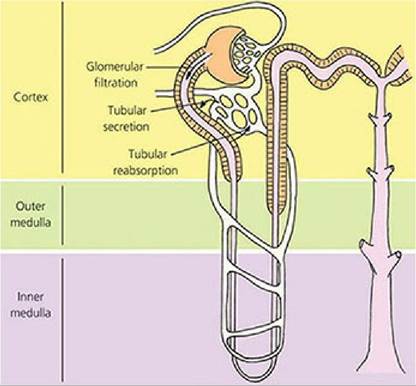
■ FIGURE 11-12 Functional nephron and processes involved in urine formation. The arrows indicate the origins and destinations of the three processes associated with the formation of urine. After glomerular filtration, glomerular filtrate enters the proximal tubule and becomes tubular fluid. Tubular secretion is directed from the peritubular capillaries into the tubules and tubular reabsorption is directed from the tubules into the peritubular capillaries.
Tubular reabsorption and tubular secretion occur throughout the length of the nephron.Distribution of Blood at the Glomerulus
Renal blood flow (RBF) refers to the rate at which blood flows to the kidneys (in milliliters per minute). Inasmuch as plasma is the fluid part of the blood, from which the glomerular filtrate is formed, renal plasma flow (RPF) refers to that part of the RBF that is plasma. As long as there continues to be an RBF, a glomerular filtrate will be formed from the plasma at the glomerulus. The rate at which it is formed is known as the glomerular filtration rate (GFR) and is measured in milliliters per minute. RBF and RPF are also measured in milliliters per minute and the ratio of GFR to RPF (GFR:RPF) is referred to as the filtration fraction (FF). The FF is the fraction (or percentage) of plasma flowing through the glomerulus that becomes glomerular filtrate. The blood that continues into the efferent arterioles has an increased value for packed cell volume and protein concentration because a fraction of the plasma has been filtered and has entered the tubules. The protein concentration is higher because it is virtually prevented from being filtered with the other plasma components (see upcoming section).
An example for the relationships of RBF, RPF, GFR, FF, and the percentage of urine formed relative to the amount of filtrate formed in 24 hours is shown in Table 11-2.
| TABLE 11-2 APPROXIMATE VALUES FOR SEVERAL KIDNEY FUNCTION VARIABLES IN AN 11.35-kg (25-lb) DOG IN A NORMAL STATE OF HYDRATION | |
| VARIABLE | VALUE |
| Cardiac output (mL/min) | 1,500 |
| Blood flow to kidneys (%,of cardiac output) | 20 |
| Renal blood flow (mL/min) | 300 |
| Renal plasma flowα (mL/min) | 180 |
| Glomerular filtration rate,(mL/min) | 45 |
| Filtration fraction (decimal equivalent) | 0.25 |
| Urine volume in 24 hb (mL) | 681 |
| Glomerular filtrate volume.in 24 h (mL) | 64,800 |
| Volume of urine as percent.of filtrate | 1.05 |
| Filtrate reabsorbed (%) | 98.95 |
| aBased on plasma portion of hematocrit being approximately 60%. bCalculated from average rate for dogs being.60 mL/kg/ 24 h. | |
■