Functional Aspects
Gilts attain puberty around 6 months. The species is polyestrous: the cycle repeats at intervals of about 17 to 25 days. Fertilization takes place in the ampullae, where the conceptuses are detained for a few days before being admitted to the uterus.
Cleavage continues there, creating blastocysts that are initially spherical and randomly placed. By the end of 2 weeks they have become filamentous and greatly lengthened—up to 60 cm—and have adopted permanent, regularly spaced stations that make full use of both horns, which is an arrangement that may have required some conceptuses to migrate from one horn to the other. The conception rate is high, but so also is prenatal mortality—40% or more. The placenta is of the diffuse epitheliochorial type. Antibody transfer does not occur in utero, and the newborn is dependent on the ingestion of colostrum for its initial immunologic protection.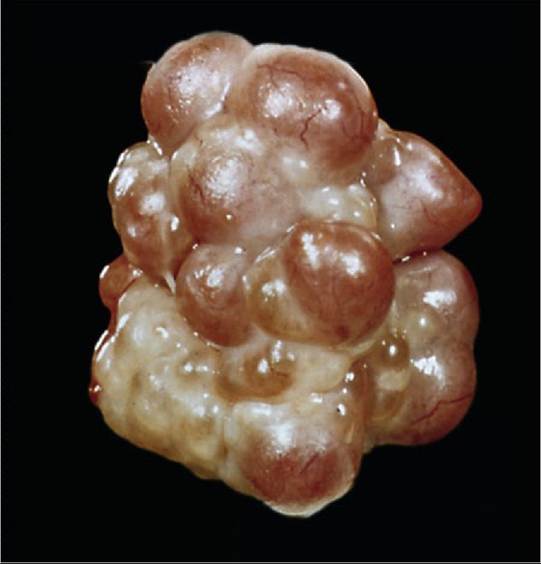
FIG. 35.3 Ovary (sow) exhibiting mature follicles.
During pregnancy, the horns increase greatly in diameter, and their length may double. Growth of the tissues within the broad ligaments allows the horns to sink into the ventral half of the abdomen, where they push the intestines craniodorsally and make contact with the stomach and liver. The ovaries are carried forward and out of reach of a hand within the rectum. Confirmation of pregnancy at this stage is provided by the firmness of the cervix and, more reliably, by the characteristic fremitus of the enlarged uterine artery. Ultrasonography is a less troublesome method of pregnancy diagnosis (Fig. 35.2B and C).
Rectal palpation is used for pregnancy detection in the pig. It is highly accurate based on the examination of the cervix, uterus, and middle uterine artery. The accuracy is approximately 95% around day 30 and 100% after day 60 of the gestation.
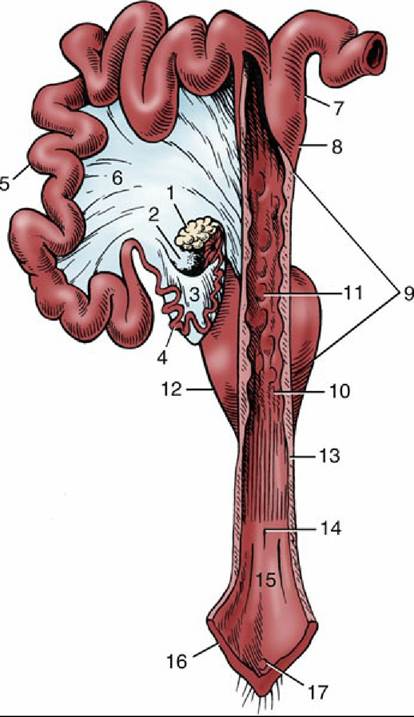
FIG. 35.4 The reproductive tract of the sow opened dorsally in part; the right uterine horn and ovary are not shown. 1, Left ovary; 2, ovarian bursa; 3, mesosalpinx; 4, uterine tube; 5, uterine horn; 6, broad ligament; 7, parallel segments of uterine horns; 8, body of uterus; 9, cervix; 10, external uterine orifice; 11, mucosal prominences; 12, bladder; 13, vagina; 14, external urethral orifice; 15, vestibule; 16, vulva; 17, glans of clitoris.
Gestation averages about 114 days with a range of 111 to 117 days, and farrowing is preceded by the usual relaxation of the joints and tissues of the pelvic region, although this may not be apparent to an observer. The risk of simultaneous arrival of two fetuses from opposite horns at the entrance to the body is prevented by the circular muscle of the uterus, which very effectively closes the exit from one horn while simultaneously securing maximal enlargement of the exit from the other. The arrangement does not operate at all times; both horns open freely into the body of the atonic uterus, which allows fetuses to be transferred from one horn to the other at cesarean section. The expulsion of first piglets lubricates the passage for easier movement of the remaining fetuses.
Some criteria that may be used for estimating the age of pig fetuses are provided in Table 35.1.