Glomerular Filtration
The glomerular filtrate is the fluid and fluid constituents that pass from the blood plasma in the glomerulus into the urinary space of Bowman’s capsule. The physical barriers through which the filtrate passes include (1) the capillary endothelium of the glomerulus, (2) the inner layer of Bowman’s capsule, and (3) a basement membrane (lamina) between these two cell layers.
The glomerular endothelium is fenestrated (i.e., has openings or pores in the cells), so this part of the barrier is highly permeable. Podocytes (cells of the inner layer of Bowman’s capsule) have cellular extensions that rest on the glomerular basement membrane, but slitlike pores between the extensions permit the passage of the filtrate (Fig. 23-9).The glomerular filtration barrier acts much like a sieve, and all substances up to a molecular weight of about 65,000 pass through the barrier. Blood cells are too large to pass, and only a small percentage of plasma proteins pass through the barrier. Most other plasma constituents (e.g., glucose, amino acids, urea, creatinine, sodium, potassium, chlorine, and bicarbonate ions) readily cross the barrier, and their concentrations in the initial filtrate are about the same as in plasma. Proteinuria is the presence of abnormal amounts of protein in voided urine. Kidney diseases that localize in or primarily affect glomeruli are often associated with proteinuria or hematuria (blood in voided urine).
The forces determining the rate of movement of fluid across the glomerular filtration barrier are the same as those that determine fluid movement out of capillaries throughout the body. The effective filtration pressure (the pressure tending to force fluid out of the capillary) is usually considered to be the difference between the blood (hydrostatic) pressure in the capillary and the osmotic pressure generated by the plasma proteins of the blood in the capillaries.
The hydrostatic pressure in the urinary space of Bowman’s capsule and the osmotic pressure generated by proteins in the fluid in the space can also be factors, and these become important in disease states (e.g., blockage of the urinary tract or renal tubules).In mammals glomerular filtration rate (GFR) and renal blood flow (RBF) remain relatively stable in normally hydrated animals in spite of minor short-term fluctuations in arterial blood pressure (20-30 mm Hg). This stability is maintained by mechanisms intrinsic to the kidney, and this phenomenon is termed renal autoregulation. Severe dehydration or severe blood loss results in lowering of blood pressure out of the autoregulatory range, and this leads to vasoconstriction of preglomeru- lar vessels, including afferent arterioles. This vasoconstriction is produced by increases in sympathetic nerve activity to the kidneys and increases in vasoconstrictors such as angiotensin II. The low blood pressure and renal vasoconstriction can reduce glomerular filtration to the point of renal failure. This type of renal failure is termed prerenal.
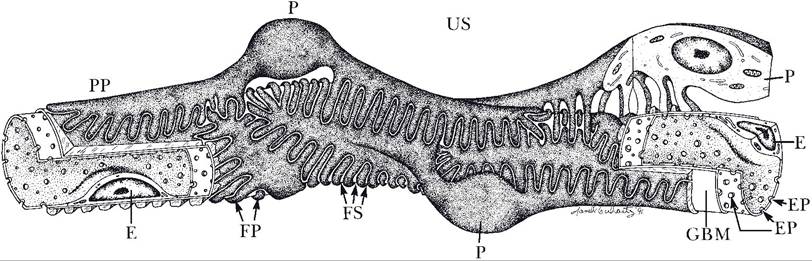
Figure 23-9. The glomerular filtration barrier. E, Fenestrated glomerular capillary endothelium; EP, endothelial pore (fenestra); GBM, glomerular basement membrane; P, podocytes, or visceral layer of Bowman’s capsule with their filtration slits (PS); US, urinary space of Bowman’s capsule. (Reprinted with permission of Wiley-Blackwell from Dellmann H.D. Textbook of Veterinary Histology. 4th ed. Philadelphia: Lea & Febiger, 1993.)
The GFR of mammals is normally about 100 times that of urine flow rate (typical values for GFR are 3-5 mLIkg body weight per minute). The high GFR relative to urine flow allows for a continuous filtration of the plasma and the rapid removal of unwanted or toxic substances from the body. if such substances can readily pass through the glomerular filtration barrier and are not reabsorbed from the renal tubules, they are rapidly eliminated via the urine.