Glomerular Filtration Rate Is Measured by Determining Plasma Clearance Rate of a Substance
Both in experimental settings and in clinical practice, GFR is one of the most important parameters of renal function. Determination of GFR relies on the concept of clearance, that is, the rate the plasma is cleared of a substance.
The rate of clearance is measured by the rate of elimination of a substance divided by its plasma concentration, mathematically expressed as follows: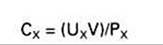
where Cλ is the volume of plasma cleared of substance X per unit time, Ux is the urine concentration of substance X, V is the volume of urine collected divided by the time period of the collection, and Px is the plasma concentration of substance X.
I he net clearance rate of a substance is the sum of the rates of filtration and secretion minus the rate of reabsorption of the substance. To determine the filtration rate accurately, the rates of secretion and reabsorption must be determined or excluded from the equation. This is neatly done by using inulin as the substance for the measurement of clearance. Inulin is freely filtered by the glomerulus but is neither reabsorbed nor secreted by the renal tubule cells. Because of these properties, and because inulin is not produced by the body, the rate of its disappearance from the blood after intravascular injection is strictly related to the rate of glomerular filtration. Therefore, measurement of GFR can be expressed mathematically by the clearance equation, in which substance X is inulin:

where GFR is in milliliters per minute, Cinu∣in is the rate of clearance of inulin from the plasma in milliliters per minute, (Jinuhn the inulin concentration in a urine sample collected over a time 7’ in minutes, V is the volume of the urine collected over time Tt and Pinuhn is the mean plasma inulin concentration during time 7’
Although the standard method Ofdetermination of GFR is by the rate of clearance of inulin from the blood, GFR can be measured in a variety of ways. In clinical situations the most widely used measure of glomerular filtration is endogenous creatinine clearance.
Creatinine is a byproduct of muscle metabolism that is handled similar to inulin by the kidney. It is freely filtered, is not reabsorbed by the tubule, and, at least in the dog, is not secreted by the tubule. In some species, however, approximately 10% of the excreted creatinine is secreted by the tubule. Nevertheless, depending on the accuracy of the assay used for creatinine, the endogenous creatinine clearance test provides an estimate of GFR. In practice the measurement of endogenous creatinine clearance requires collecting the urine produced by a patient over a 24-hour period. The volume of urine produced over 24 hours is recorded, and the creatinine concentration is measured. The mean plasma concentration of creatinine is represented either by the plasma concentration measured at the midpoint of the collection period or by the mean of the plasma concentration measured at the beginning and end of the collection period. These values are used in the clearance equation as follows:Ccfeaiinine ~ ∪creatin∣ne^Pcreatin∣ne
This results in an approximation of GFR in milliliters per minute. In veterinary medicine the GFR is better expressed on the basis of body weight or body surface area—that is, as milliliters per minute per kilogram or milliliters per minute per square meter—because of the large variation in size within individual species.
In birds, creatinine clearance cannot be used for determination of GFR because avian renal tubules can secrete creatinine when the plasma level is elevated and can reabsorb creatinine when the plasma level is normal.