GROWTH AND FUNCTIONAL CHANGES
The bovine testes have arrived in the scrotum by midgestation, a surprisingly early period. They are very small at birth but grow more rapidly than the body as a whole from the first week and at an accelerated rate when the young bull approaches puberty.
Growth for a time then keeps pace with general development; in older bulls some shrinkage is demonstrable. Libido may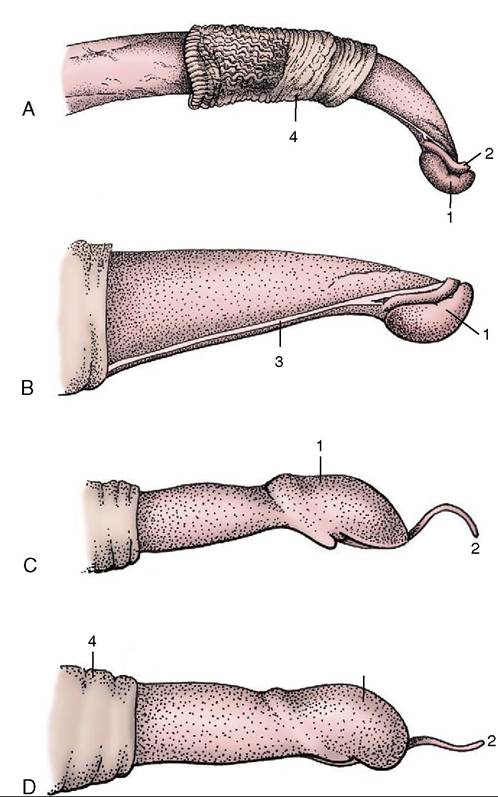
1
Figure 29-35 Right lateral view of the distal end of the bull's penis, flaccid (A) and erect (B); the distal end of the ram's (C) and buck's (D) penis. 1, Glans; 2, urethral process; 3, raphe; 4, preputial skin.
develop before spermatogenesis is achieved, which is generally about the 10th month. Epididymal growth lags a little behind that of the testes.
Progress in the development of the secondary reproductive glands is testosterone dependent and follows after testicular maturation. They are all initially small, but to varying degrees, and take some time to acquire their adult sizes and conformations.
Less than half its final length, the neonatal penis is very slender. It is without a sigmoid flexure, contains little erectile tissue, and is fused with the prepuce at its apex. The preputial cavity, which does not extend proximally beside the penis, is occupied by low folds. The characteristic bends begin to develop about the 3rd month. Growth is slow, and, though it quickens from puberty, the final size is not attained until well into the 2nd year. Separation from the sheath is first confined to the left side of the apex but later spreads around the whole circumference and extends proximally. A narrow frenulum persists for some time, and tags may remain until ruptured at first service. The occasional persistence of the frenulum may produce a ventral deflection of the apex.
Castration frustrates normal development and, if performed late, may result in regressive changes. The accessory glands are especially sensitive to the endocrine status. The reactions of these organs to artificially administered estrogens has attracted much notice because of the danger that hormone residues within the carcass may represent to human health. The practice has been made unlawful in many countries. Its occurrence is most easily detected by histological examination of the prostate. Failure of the apex of the penis to separate from the prepuce causes the castrate to urinate deep within the preputial cavity.
Erection involves only a slight increase in length and diameter; protrusion results from effacement of the flexure. Relatively little extra blood is required to engorge the cavernous spaces; this is initially produced by relaxation of the supplying arteries, which increases the pressure within these spaces from the low resting level (5 to 16 mm Hg) to the arterial pressure (75 to 80 mm Hg). The apex protrudes at this stage. Contractions of the ischiocavernosi raise the pressure further and, by compressing the vessels against the ischial arch, occlude the venous drainage route. These contractions impel blood forward through certain thick-walled veins of the corpus cavernosum to discharge at the sigmoid flexure (see Figure 29-33). Effacement of this flexure now causes the apex to protrude considerably (25 to 40 cm); contact with the vaginal wall after intromission stimulates the completion of erection. For a short period, pressure within the corpus cavernosum rises to a remarkable level; it is asserted that it can be as much as 60 to 100 times the arterial pressure. Ejaculation follows, and the semen is rapidly impelled through the urethra by the coordinated activity of the urethralis and bulbourethralis muscles.
The free part of the penis spirals in the later stages of erection, following a left-hand thread around the raphe (Figure 29-36). This is due to the apical ligament, a local concentration of collagen within the tunica albuginea. Since precocious or exaggerated spiraling makes intromission impossible, there are occasional indications for the surgical division of this ligament. Another problem, fortunately only of occasional occurrence, is rupture of a tunica albuginea unable to withstand the extreme pressure briefly developed in the late stage of erection; the weakest region appears to be the distal bend of the sigmoid flexure.
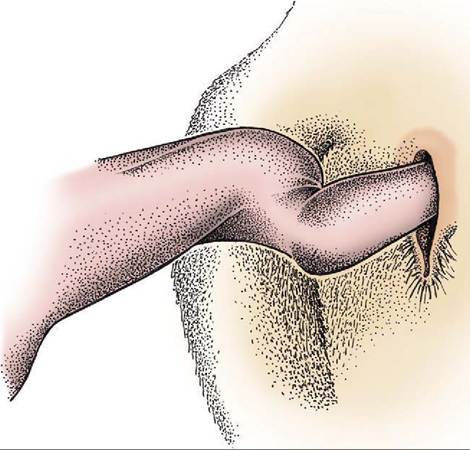
Figure 29-36 Spiraling of the free part of the bovine penis in full erection.