Horns
The horns of domestic ruminants have osseous bases provided by the cornual processes of the frontal bones. Unlike antlers, which are shed and replaced yearly, horns are permanent* and grow continuously after their first appearance soon after birth.
The dermis is tightly adherent to the cornual process and bears numerous short papillae that are slanted apically, ensuring that the horn elongates and thickens as it grows (Fig. 10.22). The horn substance resembles that of the hoof in being an admixture of tubules and intertubular horn. The horn (epiceras) produced by the epidermis at the base is soft and somewhat transparent, resembling the periople of the hoof. It gives the horn its glossy sheen.
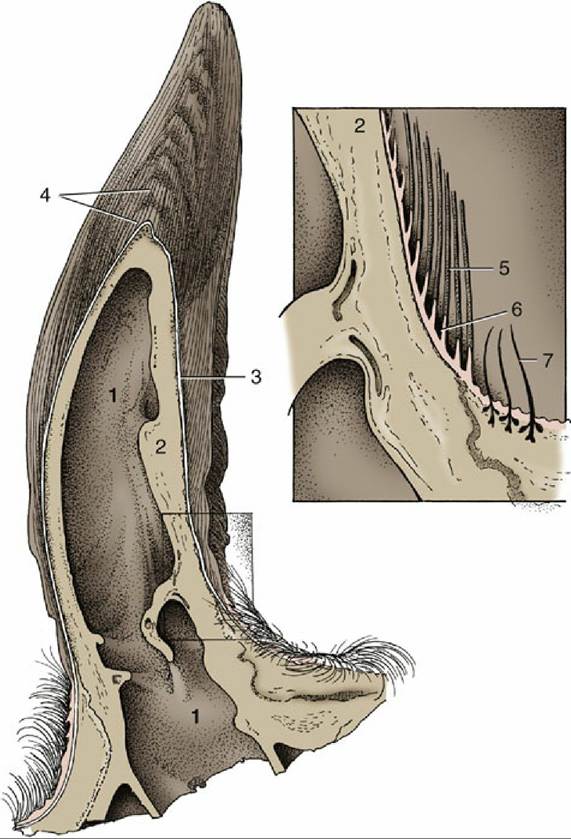
FIG. 10.22 Longitudinal section of bovine horn. 1, Caudal frontal sinus extending into horn; 2, cornual process of frontal bone; 3, combined periosteum, dermis, and noncornified stratum of epidermis; 4, horn tubules separated by intertubular horn; 5, horn tubules (inset); 6, dermal papilla; 7, hair.
Except the naturally polled breeds, the horns are found in both males, who have larger horns, and females. Their shape is strongly characteristic of the breed and reflects the shape and size of the cornual process. In cattle, these processes are invaded by the frontal sinuses (Fig. 10.22/1), a feature that may have implications for the dehorning of an adult animal.
The horny shell separates from the bony core on maceration, explaining the (obsolete) zoologic designation Cavicornia (hollow-horned animals) sometimes given to ruminants with permanent horns. Ruminants of the deer family (Cervidae) have antlers and are specifically excluded from this grouping. Antlers are sturdy outgrowths of the skull that are initially covered with skin but become exposed when the skin dies. The dead skin, or velvet, is removed by being rubbed against trees and other objects. The osseous processes lose their blood supply when exposed, die, and are shed, and the animal is left relatively defenseless until a new set of antlers grows next season.