Importance of animals’ oral health
Disorders of the oral cavity are of great importance in veterinary medicine due to their high prevalence in dogs and their serious consequences, which can even affect the systemic health of the animal [20].
Abnormalities, injuries or disorders of this organ can cause discomfort and pain, leading the animal to anorexia, due to lack of food, and adipsia, not water intake, predisposing it to conditions of decreased immunity and clinical complications [21].In addition to this great discomfort and the involvement of other organs, the inflammatory response caused by diseases in the oral cavity can lead to the gingival tissue a progressive loss of tooth fixation to the alveolar bone and, consequently, the loosening and loss of this tooth [22].
The dentistry specialty in veterinary medicine has been evolving in recent years, gaining space in the curriculum of some colleges. Even though the food industry has undergone great advances in the production of diets aimed at improving oral health, the number of professionals who perform an adequate clinical examination is still not significant. In addition to this important factor, the lack of adequate provision of oral hygiene care is worrying [22, 23].
Among dogs over one year of age, 95% have some degree of the disease, and in the clinic, it is believed that 100% of adult animals have varying degrees of periodontal disease [23]. The most common signs associated with periodontal disease are halitosis, dental calculus, inflammation and gingival bleeding, anorexia and the consequent weight loss, ptyalism, difficulty in chewing and grinding food, mobility and migration of teeth, loss of alveolar bone, gingival retraction and behavioral changes [24].
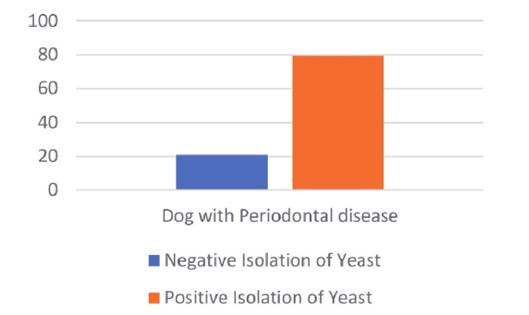
Periodontal disease is, therefore, the most common disease affecting dogs of all breeds, formed from proliferative microorganisms, defense cells (leukocytes and macrophages), epithelial cells, bacterial polysaccharides and salivary glycoproteins, which over time become organize, occurring mineralization and formation of dental calculus [25]. It is believed that this clinical condition is usually caused by the formation of bacterial plaques, but the isolation of yeasts from the oral cavity of dogs with periodontal disease is frequent (Figure 4).
The greatest risk in periodontopathic is not only the loss of teeth or the development of local infections, but the possible systemic effects of the pathological agent in the bloodstream.
Thus, the oral health of dogs is extremely important and still needs a greater focus on microbiological research and awareness of those responsible, regarding food, the importance of oral hygiene, and the attention of the tutor and the veterinarian regarding the etiopathogenesis of diseases, such as yeasts.
5.