Key points
■ Functionally, the nervous system is organised hierarchically, this is analogous to a business corporation with workers and managers.
■ The hierarchy consists of effectors (sensory and motor) and different levels of information processing and integration in the spinal cord, brainstem and forebrain.
The functional arrangement of the nervous system is hierarchical and can be likened, in some ways, to corporate structure (Fig. 4.1, Table 4.1). There are workers and management systems. The workers are those nerves that interact directly with the sensory receptors in the body and with the effectors (muscle). Thus the majority of the ‘worker’ nerves are found in the PNS. Conversely, management is confined to the CNS. It receives and processes sensory inputs, integrates information, and directs the worker outputs. There are a number of levels of management: junior, senior and executive. These levels are located to different extents in the spinal cord, brainstem and forebrain. There are also maintenance systems that keep the basal level of activity going in the body. These are represented largely by the autonomic nervous system and include visceral reflexes. For example, stimulation of baroreceptors results in cardiovascular changes to maintain appropriate blood pressure.
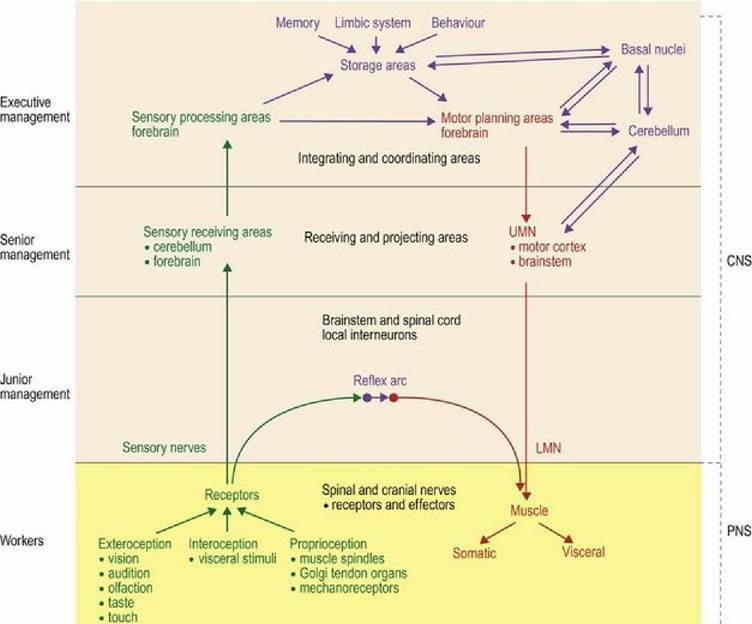
Fig. 4.1 Schematic of hierarchical structure of the nervous system. Green = sensory systems; purple =
interneurons, red = motor systems.
Table 4.1 Hierarchical arrangement of the nervous system
| Hierarchical position | Location of sensory system | Location of motor system |
| Workers Link between the PN S target organs and the CN S Involved in reflex functions | Sensory receptors and sensory nerves, with input via spinal and cranial nerves | LMNs connecting via NMJ to muscle |
| Junior management Interneuronal circuitry which links between input from sensory fibres, or UMNs, to LMN Involved in reflex functions | Spinal cord for afferent spinal nerves Brainstem for sensory input from CN V, VIII, IX, X Forebrain for sensory input from CN I, II | Spinal cord for connecting to LMNs of spinal nerves Brainstem for connecting to LMNs of CN III-VII, IX-XII |
| Senior management | Primary sensory receiving areas Cerebellum - subconscious proprioception Forebrain - visual, auditory, somatosensory cortices and olfactory lobe | UMN nuclei of the brainstem and the motor cortex of the forebrain |
| Executive management | Diverse areas of the brain processing and interpreting sensory input. Interconnections between sensory association areas, storage (memory), behaviour and emotion centres and motor planning centres with links to the cerebellum and basal nuclei | |