Lactation Can Be Induced by Hormone Administration (Estrogen and Progesterone) and Enhanced by Growth Hormone and Increased Photoperiod Exposure
The induction of lactation by hormone treatment is sometimes desired, especially in dairy animals with high-lactation records but poor reproductive performance. The use of a combined treatment ofestrogen and progesterone over a relatively short period (1 week) has induced alveolar development sufficiently to result in milk production.
Although the amount of milk produced is less than normal, the cows can he maintained in the milking string while efforts to impregnate them continue. To induce lactogenesis by hormonal means, animals should not be lactating at treatment and should have mammary glands free of infection.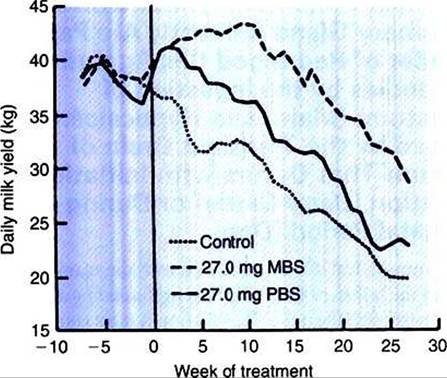
FIGURE 39-11 Average weekly milk yield of cows injected daily with diluent (control), 27 mg of methionyl bovine somatotropin (MBS), or 27 mg of pituitary bovine somatotropin /PBSZTreatments began at week 0 at an average of 84 ±10 days after parturition. (FromTucker HA: Lactation and its hormonal control. In Knobil E, Neill J, Ewing LL, et al, editors: The physiology of reproduction, vol 2, NewYork, 1988, Raven Press.)
Growth hormone, which is important to the normal lactational process, can be used for the enhancement of lactation when administered over a rather wide range of concentrations (Figure 39-11). The ability to synthesize GH is relatively recent; its availability has expanded interest in its use for increasing the amount of milk produced by dairy cows. In general, GH acts on the postabsorptive use of nutrients so that protein, fat, and carbohydrate metabolism in the whole body are changed, and the nutrients are directed toward milk synthesis. If cows are in early lactation and in a negative energy balance, GH administration results in the mobilization of body fats that are used for milk formation. If cows are in positive energy balance, GH has no effect on the metabolism of body fat.
Initially, GH treatment decreases the energy balance of cows; however, this is adjusted by a voluntary increase in feed consumption. Despite the increased feed consumption, GH administration increases the gross efficiency of lactation by as much as 19%. In essence, the effects of exogenous GH do not depend on gross alterations in nutrient digestibility or on body maintenance requirements. The use of GH may be economically viable, with the increased milk production justifying the expense of the hormone.An interesting controversy has arisen from the fact that cows treated with GH do not produce “organically” derived milk, despite that synthetic GH is almost identical to endogenously derived GH. Although there is no evidence that increased concentrations of GH occur in the milk as a result of its administration, some consider the resultant milk to be abnormal.
The results with GH are in contrast to the studies in which thyroid hormone administration, in the form of iodinated casein (thyroprotein), was used to increase lactation in cows.
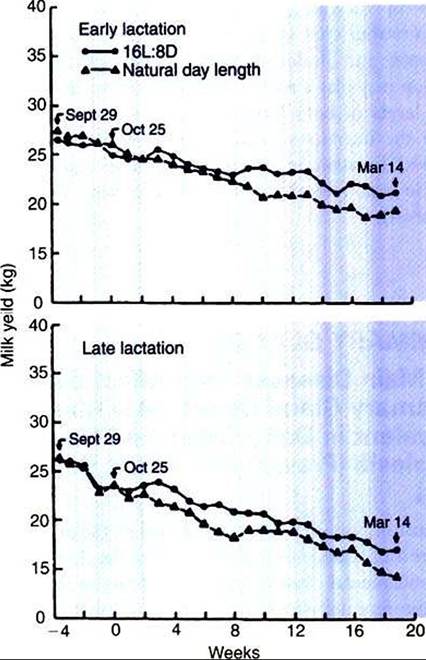
FIGURE 39-12 Influence of day length on milk production of Holstein cows. Between September 29 and October 24, cows at 37 to 74 days (early lactation) or 94 to 204 days (late lactation) after parturition were exposed to natural photoperiods of 12 hours of light per day and standardized diets. Between October 25 and March 14, cows were exposed to natural photoperiod (9-12 hours of light daily) or to 16 hours of fluorescent lighting superimposed on the natural photoperiod. Lf Light; Df dark. (FromTucker HA: Lactation and its hormonal control. In Knobil E, Neill J, Ewing LL, et al, editors: The physiology of reproduction, vol 2, NewYork, 1988, Raven Press.)
Although the administration of thyroprotein increased lactation, extra feed was necessary to prevent excessive body weight loss, and milk production declined abruptly when thyroprotein was removed from the diet.
In essence, the use of thyroprotein does not affect the efficiency of the lactational process as GH does. In dogs, one differential for gynecomastia (mammary enlargement) is profound hypothyroidism, causing elevated thyrotropin-releasing hormone (TRH) levels, which in turn stimulate prolactin secretion.Another interesting finding of the 1980s concerning the manipulation of lactation has been that the milk yield in cows can be increased by exposing them to increased light. Cows under a photoperiod regimen of 16 hours of light (8 hours of dark) produced 6% to 10% more milk than animals under the reverse photoperiod (8 hours of light and 16 hours of dark) (Figure 39-12). Although the mechanism by which light affects lactation is not known, it likely involves prolactin secretion, at least to some extent, in that increased light exposure results in increased prolactin secretion. Similarly, the queen’s estrous cycle is affected by photoperiod, mediated by melatonin and prolactin levels. Melatonin and prolactin secretion may play a role in ovarian function in the cat, with lower levels of both hormones present during estrus than during the interestrous period. Protocols exist for inducing improved lactation in postpartum bitches using low-dose oxytocin and metoclopramide (a dopamine 1)-2 receptor antagonist).