Milk Production Peaks at 1 Month Postpartum in Dairy Cattle, Followed by a Slow Decline in Production; Milking Usually Stops at 305 Days of Lactation So That the Animal Can Prepare the Mammary Gland for the Next Lactation
Milk production tends to increase for the first 3 to 4 weeks of lactation and then begins to slowly decline through the end of lactation (Figure 39-10). Cows are usually “dried up” after 305-day lactational periods; pounds of milk and butterfat production rates are calculated on this basis.
Dairy animals are forced to stop lactating in order to prepare for the next lactation. The usual procedure is to stop milking. The back pressure of milk within the alveoli gradually inhibits the secretion of milk by the alveolar epithelial cells, with a resultant regression of the alveolar cells and small ducts. The process, called involution, often requires at least a month, with a 6-week period usually desired as the minimal interval from drying off to the onset of the next lactational period. Within 1 to 2 months, the secretory (alveoli) and excretory (duct) systems regress and are once again replaced. The process by which epithelial structures regress, yet retain coding for the renewal of duct and alveolar systems, is truly remarkable.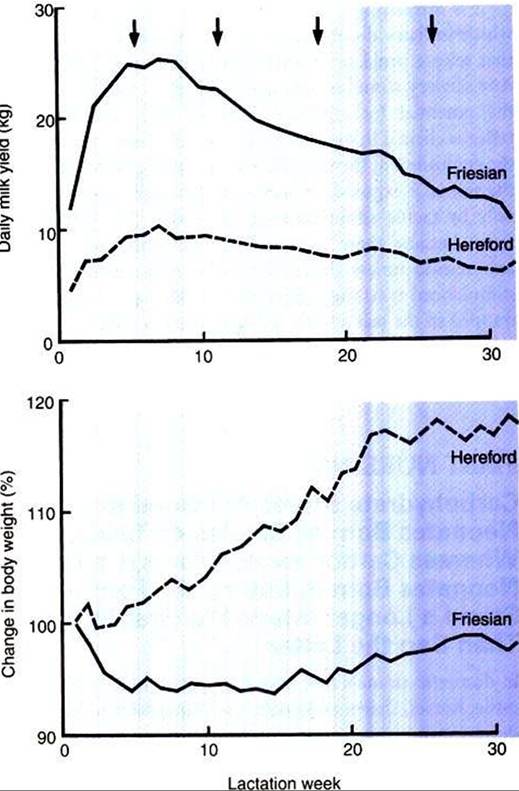
FIGURE 39-10 Average daily milk yield (top) and average percentage change in body weight (bottom) in seven low- yielding cows (broken line) and eight high-yielding cows (solid line). Arrows indicate times of blood sampling. (Courtesy Dr IC Hart. From Cowie AT: Lactation. In Austin CR, Short RV, editors: Reproduction in mammals, ed 2, vol 3, Hormonal control of reproduction, Cambridge, UK, 1984, Cambridge University Press.)
More on the topic Milk Production Peaks at 1 Month Postpartum in Dairy Cattle, Followed by a Slow Decline in Production; Milking Usually Stops at 305 Days of Lactation So That the Animal Can Prepare the Mammary Gland for the Next Lactation:
-
Veterinarian -