» Male Reproductive System
The scrotum is positioned high in the perineal region, in a position similar to that in the cat or the pig. The testes are relatively small, and although present at birth, they are soft and may be difficult to palpate in the newborn.
In adult male llamas the size of the testis is 5 to 7 cm in length, 3 to 4 cm in depth, and 2.5 to 3.5 cm wide. Adult male alpacas have slightly smaller testes, at 4 to 5 cm long and 2.5 to 3 cm wide. Their orientation in the scrotum can be vertical or horizontal; the tail of the epididymis is usually directed dorsocaudally, and the body of the epididymis runs dorsally on the testis and faces laterally. The scrotum is not pendulous in camelids, although it becomes somewhat pendulous in the summer months.Male Reproductive Organ Disorders: The spermatic cord is not as accessible for vasectomy as it is in ruminants. Cryptorchidism is rare in llamas and alpacas, but testicular hypoplasia, sometimes unilateral, occurs in an estimated 10% of individuals. Absence of one testicle has also been reported and is associated with absence of the kidney of the same side.
Male camelids lack seminal vesicles. The ductus deferens has a small ampulla at the junction with the pelvic urethra. The prostate is small (1.5-2.7 cm in length and 1-2.1 cm in width; larger in older animals) and H-shaped or bilobed, sitting dorsal to the urethra near the trigone of the bladder. It can occasionally be palpated per rectum, but usually it is evaluated via ultrasound. The bulbourethral glands are about 2 cm in diameter in the llama and are situated dorsolateral to the urethra at the level of the ischial arch. They can be digitally palpated per rectum.
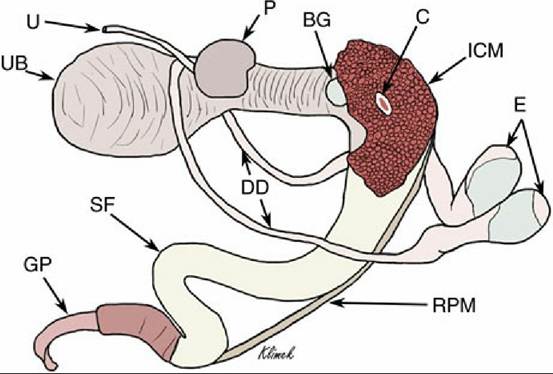
FIG. 38.26 Male llama reproductive tract (schematic). BG, Bulbourethral gland; C, transected crus of the penis; DD, ductus deferens; E, tail of the epididymis; GP, glans penis; ICM, ischiocavernosus muscle; P, prostate; RPM, retractor penis muscle, SF, sigmoid flexure; U, ureter; UB, urinary bladder.
(Drawn from TibaryA, Vaughan J: Reproductive physiology and infertility in male South American camelids: a review and clinical observations, Small
Rumlnant Res 61:283-298, 2006.)
Male camelids have a low volume of ejaculate (3 mL or less), probably as a result of the relatively small size of the testis as well as the relatively small accessory sex glands and the lack of the seminal vesicle. In addition, the diameter of the penile urethra is small. All of these factors contribute to the "dribbling" character of ejaculation in llamas and alpacas.
Camelids have a typical fibroelastic penis with a prescrotal sigmoid flexure. The retractor penis attaches to the distal part of the sigmoid flexure. The penis is about 35 to 45 cm in length in adult llamas and alpacas, with 18 to 25 cm exposed beyond the prepuce in the erect state. Fig. 38.26 is a schematic of the entire male reproductive tract.
The distal end of the penis of camelids possesses a cartilaginous tip that may be confused with the urethral process of the small ruminant, but that does not communicate with the urethra. This corkscrew-shaped cartilaginous tip has a slight clockwise twist; this matches the clockwise spiral course of the lumen of the cervix of the female and serves to dilate the cervix so that semen is deposited in the uterus. The urethral process is small and located at the base of the cartilaginous tip. The distal end of the penis is shown in Fig. 38.27. There is an adhesion of the penis to the prepuce that prevents protrusion of the penis before 2 to 3 years of age. Sexual maturity in the male llama is at 2.5 to 3 years of age; in the male alpaca it is 5 years of age.
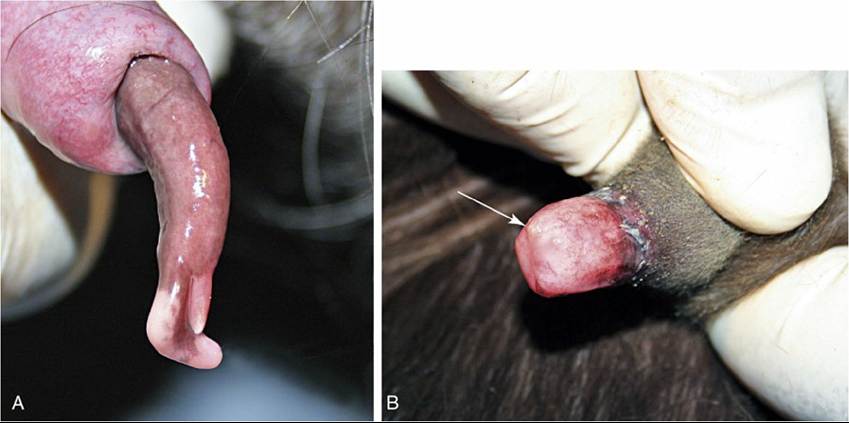
FIG. 38.27 (A) Distal end of the penis of a breeding male (age 3 years). The penis has a corkscrew orientation on its long axis and a blunt cartilaginous tip that spirals around the smaller urethral process.
(B) Distal end of the penis of an immature male (age 4 months). Note that the prepuce is adhered to the distal penis. Arrow indicates the distal urethra. (From Cebra C, Anderson DE, Tibary A, et al: Llama and alpaca care: medicine,surgery, reproduction, nutrition, and herd health, St. Louis, 2014, Elsevier, Fig. 18-3.)
The triangular-shaped prepuce is in the inguinal region, and its opening is directed caudally in the absence of sexual stimulation. There are well-developed cranial, lateral, and caudal preputial muscles that help direct the opening of the prepuce ventrally and cranially for mating. Fig. 38.28 illustrates schematically the position of the reproductive tract of the male llama.
Semen Collection: Copulation takes place in the sitting (or "cush") position (Fig. 38.29), which presents some logistic challenges for semen collection beyond the low volume of ejaculate. Semen can be collected using an artificial vagina on a dummy, or it can be aspirated from a mated female.