Membrane Receptors and Intracellular Signaling
The cell membrane protects the cell from the extracellular environment by restricting exchange between the intracellular and extracellular fluid spaces. However, cells must also be able to detect the presence of certain chemical substances in the extracellular fluid and alter appropriate intracellular functions when these chemicals are present.
These abilities are essential for communication between individual nerve cells, between nerve and muscle cells, and between cells of endocrine glands and the cells affected by the hormones secreted by endocrine glands. The recognition of the specific chemical in the extracellular fluid and the response to its presence are based on the interaction between the chemical and a membrane protein. Ligand is the general term applied to any chemical that is capable of interacting with, or binding to, a membrane protein or membrane receptor. important characteristics of the ligand-receptor relationship are reversibility, specificity, affinity, and saturation.The binding of a ligand to a membrane receptor is usually reversible, for it is due to relatively weak chemical attractions. The weakness of this binding is also a reason for some of the other characteristics of the ligand-receptor relationship. Membrane receptors can bind to only a limited number of particular ligands or chemicals; that is, receptors demonstrate specificity for certain ligands. However, even though a receptor may be capable of binding any of a number of ligands, the affinity, or strength of binding, between the receptor and ligand may not be the same for both chemicals. Ligands that form a strong bond with a receptor are described as having a high affinity for the receptor.
The number of membrane receptors on any given cell or cell population is finite. Thus, it is possible to provide enough ligand that all receptor molecules have ligand bound to them.
A receptor is described as occupied when it has a ligand bound to it. Saturation of receptors occurs when all receptors are occupied with ligand.These concepts and characteristics of ligands and receptors are the basis for a variety of pharmaceutical agents. For example, β-blocker drugs are ligands that bind to β-adrenergic receptors but do not produce any biologic response. However, because the β-blocker occupies the receptor, the binding of any other ligand is prevented. Thus, β-blockers are used when it is desirable to reduce the biologic activity of β- adrenergic receptor stimulation. The binding of the β-blocker to the β-receptor prevents normal endogenous agents (epinephrine and norepinephrine) from binding to the receptor and bringing about a biologic response.
The binding of a ligand to a membrane receptor is but the first step in the process by which a chemical in the extracellular fluid can alter the function of a cell without entering it. The second step depends on the particular type of membrane receptor. in some cases, the membrane receptor is also a membrane channel. The binding of a ligand to these types of receptors is associated with a change in the permeability of the channel; hence, these channels are described as being ligand-gated. Other membrane receptors are also enzymes that are activated by the binding of a ligand. These enzymes have active sites facing the interior of the cell, so intracellular functions are changed as a result of the ligand-receptor interaction.
Yet another way that the function of a cell can be changed after a ligand binds membrane receptors involves another specific group of membrane proteins known as G proteins. G proteins are within the cell membrane and closely associated with certain receptor proteins. The G protein acts as an intermediate in the chain of events between ligand binding and cellular response. As a result of the ligandreceptor binding, the associated G protein acts to activate or inhibit an enzyme or membrane channel.
The potential actions of G proteins are summarized in Fig. 2-17.Adenyl cyclase is a cell membrane enzyme whose activity is regulated by ligand-receptor
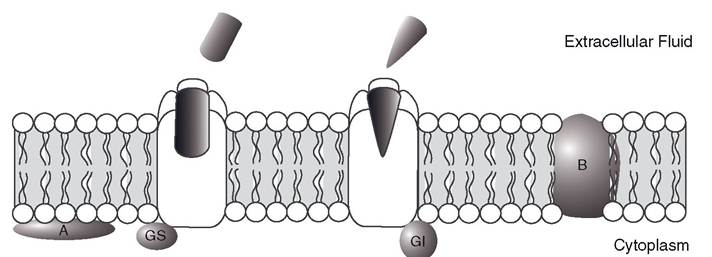
Figure 2-17. The G proteins associated with membrane receptors can be stimulatory (GS) or inhibitory (GI). The G proteins will act on associated membrane enzymes, A, or channels, B, after the appropriate ligand binds to the membrane receptor that is exposed to the extracellular fluid.
interactions. In some cases, the enzyme also acts as the cell membrane receptor, but in other cases, the enzyme is linked to a receptor via a G protein. Adenyl cyclase catalyzes the intracellular formation of cyclic adenosine monophosphate (cAMP), which in turn can activate intracellular kinases. These activated kinases can activate other intracellular proteins to change cellular function. In this general scheme, cAMP is said to be a second messenger in that it transfers a chemical signal from the membrane to the interior of the cell. cAMP is the second messenger for many of the peptide hormones that bind to membrane receptors. Examples include parathyroid hormone, glucagon, and luteinizing hormone.
Membrane proteins may also act as receptor sites for attachment of disease-causing agents, such as viruses. Some viruses bind to appropriate membrane receptors on susceptible cells, which then endocytose the virus receptor complex. This provides a means by which the virus can infect the susceptible cell.