Metabolic Acidosis Is Caused by the Accumulation of Fixed Acids or the Loss of Buffer BaserWhich Decreases Blood pH
Metabolicacidosis is the most common acid-base abnormality. During metabolism, there is a continuous production of fixed acids. An increase in their production or a failure of H+ elimination by the kidneys is the cause of metabolic acidosis.
Increased production of fixed acids results from protein catabolism or ketone production during starvation or from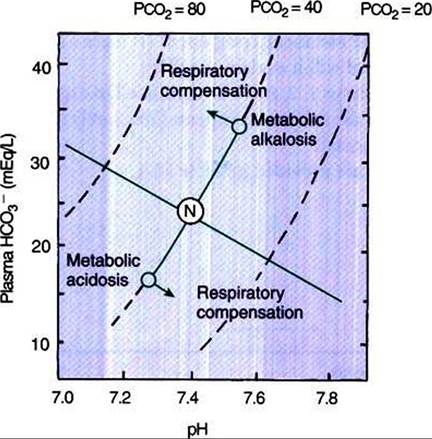
FIGURE 52-5 A pH-bicarbonate diagram showing the effects of metabolic acidosis and alkalosis on pH, bicarbonate (HCO3 ) concentration, and carbon dioxide tension (Pco2) of arterial blood. In uncompensated metabolic acidosis, there is a decrease in the bicarbonate concentration, which leads to a decrease in pH, whereas Pco2 remains constant. Respiratory compensation results in a decrease in Pco2, with a subsequent increase in pH and movement of data points parallel to the normal buffer line. In metabolic alkalosis, HCO3 increases and causes an increase in pH. Respiratory compensation is by alveolar hypoventilation, which leads to an increase in Paco2 and a return of pH toward normal. N, Normal arterial blood composition.
anaerobic metabolism that leads to lactic acidosis. Diarrhea can also cause metabolic acidosis because excessive amounts of HCO3" (buffer) are lost in the feces. In ruminants, excessive feeding of carbohydrates can lead to increased H* production in the rumen (rumen aeidosis). The H, ions that are absorbed cause metabolic acidosis.
The accumulation of Hf in the blood is combined with HCO3- and other buffers. The CO2 produced by the combination of H, and HCO3' is lost through the lungs. The loss of buffer base gives rise to a base deficit, and the HCO3- depletion decreases the [HC0370.03 ∙ Pco2I ratio; therefore the pH decreases (Figure 52-5).
The decrease in pH accompanying metabolic acidosis stimulates ventilation. This increase in alveolar ventilation has a compensatory effect on metabolic acidosis by eliminating CO2, leading to a decreased Pco2, which ultimately adjusts the ∣HC0370.03 ∙ Pco2] ratio and pH toward normal This sequence is shown in Figure 52-5. As the Pco2 decreases, IHCO3') decreases along a line that parallels the normal buffer line. This decrease in [HCO3'] is accompanied by a decrease in pH. Complete restoration of normal acid-base balance requires the restoration of the depleted base by the kidney or by therapy with intravenous fluid that contains buffers, such as bicarbonate.