Microbial Protein Can Be Synthesized in the Rumen from Nonprotein Nitrogen Sources
If sufficient carbohydrate is available, most rumen microbes, even those capable of utilizing preformed peptides, can synthesize protein from ammonia (see Figure 31-4). Thus, protein can be produced in the rumen from such nonprotein sources as ammonia, nitrates, and urea.
From a nutritional and economic point of view, this capability has been exploited by the inclusion of inexpensive nonprotein nitrogen sources in place of expensive protein in ruminant diets, allowing the microbes to synthesize protein for the amino acid needs of the host. This process also can be exploited physiologically by the recycling of endogenous urea.Urea, the nitrogenous waste product of protein catabolism, is formed in the liver. In ruminant animals, hepatic urea production is from two sources: (1) nitrogen arising from the deamination of endogenous amino acids and (2) nitrogen absorbed as ammonia from the rumen (Figure 31 -6). Ammonia absorption from the rumen is proportional to the ruminal ammonia production rate, which is subject to the influences of ruminal carbohydrate and protein availability, as discussed earlier. Ammonia, which is toxic at moderate concentrations, is absorbed from the rumen and delivered to the liver through the hepatic-portal blood vascular system. The liver extracts ammonia from the portal blood efficiently; thus little of the potentially toxic ammonia reaches the systemic circulation.
In monogastric animals, urea is excreted from the body almost exclusively by the kidneys. In ruminants, however,
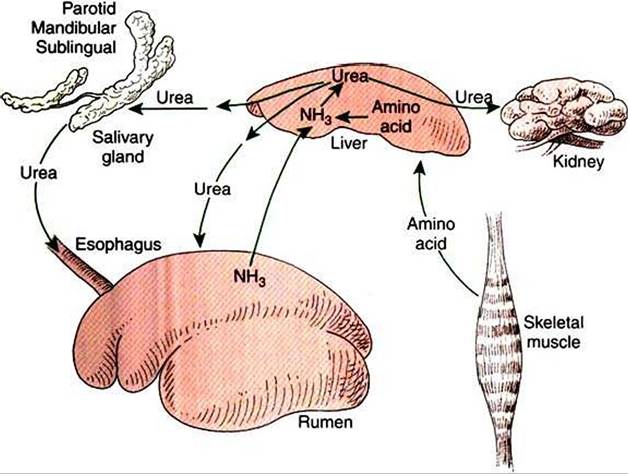
FIGURE 31-6 Interorgan nitrogen cycling in ruminants.The diagram shows the effects of rumen ammonia (NH3) concentration on the formation and utilization of urea. When rumen ammonia concentrations are high, the net movement of nonprotein nitrogen is toward the liver, resulting in high urea production rates and poor nitrogen conservation. When rumen ammonia concentrations are low, the net movement of nonprotein nitrogen is from liver to rumen, resulting in protein production from endogenous urea.
urea also may be excreted into the rumen (see Figure 31-6).
Such excretion can occur by direct absorption of urea into the rumen from the blood or by excretion of urea into saliva. In either case, the urea reaches the rumen, where it is quickly transformed to ammonia, and enters the general pool of rumen nitrogen from which microbial proteins are synthesized.The direction of nonprotein nitrogen flow, either into the rumen as urea or out of the rumen as ammonia, depends on rumen ammonia concentrations. During times of high nitrogen availability in the rumen, relative to carbohydrate availability, this system results in high blood urea concentrations and the extensive loss of precious nitrogen through urinary excretion, making ruminants nutritionally inefficient under these dietary conditions. However, during times of high carbohydrate availability relative to nitrogen availability, the major flow of urea nitrogen is from the blood into the rumen. Under these circumstances, in which ruminal ammonia concentrations are low, most of the blood urea is from endogenous protein catabolism. A portion of this urea, which in monogastric animals would be unavailable for protein synthesis, is excreted into the rumen, where it can be resynthesized into protein that will contribute eventually to the amino acid needs of the host. Thus, under conditions of low dietary protein, ruminants are efficient Conservers of nitrogen.