A Molecule of Hemoglobin Can Reversibly Combine with Four Molecules of Oxygen
Mammalian hemoglobin consists of four units, each containing one heme and its associated protein (globin). Globin is a polypeptide composed of 140 to 150 amino acids. Heine is a protoporphyrin consisting of four pyrroles with a ferrous iron at the center.
Each ferrous iron can combine reversibly with a single molecule of oxygen. The complete hemoglobin molecule has four hemes each with its associated globin and thus can combine reversibly with up to four molecules of oxygen. The type and sequence of amino acids that compose globin are critical to oxygen binding. Without the presence of globin, oxygen would irreversibly oxidize the ferrous iron to ferric iron. The amino acids in globin cradle the heme and limit access of oxygen to the ferrous iron. This prevents oxidation and allows uptake and release of oxygen in response to local Pθ2.The type and sequence of amino acids that compose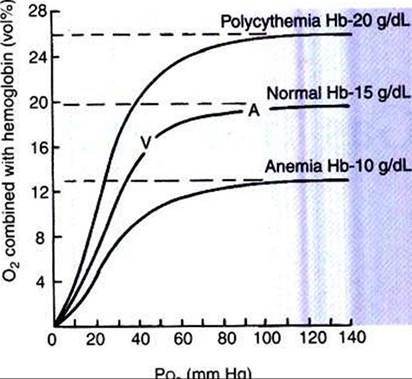
FIGURE 48-2 Oxyhemoglobin dissociation curve of normal (hemoglobin ∣Hb] = 15 g∕dL), anemic (Hb = 10 g∕dL), and polycythemic (Hb = 20 g∕dL) blood.The amount of oxygen combined with hemoglobin (i.e., the oxygen content) is plotted as a function of oxygen tension (Po2). A, Arterial; V, venous.
globin define the different types of mammalian hemoglobin. Adult hemoglobin contains two alpha (α) and two beta (β) Uinino acid chains; fetal hemoglobin contains two α and two gamma (γ) chains. Closely related species, such as humans and anthropoid apes, have similar amino acid sequences on the side chains, whereas more divergent species have more differences in amino acid sequences.
Each hemoglobin molecule can reversibly bind up to four molecules of oxygen, one with each heme. The reversible combination of oxygen with hemoglobin is shown in the oxyhemoglobin dissociation curve (Figure 48-2). The binding of oxygen is a four-step process, and the oxygen affinity of a particular heme is influenced by the oxygenation of the others. This means that when the first heme unit is oxygenated, oxygen affinity of the second heme unit is increased, and so on. These heme-heme interactions are responsible for the sigmoid shape of the oxyhemoglobin dissociation curve.