A Small Amount of Oxygen Is Transported in Solution in Plasma, but Most Is in Combination with Hemoglobin
Oxygen is poorly soluble in water and therefore in plasma. Because of this low solubility, most animals need an oxygencarrying pigment to transport sufficient oxygen to the tissues.
The only animals that can exist without hemoglobin live deep in the ocean in the cold parts of the world. The depth at which they live results in a high ambient pressure and thus a high oxygen tension (Po2). In addition, the cold environment results in a low metabolic rate and therefore little need for oxygen. The high Po2 and low oxygen demand enable them to exist without an oxygen-carrying pigment. All land-dwelling animals seen by veterinarians have such a pigment, and in mammals and birds, that pigment is hemoglobin.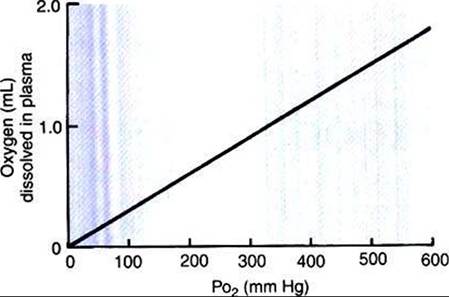
FIGURE 48-1 Amount of oxygen (in milliliters) dissolved in plasma as a function of oxygen tension (Po2).
When blood in the pulmonary capillaries flows past the alveoli, oxygen diffuses from the alveoli into the blood until the partial pressures (tensions) equilibrate: that is, there is no further driving pressure difference. Because oxygen is poorly soluble in water, only a very small amount dissolves in the plasma, and hemoglobin is necessary for delivery of sufficient oxygen to the tissues. Without hemoglobin, which transports the majority of the oxygen, the cardiac output would have to be inordinately high to maintain the oxygen supply to the body organs.
Even though the amount of oxygen dissolved in plasma is small, it increases directly as the partial pressure of oxygen increases; 0.003 mL of oxygen dissolves in each IOO mL (I dL) of plasma at an oxygen tension (Po2) of I mm Hg (Figure 48-1). The pulmonary capillary blood equilibrates with the alveolar oxygen tension (PAo2) of IOO mm Hg; therefore, 0.3 mL of oxygen dissolves in each deciliter of blood. If an animal breathes pure oxygen so that the PAo2 increases to approximately 600 mm Hg, 1.8 mL of oxygen dissolves in each deciliter of plasma.