Most Skeletal Muscle Fibers Can Be Classified as Either Fast-Contracting or Slow-Contracting Fibers
Skeletal muscle fibers with short contraction times are sometimes called fast-twitch fibers. They tend to be larger, have extensive sarcoplasmic reticulum for rapid release of Ca21 ions, and have less extensive blood and mitochondrial supplies because aerobic metabolism is less important.
Fast-twitch fibers are fairly rapidly fatigued but are well adapted for jumping, sprinting, and other brief, powerful movements.In contrast, slow-twitch fibers are smaller muscle fibers, have a rich blood and mitochondrial supply, and have a large amount of myoglobin, an iron-containing and oxygen-storing protein similar to hemoglobin. These fibers rely more heavily on oxidative metabolism, are less amenable to fatigue, and are better adapted for the continual contraction of antigravity extensor muscles.
Because slow-twitch fibers have more myoglobin, they are sometimes called red muscle; fast-twitch fibers are sometimes called white muscle. A third type of fiber, a subclass of fast-twitch fibers, has properties between the two types. Usually, a muscle belly is made up of a blend of these three types, the proportions varying in accordance with the muscles use. This blend can be changed somewhat with exercise, such as in an athlete training for a different type of sports event.
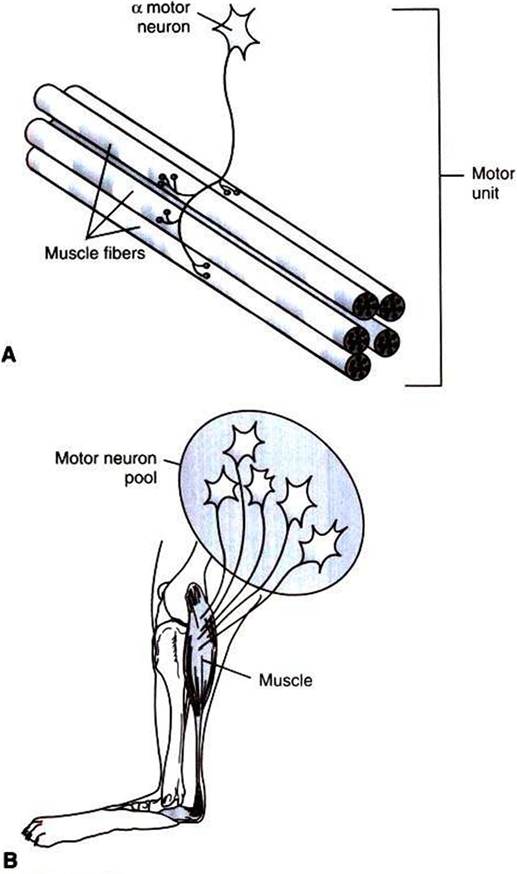
FIGURE 6-6 Innervation of skeletal muscle by α motor neurons of central nervous system (CNS). Ar Motor unit is an α motor neuron and all the skeletal muscle fibers it innervates. Br Neuronal cell bodies of all the motor units from a single muscle form a cluster within the CNS called the motor neuron pool of that muscle. (Redrawn from Bear MFr Connors BWr Paradiso MA: Neuroscience: exploring the brain, ed 3r Philadelphia, 2007, Lippincott Williams & Wilkins.)