Motility of the Colon Causes Mixing, Retropulsion, and Propulsion of Ingesta
The colon has multiple functions, including (1) absorption of water and electrolytes, (2) storage of feces, and (3) fermentation of organic matter that escapes digestion and absorption in the small intestine.
The relative importance of these functions varies with the species, and tremendous differences in colon size and shape exist among animals. The major determinant of colon size is the importance of colonic fermentation to the energy needs of the animal. Some species, such as the horse and rabbit, make extensive use of fermentation products for nutritional needs and have large and complex colons. (The ruminant’s fermentation chamber is in the stomach.) Other species, such as the dog and cat, do not rely on fermentation products and have relatively simple colons. Figure 28-10 illustrates differences in colonic anatomy among four species with different needs for fermentative digestion.Considerable similarity appears to exist in colon motility patterns among animals, despite the anatomical diversity. Mixing activity is prominent in the colons of all species because mixing and circulating are important to both absorptive and fermentative functions. Mixing is achieved by segmentation contractions along with other types of motility. In many species, such as the horse and pig, colonic segmentation is pronounced and in some areas results in the formation of Sacculations known as Iiaustray which are visible even after death.
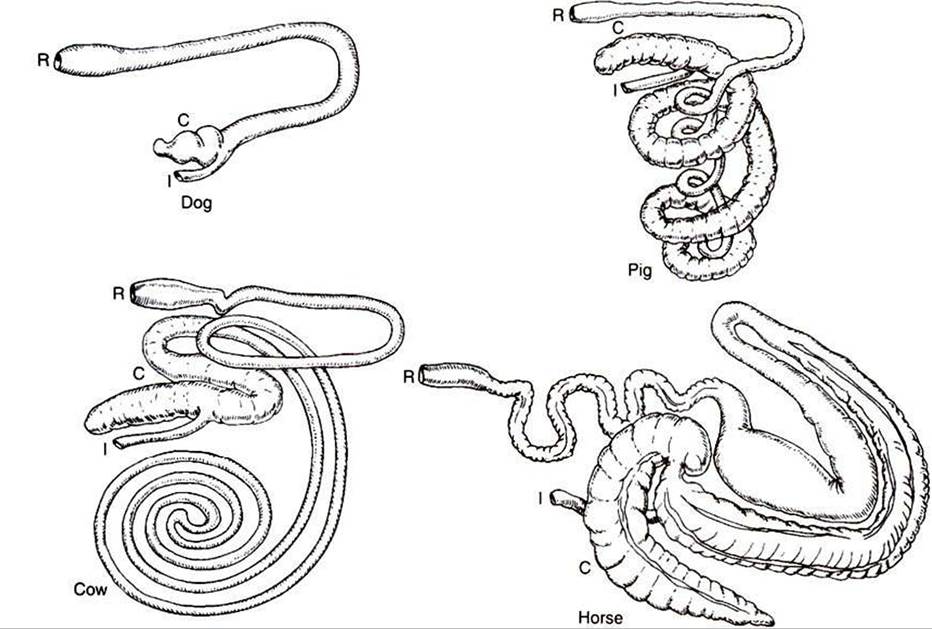
FIGURE 28-10 ■ Variations of colon anatomy of four mammals. Animals with simple colons, such as the dog, are not dependent on colonic fermentation to supply energy needs. Horses, which have tremendous colonic development, rely on colonic fermentation for a large portion of their energy needs. In animals such as pigs and cattle, the importance of colonic fermentation to digestive needs is intermediate between that of the horse and dog, and this intermediate position is noted in their colon development. C, Cecum; /, ileum; Rf rectum.
A particular characteristic of colonic motility is retro- pulsion, or antiperistalsis. This type of peristaltic contraction migrates orally, the opposite of normal peristaltic movement. Such motility results from colonic slow-wave activity that is somewhat more complex than that of the small intestine. In the colon, as in the small intestine, the slow waves originate in the ICC. The colonic ENS, however, can influence the ICC in such a manner as to shift the site of origin of slow waves and the direction of their propagation. Under resting conditions in the colon, slow waves originate from “pacemakers” in one or more central sites. The pacemakers are not anatomical structures; rather, they are areas defined by activities of the ENS. Thus the pacemakers are not always the same areas; they can disappear and form in different locations in response to the need for different motility patterns. Antiperistaltic contractions occur in the segments in which slow waves migrate in an oral direction. Antiperistaltic contractions are retro- pulsive and impede the movement of ingesta, causing intense mixing activity and forcing material to accumulate in the proximal portions of the colon. Retropulsion appears to be particularly strong near the pacemakers, and the pacemakers therefore represent sites of high resistance to the flow of colonic ingesta.
Because of continued inflow of material from the ileum into the colon, some ingesta escape the retropulsive, anti- peristaltic motility, move into areas of propulsive, peristaltic activity, and proceed along the colon. In addition, there are periods of intense propulsive activity that involve the entire colon. These are called mass movements and frequently involve the distal translocation of the entire colonic content.