The Colon Is an Important Site of Storage and Absorption in All Animals
The colon of the dog and cat is a relatively simple organ consisting of a short cecum, an ascending part, a transverse part, and a descending part. During the resting phase, there is a colonic pacemaker at about the junction of the transverse and descending colons (Figure 28-11).
This gives rise to anti- peristaltic activity in the proximal colon, with resultant accumulation of ingesta in the cecum and ascending colon areas. Moderate peristaltic activity usually occurs in the descending colon, whereas the distal colon and rectum are usually constricted and empty.Material entering the carnivore colon is of a fluid consistency. It is thoroughly mixed in the ascending and transverse colons, and much of the water and many of the electrolytes are absorbed. By the time it reaches the descending colon, it is semisolid and becoming feces.
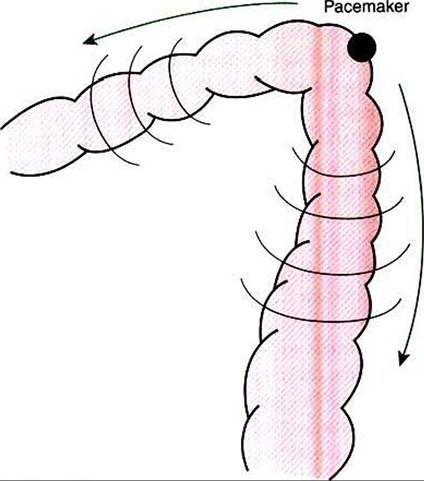
FIGURE 28-11 A pacemaker is present at the junction of the transverse and descending parts of the colon of the cat and probably in other mammals with similar colonic anatomy. Slow waves and peristaltic activity emanate in both directions from the pacemaker. Retrograde, or reverse, peristalsis in the proximal portions of the colon causes ingesta to be retained there, promoting the storage and absorptive functions of the colon.