Muscles of the Head
Muscles of Mastication
Muscles of mastication are those that have attachments to the mandible and whose contractions produce the jaw movements associated with chewing (Fig. 7-11).
As a general rule, considerably more muscle mass (and therefore strength) is devoted to the elevation (closure) of the mandible than to depression (opening). Most of the muscles of mastication are innervated by the trigeminal nerve (see Chapter 9).The m. temporalis is a strong muscle arising from the sagittal crest and the expansive temporal fossa of the lateral cranium and inserting on the coronoid process of the mandible. its action is to elevate the mandible, bringing the upper and lower teeth together.
The m. masseter is especially well developed in herbivorous species. This powerful masticatory muscle arises from the maxillary region of the face and the zygomatic arch. It inserts on the caudal mandible, and its primary actions are to elevate the mandible and to draw it laterad. The broad expanse of the horse’s cheek is formed by the masseter muscle.
Medial to the mandible are two pterygoid muscles (mm. pterygoideus). These arise from the ventral parts of the skull (the pterygoid and palatine bones) and insert on the mandible. These muscles assist in closing the mandible and play an important role in the side-to-side grinding movements typical of herbivore mastication.
opening of the jaw is largely assisted by gravity, but forceful depression of the mandible is primarily the function of the m. digastricus.
This muscle arises from the region caudal to the temporomandibular joint and inserts on the angle of the mandible. As the name implies, the muscle has two bellies, indistinctly divided near the muscle’s center.
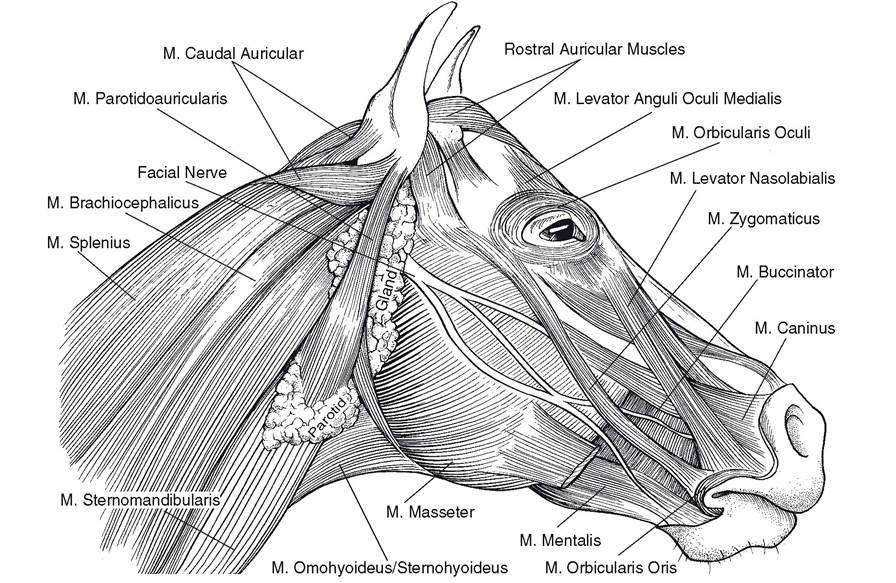
Figure 7-11. Muscles of the equine head.
Muscles of Facial Expression
The muscles that move the skin and appendages of the face and head are the muscles of facial expression or mimetic muscles. These are generally thin cutaneous muscles innervated by the facial nerve (see Chapter 9).
The auricular muscles are roughly divided into a rostral and a caudal group. The contraction of auricular muscles produces the range of ear movements characteristic of domestic animals.
The m. orbicularis oculi is a sphincter-like muscle that surrounds the palpebral fissure (the opening of the eyelids). Contraction of the m. orbicularis oculi produces a forceful closure of the fissure.
A large number of muscles produce movements of the lips and cheeks; these are important in prehension of food and assist with mastication by keeping food in the mouth and positioned between the teeth. A sphincter-like muscle, the m. orbicularis oris, surrounds the lips; its contraction purses the lips. The m. buccinator forms the wall of the cheek. other mimetic muscles lift and depress the lips, change the shape of the nostrils, and produce other facial movements.
Other Muscles of the Head
A number of striated muscles lie within the orbit associated with the globe of the eye. These extraocular muscles (so called because they are attached to the outside of the eyeball) move the globe of the eye in the many directions of which it is capable. The extraocular muscles are described in Chapter 11 with the anatomy of the visual apparatus.
A large number of muscles associated with the pharynx and soft palate are important in deglutition (swallowing) and phonation (vocalization). Their various functions are to lift or depress the palate and to constrict or dilate the pharynx. This same region contains many muscles that originate or insert on the hyoid apparatus. These act to move the hyoid apparatus relative to the tongue and larynx or, when the hyoid apparatus is fixed in place, to move these latter structures relative to it.
The tongue of domestic animals is an organ capable of extraordinary movements; it is used to prehend and masticate food, drink water and suckle milk, and is used as a grooming tool. The intrinsic muscles of the tongue are arranged in fascicles that run longitudinally, transversely, and vertically, allowing the tongue to change shape in multiple planes. Extrinsic muscles of the tongue, those that arise from outside the tongue, include the m. genioglossus, which arises from the rostral part of the mandible (the genu) and inserts in the base of the tongue so that its contraction draws the entire tongue rostrad. The m. hyoglossus arises from the hyoid apparatus and inserts in the base of the tongue; it draws the tongue caudad. The m. mylohyoideus lies transversely between the rami of the mandible. It is not, therefore, strictly a muscle of the tongue, but its contraction lifts the floor of the mouth, hence the tongue.