Neurulation
Beginning around the second week of development, the mesoderm on the midline of the developing embryo condenses into a longitudinal rod, the notochord. The notochord in vertebrates is essential to inducing the formation of the overlying nervous system and the differentiation of adjacent mesoderm into definitive vertebrae.
Ectoderm overlying the notochord is induced by it to thicken, forming the neural plate. From this point, these cells, destined to become the
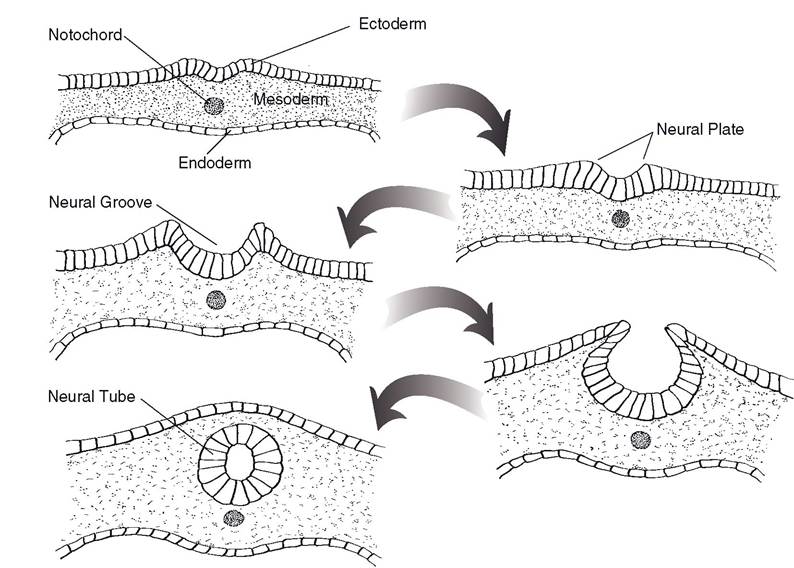
Figure 3-3. Neurulation. Shown in cross-section, the ectoderm overlying the notochord is induced to thicken, forming the neural plate. Differential growth of cells of the neural plate produces a depression, the neural groove. The edges of the neural groove approach one another and fuse, creating the neural tube, the precursor to the spinal cord and brain.
nervous system, constitute the neurectoderm. The lateral edges of the neural plate thicken and grow dorsad, turning the neural plate into a neural groove. The dorsal growth of the edges of the neural groove continues until they meet and fuse, forming the neural tube (Fig. 3-3). The formation of the neural tube proceeds from cranial to caudal, so that the brain develops before the caudal portions of the spinal cord. The lumen of the neural tube persists in the adult as the ventricular system of the brain and the central canal of the spinal cord.