TASTE
1. What is the physiological name.for taste?
2. What is a function of taste in animals?
3. Where are most of the taste buds located?
4. Study the location of taste buds relative to papillae and the glands of von Ebner.
5. To stimulate taste hairs, what part of a taste bud must dissolved substances enter?
6. How are taste substances classified in animals?
7. At what temperature does water rejection occur for poultry?
8. What is meant by a depraved appetite in animals?
The sense of taste is referred to as gustation. The function of taste in animals seems to be one of discrimination; they seem to be able to discriminate between those substances that are healthful and harmful. Also, foods might be sought that contain nutrients that are lacking in the diet.
Taste Reception
The receptor organ for the sense of taste is the taste bud. Most of the taste buds are located on the tongue in association with the various papillae (Figure 5-3A), and some are found on the palate, pharynx, and larynx. A collection of taste buds and their locations relative to a vallate papillus is shown in Figure Figure 5-3B. A taste bud contains gustatory cells and supporting cells (Figure 53C). The gustatory cells are the receptors for taste sensations. A tiny hair arises from each and extends into the pit of the taste bud. The pit communicates with the oral cavity by way of a pore (see Figure 5-3C). Any substance to be tasted must get into solution and enter the pore of a taste bud. The hair of the gustatory cell that extends into the pit is affected in some way so that the gustatory cell is stimulated. The generated impulse is transmitted to the brain by branches of cranial nerves VII and IX (anterior two-thirds and posterior third of the tongue, respectively). The afferent ends of these cranial nerve branches originate at the deep ends of.taste buds and are in intimate contact with the gustatory cells.
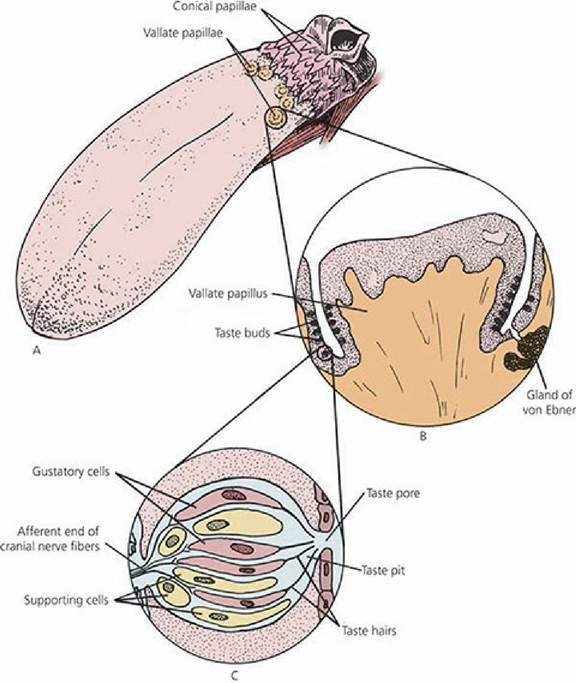
■ FIGURE 5-3 Taste buds associated with papillae on the dog tongue.
A. Fungiform and filiform papillae are represented by the finer dots. Circumvallate and conical papillae are located at the base. B. A vallate papillus with taste buds lining its moat-like furrow. Glands of von Ebner provide a watery secretion for dissolving substances to be tasted. C. A taste bud with its gustatory (taste) cells and supporting cells.The glands of von Ebner (see Figure 5-3B) are embedded deep within the underlying muscle tissue. Their watery secretion is conveyed to the moat-like furrow that surrounds the papillae by excretory ducts,.and the substances to be tasted are dissolved in it.
Taste Sensations
Taste sensations in humans are classified according to verbal reports as being salty, sweet, bitter, or sour. Each taste sensation probably results from some combination of these basic tastes. Much of the current opinion about taste sensations that can be perceived by animals is based on casual observations and folklore.
A common method used to evaluate the sense of taste in animals is the preference test. Accordingly, responses are divided into pleasant, unpleasant, and indifferent. There is considerable individual variation within species. A substance considered to be pleasant by one dog might be regarded as unpleasant or indifferent by others. Similarly, variability of taste exists among pigs in the same litter for the same substances.
Temperature and Taste
In humans the temperature of a beverage or food markedly affects its taste. The effect of water temperature and its acceptance has been studied in domestic fowl. Acceptability of water decreases as its temperature increases above the ambient temperature. Water for domestic fowl that is placed in sunlight soon becomes warmer than the ambient temperature and is rejected. Chickens will suffer from acute thirst rather than drink water that is 5 °C above their body temperature (41 °C), but chickens readily accept water down to the level of freezing. Recognition of these preferences is important for maximum productivity and health in poultry production.
Depraved Appetite
A depraved appetite is recognized in animals when they are seen eating dirt, wood, and other materials not usually considered to be foodstuffs (this is different from similar habits that can develop in some animals). The depraved condition is termed pica. Its exact cause is difficult to determine, but it could be related to certain dietary deficiencies.
■