Passive Changes in Vascular Resistance Result from Changes in Vascular Transmural Pressure
The diameter of blood vessels is a function of the pressure difference between the inside and the outside of the vessel, called the transmural pressure. When the pulmonary blood vessels contain an increased volume of blood, such as during exercise, pressure within the vessels increases.
This leads to an increase in transmural pressure, which causes the vessels to dilate. Transmural pressure can also increase if the pressure surrounding the vessel decreases. This occurs in large pulmonary arteries and veins as the lung inflates. These vessels are contained in the bronchovascular bundle, which is enlarged by the traction of the surrounding alveolar septa during lung inflation (see Chapter 45). Consequently, pressure in the perivascular connective tissue of the bronchovascular bundle decreases. This leads to an increase in transmural pressure, and these extra- alveolar vessels therefore dilate.The overall changes in PVR during lung inflation and deflation reflect opposing effects on alveolar and extra-alveolar vessels. When the lung deflates to residual volume, PVR is high because extra-alveolar vessels are narrowed. As the lung
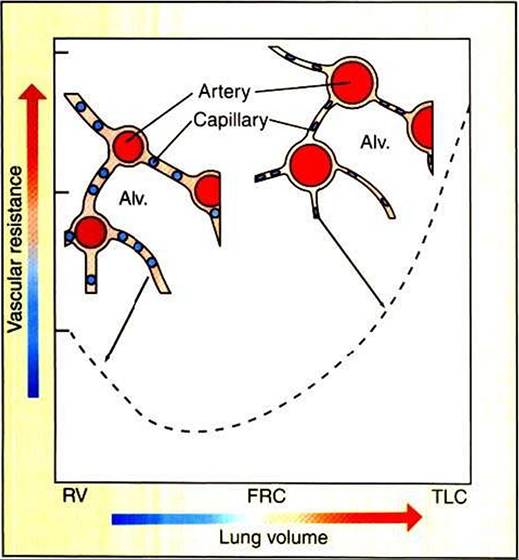
FIGURE 46-5 Change in vascular resistance that occurs with an increase in lung volume.The diagram shows alveolar capillaries (blue) and extra-alveolar vessels, in this case arteries (red). At residual volume (RV) the arteries are narrowed, but the capillaries are distended. At total lung capacity (TLC)1 the arteries are distended, but the capillaries are flattened because of the tension in the alveolar septum. Vascular resistance, which is the sum of the resistance provided by extra alveolar vessels and capillaries, is minimal close to functional residual capacity (FRC). Alv., Alveolus.
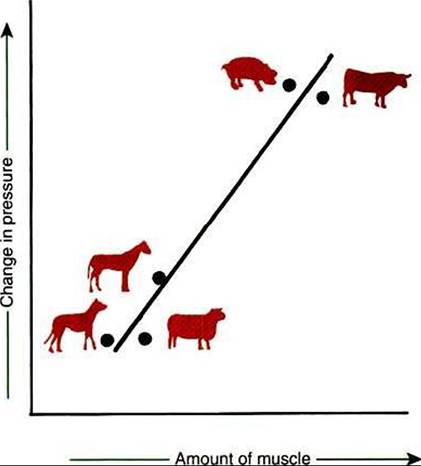
FIGURE 46-6 Relationship between the amount of muscle in the media of small pulmonary arteries and the change in pulmonary arterial pressure when animals are exposed to a hypoxic environment. Animals with thicker muscle layers, such as the cow and pig, have a greater vascular response to hypoxia than do animals with a small amount of muscle in the small pulmonary arteries, such as the dog and sheep. The horse has an intermediate response.
inflates to functional residual capacity, resistance decreases, primarily because of dilation of extra-alveolar vessels. Further inflation above functional residual capacity increases PVR, primarily because alveolar capillaries are flattened by the high tension in the stretched alveolar septa (Figure 46-5). Capillaries become progressively more elliptical and therefore offer more resistance to flow.