The Distribution of Pulmonary Blood FIowWithin the Lung Is Influenced by Several Factors
The understanding of the distribution of blood flow within the Iung was based for many years on experiments performed on isolated, perfused dog lungs suspended vertically to mimic the position of lungs in humans.
Such experiments and measurements in humans indicated that there is a vertical gradient of perfusion, with blood flow per unit lung volume increasing from the top to the bottom of the lung. Elegant models that considered pulmonary arterial, pulmonary venous, and alveolar pressures were proposed to explain gravity-dependent distribution of blood flow.Although this description of gravitational zones has traditionally provided a good theoretical basis for understanding the effects of pressures on blood flow, its applicability to quadrupeds is now in doubt. Gravity is probably not the major factor determining distribution of blood flow in quadrupeds, particularly during exercise. There appears to be gravityindependent, preferential distribution of blood flow to the dorsocaudal region of the lung of standing quadrupeds (Figure 46-4). This distribution is accentuated by exercise and may even persist in animals under anesthesia. It is most likely that the branching pattern of pulmonary arteries and arterioles and the relative resistances of each vessel are the major determinants of blood Ilow distribution.
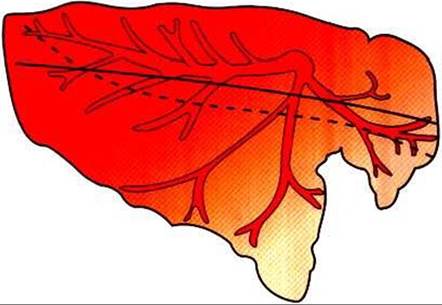
FIGURE 46-4 Graphic representation of the distribution of pulmonary blood flow in the horse's lung. Relative blood flow is indicated by the intensity of the red shading. Blood flow distribution in a dorsal-caudal direction at rest and during exercise is shown by the solid and broken lines, respectively. (Compiled from data in Hlastala MP, Bernard SL, Erikson HH, et al: Pulmonary blood flow distribution in standing horses is not dominated by gravity, JAppI Physiol 81:1051, 1996.)