Passive Transport Occurs Either Through Ion Channels in Cell Membranes or Directly Through the Tight Junctions
Ion channels, which are protein constituents of cell plasma membranes, are the transport pathways of passive diffusion
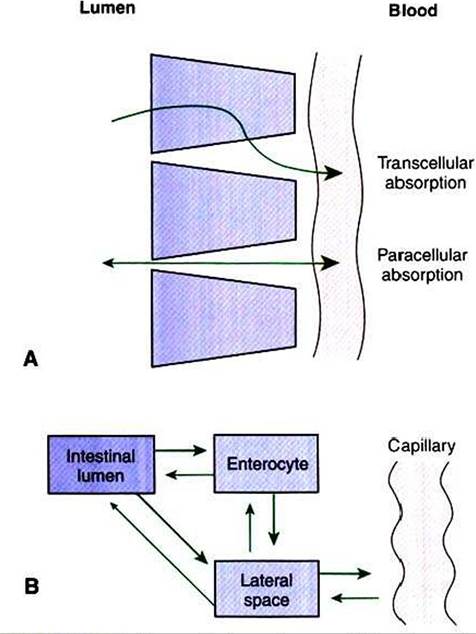
FIGURE 30-15 Transcellular and paracellular absorption.
A, Substances move from the intestinal lumen to the capillary by either transcellular (through the enterocyte) or paracellular (through the tight junction) absorption. Bz Intestinal Iumenz enterocytesz and lateral spaces form three separate pools that may contain nutrients in different concentrations. Note that nutrients move into the capillaries from the lateral spaces and that reverse transport (from the capillary to the intestinal lumen) is possible for some substances.into cells. Ions move through the channels in a completely passive manner, responding only to electrochemical gradients. No metabolic energy is directly required to effect ion movement. The only regulatory influence the cell can exert over this form of transport is in opening or closing of the channels (see Chapter I).
A second form of passive molecular movement through the intestinal epithelium is through the tight junctions. As previously mentioned, the “tight” junctions are not so tight, especially in the duodenum and upper jejunum. In these areas the tight junctions are freely permeable to water and small, inorganic ions. Thus, water and ions move across the tight junctions in response to osmotic pressure and electrochemical gradients. Movement of materials through the tight junctions is called paracellular (around the cells) absorption, in contrast to absorption through the apical membrane, which is called transcellular (through the cells) absorption. Transcellular absorption and paracellular absorption work in a complementary manner to produce an efficient absorptive process (Figure 30-15).