Peripheral Chemoreceptors Are the Only Receptors Monitoring Blood Oxygen Levels
Chemoreceptors are located at several sites in the body. Peripheral chemoreceptors are the carotid and aortic bodies, and their removal eliminates the respiratory response to hypoxia.
The response to CO2 levels persists because these are also detected by a central chemoreceptor. Changes in pH are detected by both the peripheral chemoreceptors and the central chemoreceptor.The carotid bodies are located close to the bifurcation of the internal and external carotid arteries, and the aortic bodies are located around the aortic arch. The latter appear to be most active in the fetus and of little importance in the adult. The aortic bodies are supplied by the vagus nerve, and the carotid bodies are supplied by a branch of the glossopharyngeal nerve. Fibers within the nerves supplying the peripheral chemoreceptors are primarily afferent, with a few parasympathetic and sympathetic efferent fibers to blood vessels.
The carotid bodies are small, pink nodular structures with extremely high blood flow per gram. This high blood flow/ metabolism ratio allows the carotid bodies to obtain their oxygen needs from dissolved oxygen. Consequently, there is only a small arteriovenous difference in oxygen tension (Po2) across ’.he carotid bodies and no difference in hemoglobin saturation.
Carotid bodies contain several cell types. Type I cells, or glomus cells, synapse with afferent nerves that transmit information back to the brain. These glomus (or glomerular) cells contain a variety of neurotransmitters, including catecholamines, especially dopamine. Glomus cells are probably responsible for the chemosensitivity of the carotid bodies because they depolarize when Po2 decreases. Alternatively, they may modify the chemosensitivity of the afferent nerve terminals. Type II cells, or sustentacular cells, support the axons and blood vessels that ramify within the carotid body.
When the carotid bodies are perfused with blood that has a low Po2, high carbon dioxide tension (Pco2), or low pH, firing rates in the carotid sinus nerve afferent fibers increase. As Pco2 increases and pH decreases, there is an almost linear increase in ventilation. The response to Po2 is nonlinear. Modest increases in firing rate and ventilation occur as Po7 decreases from non physiological levels of 500 to 70 mm Hg. Further decreases cause a more rapid increase in ventilation, particularly at a Po2 of less than 60 mm Hg, which is the Po2 level at which hemoglobin begins to desaturate (Figure 49-3). Ventilation does not increase in response to either modest anemia or carbon monoxide (CO) poisoning, conditions that decrease the oxygen content of blood but not Pao2. This is because Po2 is more important than oxygen content as a stimulus to the carotid bodies.
Figure 49-4 shows possible mechanisms of chemosensitivity of the carotid bodies. Glomus cells are depolarized by hypoxemia. Depolarization involves potassium (Kt) channels and leads to an increase in intracellular calcium (Cai2+). The latter causes release of neurotransmitters, primarily dopamine and acetylcholine, which activate the afferent nerve terminals.
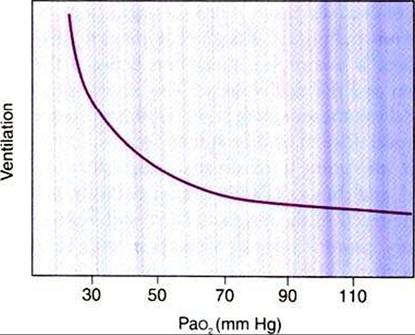
FIGURE 49-3 Effect of arterial oxygen tension (Pao2) on Ventilation-Ventilation does not increase much until Pao2 is less than 65 mm Hg.
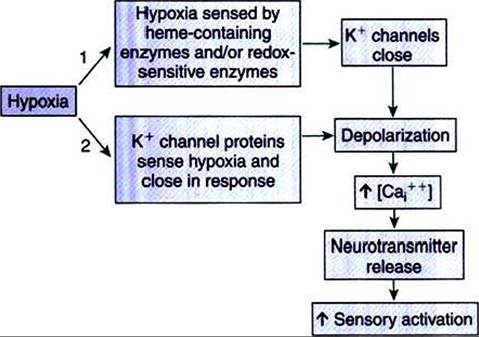
FIGURE 49-4 Hypothesized mechanisms of chemosensitivity in the carotid body. 1, Hypoxia is sensed by enzymes in the glomus cell, leading to closure of potassium (K+) channels, depolarization, and neurotransmitter releases. 2, Hypoxia is sensed directly by potassium channels, causing their closure. (Modified from Prabhaker NR: Oxygen sensing by the carotid body chemoreceptors, J Appl Physiol 88:2287, 2000.)
Hypercapnia (elevated Pco2) and changes in blood pH also may release neurotransmitters by decreasing the pH in the glomus cells*