Protein Hormones Are Initially Synthesized as Preprohormones and Then Cleaved in the Rough Endoplasmic Reticulum to Form Prohormones and in the Golgi Apparatus to Form the Active HormonesfWhich Are Stored in Granules Before Being Released by Exocytosis
The major classes of hormones include proteins (e.g., growth hormone, insulin, corticotropin [previously called adrenocorticotropic hormone, or ACTHJ); peptides (e.g., oxytocin and vasopressin); amines (e.g., dopamine, melatonin, epinephrine); and steroids (e.g., cortisol, progesterone, vitamin D).
The protein and peptide hormones are initially synthesized on ribosomes as larger precursor proteins, which are referred to as preprohormones (Figure 33-3). Synthesis of protein hormones begins in ribosomes, with the “pre” portion immediately attaching to the rough endoplasmic reticulum (RER), which pulls the ribosomes into close apposition with the RER. During synthesis, the preprohormone is secreted into the interior of the RER. The presence of a peptidase within the wall of the RER allows the “pre” portion of the molecule to be rapidly removed and the prohormone to leave the RER in vesicles that have been pinched off from the RER. These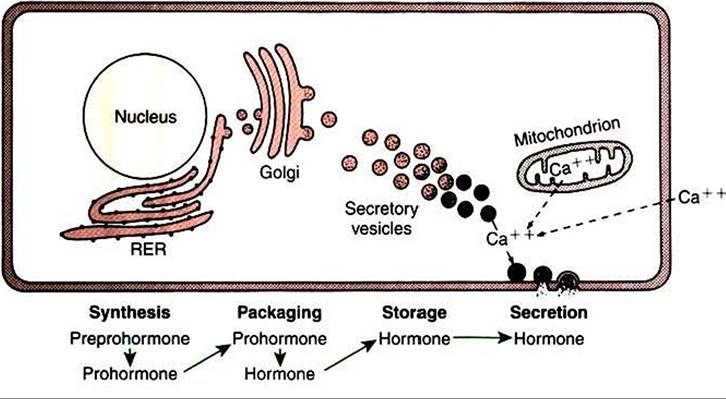
FIGURE 33-3 Subcellular components of peptide hormone synthesis and secretion. RER, Rough endoplasmic reticulum. (From Hedge GA, Colby HD, Goodman RL: Clinical endocrine physiology, Philadelphia, 1987, Saunders.)
vesicles then move to the Golgi apparatus, where they coalesce with Golgi membranes to form secretory granules. The prohormone is cleaved during this process, so most of the hormone is in its final form within the Golgi apparatus, although some prohormone can also be found.
Protein hormones are stored in granules within the gland until needed for release. Although some of the hormone is secreted on a continuous basis, most is secreted through the process of exocytosis of granules in response to a specific signal. The process of exocytosis requires adenosine triphosphate (ATP) and calcium (Ca2+). Increased Qloplasmic calcium results from intracellular release of Ca2+ from mitochondria, or endoplasmic reticulum, or from the influx of extracellular Ca2∖