Puberty Is the Time at Which Animals First Release Mature Germ Cells
In order for females to begin reproductive cycles, they must undergo a process called puberty. The term puberty is used to define the onset of reproductive life. For the female, although the onset of sexual activity (in domestic animals) or first menstrual bleeding (in primates) is often used as the onset of puberty, the most precise definition is the time of first ovulation.
For all species, there is a critical requirement for the attainment of a certain size in order for puberty to be initiated, in cattle about 275 kg, for example, and in sheep about 40 kg (Figure 37-3). If this critical requirement is not met because of inadequate nutrition, puberty is delayed. The age at puberty for domestic animals is as follows: cats, 6-12 months; cows, 8-12 months; dogs, 6-12 months; goats, 7-8 months; horses, 12-18 months; and sheep, 7-8 months. Classically, bitches have attained 75% of their adult size before puberty occurs.The physiological mechanisms involving control of puberty in domestic animals are best known in sheep. One of the fundamental concepts of the onset of puberty involves an increase in the synthesis and release of gonadotropin-releasing hormone (GnRH) from the hypothalamus, which drives gonadotropin secretion (in pulsatile form) and follicle growth. Before puberty, GnRH and gonadotropin secretion are kept in check because the hypothalamus is highly sensitive to negative-feedback inhibition by estrogens. One of the keys to puberty in lambs is a maturation of the hypothalamus, which results in reduced sensitivity to negative feedback by estrogen. Puberty onset is not held back because of lack of responsiveness of the prepubertal gonads, because ovarian follicle development can be elicited by gonadotropin administration.
Changes in photoperiod are important for allowing lambs to enter puberty. It has been shown that lambs must have some exposure to a long photoperiod during their prepubertal development; the period can be as short as 1 to 2 weeks (under experimental conditions).
Termination of the long photoperiod, which occurs with the summer solstice, allows the sensitivity of the hypothalamus to decrease in response to negative estrogen feedback. The minimal interval from the end of the long photoperiod exposure to the onset of puberty is 10 weeks under experimental conditions. This aspect agrees well with the timing of spontaneous puberty, in which the first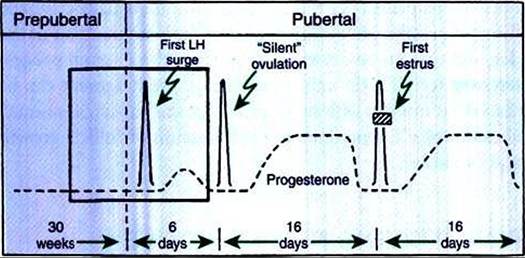
FIGURE 37-4 Schematic overview of major events during the transition into adulthood in the female sheep. LHt Luteinizing hormone. (From Foster D, Ryan K: Mechanisms governing onset of ovarian cyclicity at puberty in the lamb, Ann Biol Anim Bioch Biophys 19:1369, 1979.)
ovulation often occurs in the latter part of September, or about 13 weeks from the occurrence of the summer solstice. Note that this concept of the initiation of puberty does not involve decreasing photoperiod; the emphasis is on a turning point that involves the cessation of exposure to a long photoperiod (see Figure 37-7).
With appropriate growth and photoperiod exposure, the secretion of gonadotropins in Iambs causes significant follicle growth. This growth is maintained because of decreased sensitivity of the hypothalamus to estrogens produced by growing follicles. I he first endocrine event of puberty in the ewe lamb is the appearance of a preovulatory-type surge of gonadotropins, presumably induced by estrogens produced by developing follicles (Figure 37-4). The gonadotropin surge results in the production of a luteal structure, through luteinization of a follicle(s), which has a short life span, 3 to 4 days. After the demise of the initial luteal structure, another gonadotropin surge occurs, leading to ovulation and the formation of a CL, usually of a normal life span. At this time, cyclical ovarian activity is finally initiated in the ewe lamb.
Photoperiod can have a suppressive effect on the timing of puberty in animals whose ovarian cyclicity is controlled by light.
Kittens born in the spring may be large enough to enter puberty by late autumn, but puberty could be delayed a few months if the kittens are under the natural photoperiod.Photoperiod influences the timing of puberty onset in macaque monkeys, depending on the physiological maturity of the individual. The first ovulation, or puberty onset, can occur during the late autumn or early winter, at about 30 months of age (20% of animals) or 12 months later at about 42 months of age (80% of animals). The animals undergoing puberty at about 30 months have an earlier maturation of the neuroendocrine system, in which significant gonadotropin secretion begins during the previous spring. Thus, there is a window of opportunity for the onset of puberty in macaques that must be entered within the favorable photoperiod of decreasing light if puberty is to occur at an earlier time; nutrition and growth are likely determinants of the earlier time for onset of puberty.
The onset of puberty usually results in the establishment of cyclical ovarian activity within a relatively short period (i.e., within a few weeks to a month in lambs). Ewe lambs can initiate normal ovarian activity at the onset of puberty, which can lead to pregnancy (if mated) at the first estrus, or they can have false starts with the establishment of limited luteal phases and cessation of ovarian activity for several weeks to a month before they resume ovarian activity. In general, the onset of ovarian cyclicity starts later and ends earlier for ewe lambs compared with adults of the same breed. The earlier cessation of ovarian activity results from an earlier response to negative estrogen feedback.
The initiation of cyclical ovarian activity in pubertal primates takes longer; the first significant follicle growth usually ends in ovulatory failure. In macaque monkeys, 3 to 6 months is usually required after the onset of menarche, or first vaginal bleeding, before the occurrence of the first ovulation of puberty.
In humans, follicle growth without ovulation can occur for up to a year before the establishment of normal ovarian cyclicity, including ovulation and CL formation.For male lambs, the onset of puberty is first keyed when lambs begin to lose their sensitivity to estrogen feedback inhibition, usually by about 15 weeks of age. For many males, this occurs during the period of increasing, or long, photoperiod, which is in contrast to the ewe lamb. Spermatogenesis (process of sperm production resulting in the presence of mature sperm) usually begins at this time, but because of the length of the process, lambs are usually not capable of successful breeding until about 30+ weeks of age, or in concert with the onset of puberty in ewe lambs. Thus, puberty is a relatively gradual phenomenon in male sheep compared with the abrupt process in females.
Because adult ewes experience the same double gonadotropin surge at the onset of the breeding season, it has been suggested that adult animals recapitulate puberty each year as they enter the breeding season. Recent studies in adult ewes, however, indicate that refractoriness to the long photoperiod experienced by animals during the spring and summer is the most critical aspect for the establishment of ovarian activity. Thus the concept that the renewal of ovarian activity in sheep recapitulates puberty appears not to be accurate, at least in some aspects.