The Two Types of Reproductive Cycles Are Estrous and Menstrual
Two types of reproductive cycles are recognized, estrous and menstrual, with the term ovarian cycle representing the interval between two successive ovulations. These terminologies have developed in order to use certain external characteristics for accurately identifying a particular stage of the reproductive cycle and, most importantly, relating it to the time of ovulation.
In domestic animals, which have limited periods of estrus (or sexual receptivity), the term estrous cycle is used, and the onset of proestrus defines the start of the cycle (Figure 37-1). In primates, which are sexually receptive during most of the reproductive cycle, the term menstrual cycle is used, with the onset of menstruation (vaginal discharge of blood-tinged fluids and tissues) designated as the start of the cycle (Figure 37-2). The first day of the cycle for both estrous and menstrual cycles in many species begins shortly after the end of the luteal phase. In the dog a normal anestrous period, lasting approximately
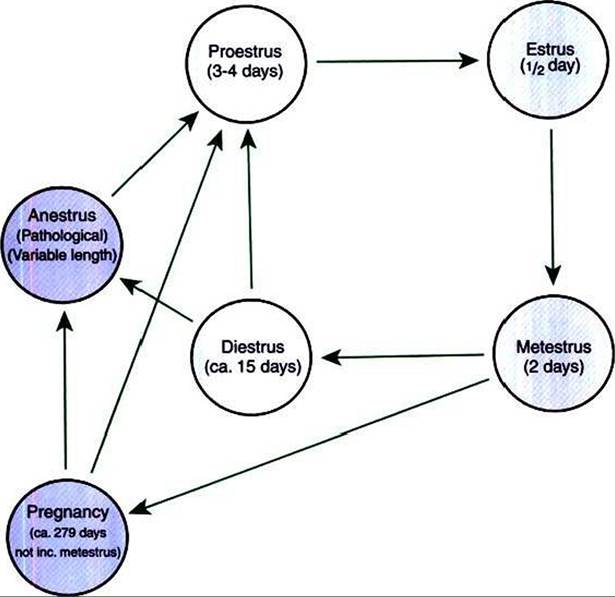
FIGURE 37-1 Various stages of the ovarian cycle of the cow. (From McDonald LE, Pineda MH, editors: Veterinary endocrinology and reproduction, ed 4, Philadelphia, 1989, Lea & FebigerJ
3 months, separates diestrus and proestrus (the stages of the cycle are described later).
In domestic animals, proestrus usually begins within 48 hours after the end of the luteal phase; the dog and pig are exceptions, with proestrus in the pig not occurring for 5 to 6 days. In primates, menstruation usually begins within 24 hours of the end of the luteal phase. Even though both
cycles begin at the same time in relation to the luteal phase (shortly after), the time of ovulation differs. This is because, as previously discussed, luteal and follicular phases are separated in primates, with ovulation occurring at a minimum of 12 to 13 days after the onset of menses.
In most domestic animals the follicular phase overlaps the luteal phase, and therefore ovulation occurs relatively earlier in the estrous cycle. Ovulation is easier to predict in domestic animals (vs. primates) because estrus is usually tightly coupled to the preovulatory release of gonadotropins and ovulation. The onset of follicular development in primates can be delayed for a variety of reasons (e.g., stress), making the time of ovulation less predictable for primates than for domestic animals.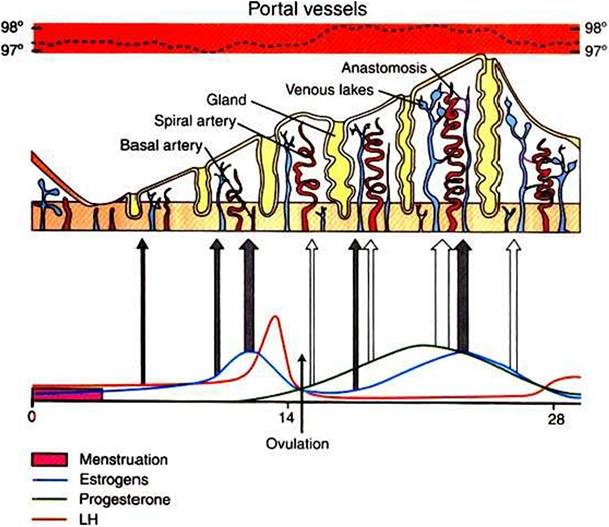
FIGURE 37-2 Changes in human endometrium during the menstrual cycle. Underlying steroid changes are indicated below, and basal body temperature is indicated above.Thickness of arrows (estrogens shaded; progestogens white) indicates strength of action. LH, Luteinizing hormone. (From Johnson M, Everitt B, editors: Essential reproduction, ed 3, London, 1988, Blackwell Scientific.)
The estrous cycle has been classically divided into stages that represent either behavioral or gonadal events (see Figure 37-1). The terminology, originally developed for the guinea pig, rat, and mouse, is as follows:
■ Proestrus: period of follicle development, occurring subsequent to luteal regression and ending at estrus.
■ Estrus: period of sexual receptivity.
■ Metestrus: period of initial development of the corpus Iuteum (CL).
■ Diestrus: period of mature phase of the CL.
The classic terminology is not particularly useful for domestic animals. The common terminologies used for domestic animals involve either behavioral or gonadal activity. The cycle can be described in a behavioral manner by indicating whether animals are in estrus (sexually receptive) or not, including the stages of proestrus, metestrus, and diestrus. The cycle can also be described with reference to the activity of the gonads if differentiation of follicles and the CL is possible.
Animals can be in the follicular phase (proestrus and estrus) or the luteal phase (metestrus and diestrus).Because the equine CL is relatively difficult to identify by palpation per rectum, horses are usually classified by sexual behavior: estrus or nonestrus. The behavioral classification is also used in other domestic species, including the goat, pig, and sheep, because of the difficulty of determining their ovarian status. The ovarian status of cattle can be determined accu-
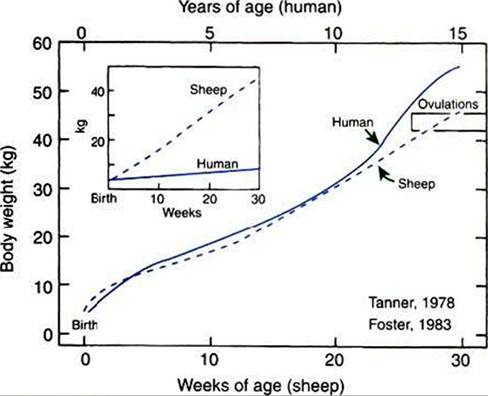
FIGURE 37-3 ■ Body weight from birth through the initiation of ovulation for sheep (mean) and humans (50th percentile). Inset shows absolute growth during the first 30 weeks. (From Foster DL, Karsch FJ, Olster DH, et al: Determinants of puberty in a seasonal breeder, Rec Prog Horm Res 42:331, 1986.)
rately by palpation per rectum, and cows are usually classified by ovarian status: follicular or luteal. The ovarian status of the dog and cat can be determined by measuring serum progesterone levels. If a CL can be identified, the judgment can be made that ovarian activity is normal in the particular animal, because the CL represents the culmination of follicle growth and ovulation.