Sexual Organization of the Genitalia and Brain Depends on the Presence or Absence of Testosterone
The development of the genital tubular system and the external genitalia is under the control of the developing gonad. If the individual is female—that is, the developing gonad is an ovary—the miillerian duct develops into oviduct, uterus, cervix, and vagina, whereas the wolffian duct regresses; the absence of testosterone is important for both changes (Figure 35-2).
If the individual is male, the rele testis produces miillerian-inhibiting factor, which causes regression of the miillerian ducts. The wolffian duct is maintained in the male because of the influence of androgens produced by the testis. To summarize, the miillerian ducts are “permanent” structures, and the wolffian ducts are “temporary” structures unless acted on by the presence of male hormones. The presence of an enzyme, 5α-reductase, is important for the effect of the androgens because testosterone must be converted intracellularly into dihydrotestosterone for masculinization of the tissues to occur. The use of synthetic 5α-reductase inhibitors for the treatment of benign prostatic disease in humans is contraindicated without concurrent birth control measures, because disorders of sexual development in male fetuses can occur.Development of the external genitalia follows the development and direction of the gonads. If the individual’s genotype is female, folds of tissue called labia form the vulva, and a
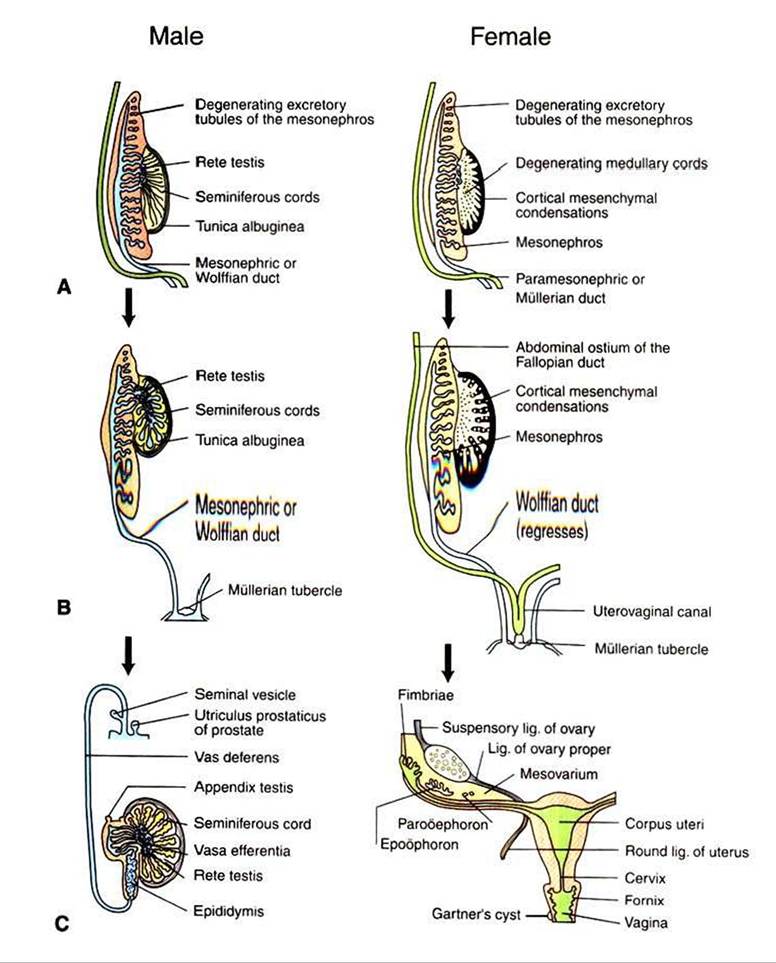
FIGURE 35-2 Differentiation of the internal genitalia in the human male and female at A, the sixth week of gestation, B, the fourth month of gestation, and C, the time of descent of testis and ovary. Note that the miillerian and wolffian ducts are present in both genders early on; the miillerian ducts eventually regress in the male and persist in the female, and the wolffian ducts regress in the female and persist in the male.
The appendix testis and utriculus prostaticus in the male and epoophoron, paroophoron, and Gartner's cyst in the female are remnants of the degenerated miillerian and wolffian ducts, respectively. Lig., Ligament. (From Johnson M, Everitt B, editors: Essential reproduction, ed 3, London, 1988, Blackwell Scientific.)clitoris develops. If the individual is male, androgens from the testis direct formation of the penis (male counterpart of the clitoris) and the scrotum (male counterpart of the labia). Again, the absence or presence of androgens is an important factor influencing the formation of external genitalia.
The final organization of the individual with regard to gender comes with sexual differentiation of the hypothalamus. Exposure of the hypothalamus to androgens at about the time of birth causes the hypothalamus to be organized as male. A paradoxical finding is that conversion (aromatization) of androgens to estrogens is essential for maleness, mediated by enzymes in the neural tissue. In the absence of androgens, the hypothalamus is organized as female.
The fundamental concept of organization of the reproductive system with regard to genotype is that the female system is organized in the absence of testes. If the individual is to be male, there must be active intervention by the testes through the production of androgens and appropriate tissue enzymes
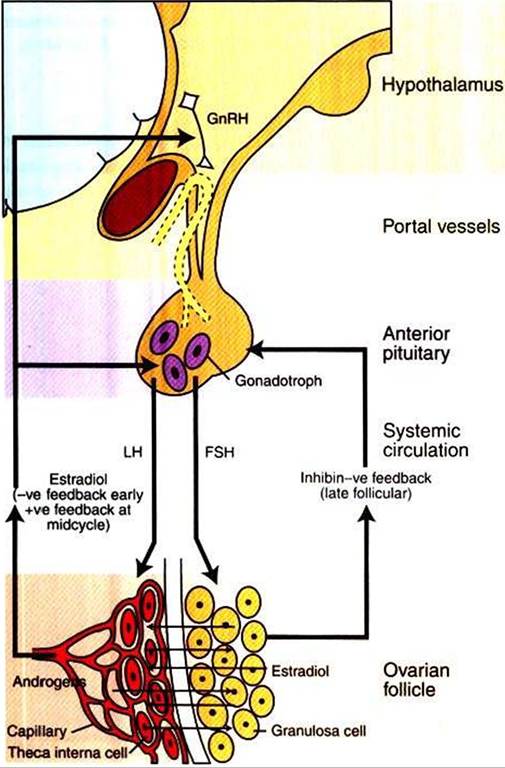
FIGURE 35-3 Summary of hypothalamic-pituitary-ovarian interactions during the follicular phase of the cycle. FSH, Follicle-stimulating hormone; GnRH, gonadotropin-releasing hormone; LH, luteinizing hormone; -ve, negative; +ve, positive. (From Johnson M, Everitt B, editors: Essential reproduction, ed 3, London, 1988, Blackwell Scientific.)
in two circumstances: (1) within the internal genitalia for conversion to more potent androgens, and (2) within the hypothalamus for conversion to estrogens.