SKELETAL SYSTEM
Bone structure
The mammalian haversian bone system allows for rapid remodeling of bone and the capacity for speedy transfer of calcium from plasma to bone. Such systems are lacking in lizards and snakes and are restricted to only certain cortical areas in crocodiles and chelonians (Enlow 1970).
Therefore, remodeling is less a feature of bone healing in reptiles with less periosteal new bone. Bone healing is also much slower and it can take 6 to 30 months for full bone union.Reptiles
22
Calcium / phosphorus
The bone contains about 99% of the body's calcium store (Boyer 1996). Plasma calcium must be maintained for vertebrate neuromuscular function so that, when ionized calcium drops, parathyroid hormone (PTH) increases and acts on bone to produce calcium and phosphorus. It also increases phosphorous excretion and stimulates further absorption of cholecalciferol from the small intestine. When plasma calcium levels are high calcitonin antagonizes PTH and stops calcium resorption from bone.
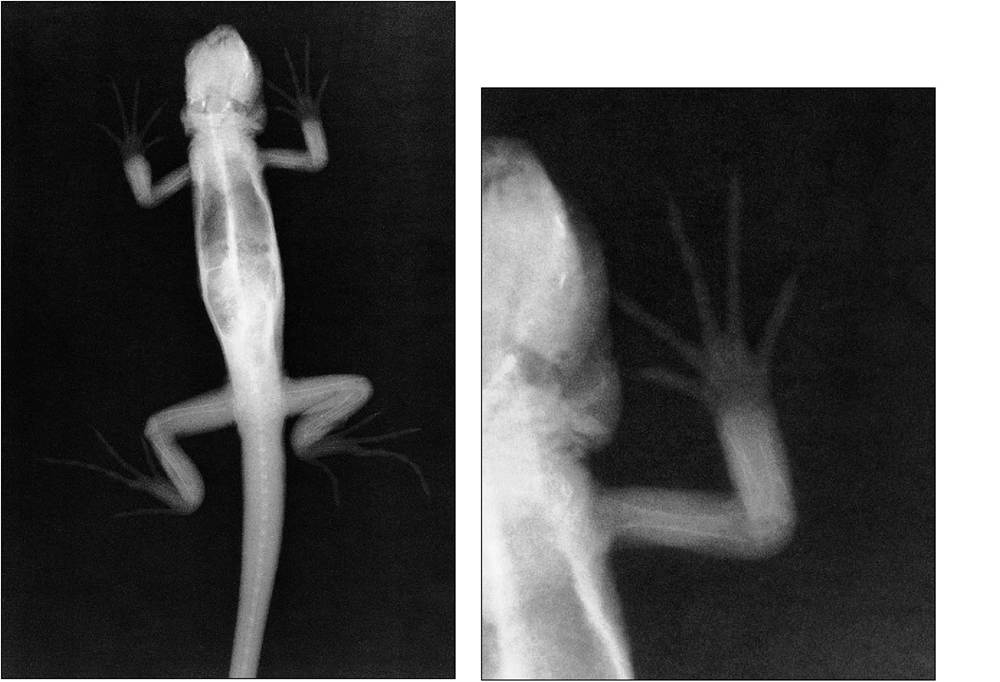
Nutritional osteodystrophies (metabolic bone disease) develop if the dietary input of calcium in captivity is not sufficient to replenish the bone reservoirs (Figs. 2.5 and 2.6). Reptiles have a Ca/P ratio of 2:1 but as they are commonly fed a diet rich in meat or insects, which have an inverse Ca/P ratio, metabolic bone disease is common. Herbivore diets are also low in calcium and phosphorus. Adult snakes that eat whole vertebrate prey rarely suffer from this problem, although it can be seen in juveniles (Boyer 1996).
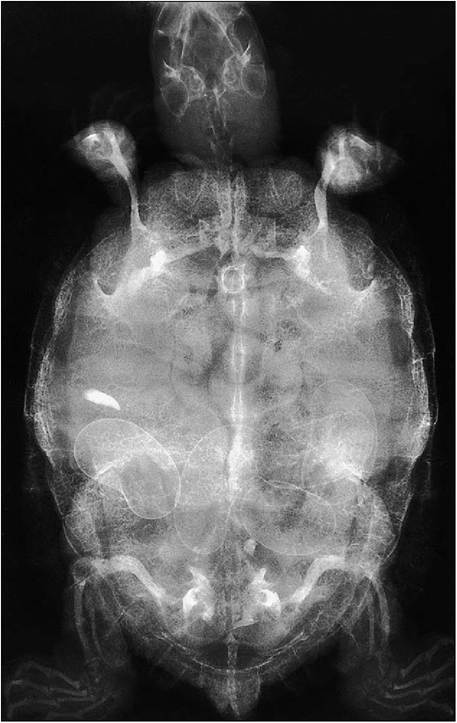
Figure 2.5 • Nutritional osteodystrophy (commonly called metabolic bone disease) in a Red-eared slider (Trachemys scripta elegans) fed a calcium deficient diet of prawns and chicken. The shell and limb girdles are severely demineralized with coarse bone trabeculae and there are thin- shelled and misshapen eggs (compare with shell in Fig.
3.14).Reptile growth
In reptiles such as chelonians, snakes, and crocodiles the epiphyses never close so there is no skeletal maturity and some species keep growing all their lives. Lizards, however, do have secondary centers of ossification, like mammals, although these occur at a much later stage (Bellairs 1969a; Haines 1970). The rate of growth is much more variable than in mammals and will depend on food supplies, temperature and other environmental factors. Some reptiles, like pythons, can growth at a phenomenal rate in the early growth years.
Skull
The reptile orders have been classified into two subclasses based on the presence or absence of openings (fenestrae) in the temporal region of the skull (Fig. 2.7). These lie behind the eyes and provide better attachment points for the jaw musculature.
Chelonians belong to the subclass Anapsida (without arches) because they lack true temporal openings. However, many species do have gaps in the temporal region that provide a pseudotemporal fossa for muscle attachments. The tuatara, crocodiles and squamates all belong to the subclass Diapsida. Crocodiles and the tuatara have a true diapsid skull with a dorsal and lateral opening. Lizards have only one dorsal opening while snakes have an even more modified diapsid skull, having completely lost the upper temporal arch between the two openings (Bellairs 1969b; Carroll 1979; Pough 1998f). This has enabled the quadrate bone to move backwards and forwards in a condition called streptostyly.
Reptiles, like birds, have a cranial kinetic skull enabling the mouth to gape wide and this is highly developed in the snake where the jaw can literally walk along the prey being devoured. Lizards and crocodiles also have powerful snapping jaws. This is achieved by the adductor jaw muscles (Fig. 2.8) which arise from the temporal fossae and insert at right angles to the open jaw (King 1996b; King & Custance 1982).
Vertebrae
Reptiles do not need a rigid backbone to support the weight between their limbs as they normally have their belly on the ground; instead, flexibility of the spine is most important.
As reptiles have no diaphragm, and consequently no division between the thorax and abdomen, the terms thoracic and lumbar are redundant. Instead, the backbone can be divided into a presacral, sacral and caudal region. The number of presacral vertebrae varies from 24 in some lizards, 18 in Chelonia to 200-400 in snakes (Hoffstetter & Gasc 1970). The epaxial muscles lie dorsally while the hypaxial muscles are usually lodged ventrally and between the ribs.
The atlas and axis are more rigidly connected together than in mammals so the main center of movement is between the single occipital condyle and the backbone. Apart from
Reptiles
23
Figure 2.6 • Nutritional osteodystrophy in a juvenile Green iguana (Iguana iguana). The bone cortices are thin and shell-like with complete demineralization of such extremities as the feet and transverse processes of the tail (see close up of right foot and compare with normal skeleton in Fig. 4.12).
in Chelonia the ribs are well developed and, in addition to supporting the body wall, they perform the function of respiration and locomotion (Bellairs 1969a; Hofstetter & Gasc 1970).