CARDIOVASCULAR SYSTEM
The typical heart of snakes, lizards or chelonia has three chambers (two atria, one ventricle) whereas crocodiles have a 4-chambered heart. The right atrium receives deoxygenated blood from the systemic circulation via the sinus venosus.
This is a large chamber that receives blood from the right and left cranial vena cava and left hepatic vein. There are also two aortae. The left aorta gives rise to a celiac, cranial mesenteric, and left gastric artery before uniting with the right aorta caudal to the heart. A renal portal system is also present (see Urinary system).Although reptiles have only one ventricle it has three subchambers: the cavae venosum, arteriosum and pulmonale. Although there is no permanent division, the anatomical arrangement of the two atria, atrioventricular (a-v) valves, a muscular ridge, and the three subchambers creates a pressure differential. This, combined with the timing of ventricular contractions, means oxygenated and deoxygenated blood never actually mixes in the reptile heart (King & Custance 1982; Murray 1996a; White 1976).
The right atrium opens into the cavum venosum which gives rise at its ventral aspect to the paired aortas. The left atrium receives blood from the lungs via the left and right pulmonary vein and empties into the cavum arteriosum. The cavum pulmonale is the equivalent of the right ventricle in mammals and opens into the pulmonary artery. A muscular ridge partially separates this compartment from the cavum venosum and can redirect the blood flow (Pough et al. 2002a).
Normal intracardiac blood flow
Deoxygenated blood flows from the right atrium into the cavum venosum while oxygenated blood flows into the left atrium and cavum arteriosum. When the atria contract the a-v valves hinge medially to direct the flow of deoxygenated blood from the cavum venosum into the cavum pulmonale.
When the ventricle contracts blood flows into the pulmonaryReptiles
24
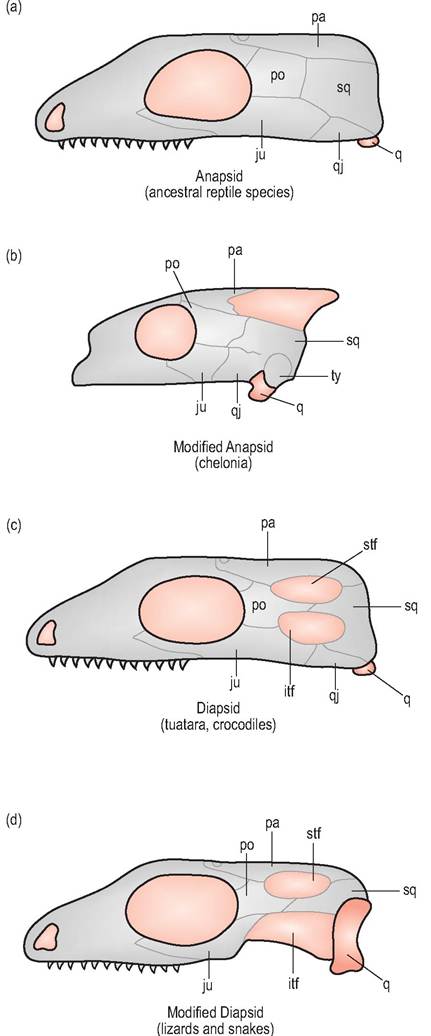
q = quadrate bone pa = parietal bone sq = squamosal bone po = post orbital stf = superior temporal fossa itf = inferior temporal fossa ju = jugal bone qj = quadratojugal ty = tympanic fossa
Figure 2.7 • Diagram of skull.
(a) Anapsid (ancestral reptile species)
(b) Modified anapsid (chelonians)
(c) Diapsid (tuatara, crocodiles)
(d) Modified diapsid (lizards, snakes)
artery. The a-v valves close over allowing the oxygenated blood from the cavum arteriosum to flow into the cavum venosum and out into the aortic arches. The muscular ridge between the cavum pulmonale and cavum venosum prevents mixing of blood (Pough et al. 1998d, 2002a; White 1976).
Blood shunting
The circulation can be shunted depending on pulmonary resistance. During peak respiratory activity pulmonary resistance is low so deoxygenated blood flows through the pulmonary arch to the lungs while oxygenated blood travels systemically.
In reptiles, which routinely experience periods of oxygen starvation (e.g., when turtles dive or snakes swallow large prey), the muscular ridge and a-v valves can divert blood away from the pulmonary circulation, where it is not needed, into the aortic arches and the systemic circulation. This right to left intracardiac shunt reduces blood flow to the lungs. This means less oxygen will be lost from the circulation and blood pressure will not drop as it passes through the capillaries of the lung.
Control of shunting
Shunting of blood is controlled by the differences in pressure between the pulmonary circuit and the systemic one. Normally the lungs provide little resistance to flow and the valves open first so blood flows through the lungs. However, during diving or apnea, vasoconstriction in the pulmonary arteries increases pulmonary resistance so blood is consequently shunted away from the lungs to the systemic circulation (Pough 1998d; White 1976).
Heart rate
Heart rate varies with temperature, body size, respiration and stress. Larger sized reptiles have lower heart rates. It can also vary with activities like diving or breathholding (Murray 1996a). The Red-eared slider (Trachemys scripta) normally sends 60% of its blood flow to the lungs but while diving the majority of blood bypasses the lungs and enters the systemic network via the aortic arches. The heart rate slows down and total cardiac output falls. When the animal surfaces this is rapidly reversed in the first post-dive breath. (White 1976). This state can also occur even in terrestrial reptiles during apnea. Tortoises have been recorded to breathhold for 33 hours and even lizards like the iguana can breathhold for 30 minutes under water to escape predators (Pough et al. 1998d; White 1976).
Blood volume
The normal blood volume is approximately 5 to 8% of body weight. In a healthy reptile about 10% of this could be safely taken for blood sampling. The time of year, sex, and environment play a major role in hematological and biochemical blood parameters.
Blood cells
25
Reptile erythrocytes are nucleated and the lower metabolic rate of reptiles means they have a longer life span than mammals and birds (Bellairs 1969c; Campbell 1996). The hematocrit (average 20-35%) does not vary with high altitudes or hypoxia, as it does in mammals, but varies instead with temperature and season.
The white blood cells include heterophils (the equivalent of mammalian neutrophils), eosinophils, basophils, lymphocytes, and monocytes. Azurophils are unique to reptiles - they are similar to monocytes but have a red-purple cytoplasm and are a feature particularly of snakes (Campbell 1996; Redrobe & MacDonald 1999).
ADVANTAGES OF INTRACARDIAC SHUNTING
CLINICAL NOTE
• Ability to breath-hold while diving or inside shell
• Thermoregulation
• Stabilization of oxygen levels during intermittent breathing Reptile erythrocytes are susceptible to lysis by EDTA anticoagulant. Lithium heparin is better for preventing clotting and preserving cell morphology, although fresh blood smears should always be made as well.
CLINICAL NOTE
The ability of reptiles to divert blood away from the lungs via right to left shunts presents problems for anesthesia. It may also mean that chronic pneumonia or lung damage, which increase lung resistance, may also divert blood away from where it is most needed.
More on the topic CARDIOVASCULAR SYSTEM:
- Bibliography
- CARDIOVASCULAR SYSTEM
- Two Modes of Transport Are Used in the Cardiovascular System: Bulk Flow and Diffusion
- Section VI—Cardiovascular System
- ANATOMY OF THE CARDIOVASCULAR SYSTEM
- Abstract
- CONCLUSION
- CARDIOVASCULAR SYSTEM
- Cardiovascular System
- Specific Diseases of the Cardiovascular System