SMELL
1. What is the physiological name for smell?
2. Where are the nerve cell bodies for smell located?
3. Why do dogs have a better sense of smell than humans?
4. Differentiate among anosmatic, microsmatic, and macrosmatic.
5. What is the function of the glands of Bowman secretion?
6. What is the function of olfactory epithelial basal cells?
7. Can more than one odor be perceived at one time?
8. What is meant by adaptation to smell?
9. What are pheromones?
0. What are some functions of animal pheromones?
As development progressed from the simplest animal forms, nerve cell bodies migrated centrally so that only the nerve fibers remained in a peripheral position. Because nerve cell bodies are not regenerated, this central location provided for greater protection from destruction. If the neuron extensions are injured, regeneration can occur to some extent. Central migration did not occur for the nerve cell bodies of cranial nerve I (olfactory), however, and they are found in the mucous membrane of the nasal cavity. They are located in what is known as the olfactory region. The size of the olfactory region is directly related to the degree of development of the sense of smell, and its size varies among species. The individual olfactory receptor of the dog is probably no more sensitive than that of the human, but their larger olfactory region allows dogs to detect odorous substances at concentrations 1:1,000 of that detectable by humans.
The sensation of smell is known as olfaction. Animals with a greatly developed sense of smell (most domestic animals) are macrosmatic. A relatively lesser-developed sense of smell is known as microsmatic; humans, monkeys, and some aquatic mammals belong to this group. Animals with no sense of smell (e.g., many aquatic mammals) are anosmatic. Macrosmatic animals can become microsmatic or anosmatic, and microsmatic animals can become anosmatic because of disease loss of cells or temporary impairment.
The peripheral location of the olfactory nerve cell bodies renders them more susceptible to destruction from inflammatory disease. Sensitivity to smell probably decreases with time.Olfactory Region Structure
A microscopic view of a section taken from the olfactory region is shown in Figure 5-4. Each olfactory receptor cell has a cell body and a nerve fiber extending from each of its ends, one a dendrite and the other an axon (see Figure 5-4). The dendritic process of the olfactory cell extends to the outside of the olfactory region membrane in crevices between the sustentacular cells. The sustentacular cells seem to provide major support to the dendritic processes and allow for the olfactory cell bodies to be shielded from the nasal cavity. At this location there might be several hairlike structures (olfactory cilia) extending into the nasal cavity from the olfactory vesicles (expanded part of a dendrite). Usually they are covered with a thin secretion from the glands of Bowman (subepithelial glands). The ducts of these glands lead through the epithelium to the surface. Their secretion constantly freshens the thin layer of fluid that continuously bathes the olfactory hairs on the surface of the olfactory region. Sniffing allows for the back-and-forth movement of air and provides a greater chance for the substance to be smelt to go into solution. This becomes the stimulus for the impulse to be transmitted to the brain. The axons of the olfactory cells join with others and proceed with them as fibers and branches of the olfactory nerves. Basal cells divide and differentiate into either sustentacular cells or olfactory cells. This is a safeguard against loss of smell that might otherwise occur as a result of nasal mucosal disease.
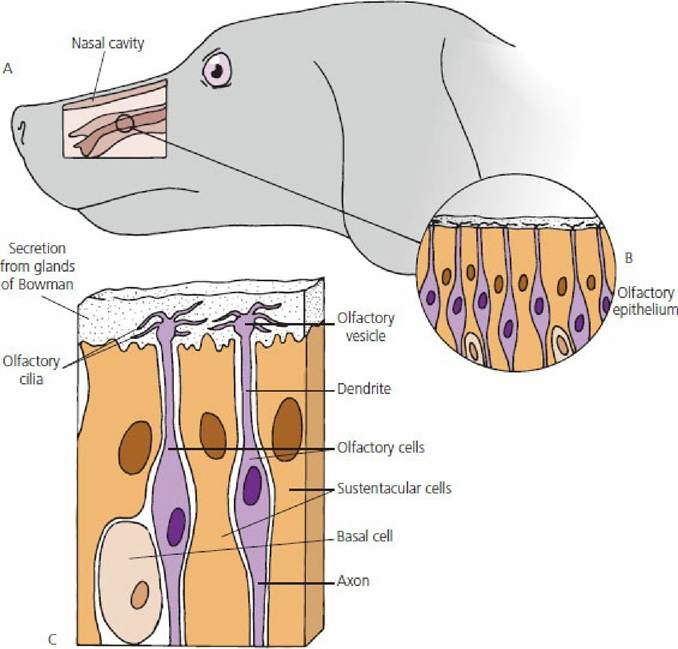
■ FIGURE 5-4 The olfactory region of the dog and the cells associated with smell. A. Nasal cavity. B. Olfactory epithelium from nasal cavity mucous membrane.
C. Olfactory cells, basal cells, and sustentacular (supporting) cells are associated with olfactory epithelium. Subepithelial glands of Bowman (not shown) provide secretion-covering olfactory cilia.Odor Perception
Considering the great number of smell possibilities, it is unlikely that a specific type of olfactory cell exists for each smell. It is more probable that basic smells combine to provide the sensation for a particular odor.
Only one odor can be perceived at any one time. Some room deodorants are effective because they can stimulate olfactory cells more than the offensive odor. The offender is not eliminated; it is only masked. The olfactory cells become adapted to odors so that they do not persist for a particular individual. This is why the smell of fresh-baked bread is so apparent when someone enters a bakery, whereas the baker might not even smell it anymore.
Pheromones
Animals use odors to communicate with each other. Black-tailed deer and Rocky Mountain mule deer have been found to use the tarsal glands on the insides of their hind legs as transmitters of odors to identify species as friendly or alien to their own kind. The scent is deposited on the skin and hair by the tarsal glands, and communication is established by sniffing other members of their group approximately once each hour. A chemical secreted by one animal that influences the behavior of other animals is known as a pheromone. The first chemical analysis of a mammalian pheromone was accomplished using the deer tarsal gland substance. Some animals have scent glands in the spaces between their hoof pads. Rabbits have a scent gland on the chest and around the anal opening. Cats have glands on the chin and lips and mark people or objects by rubbing their heads on them. Pheromones provide for a chemical language among animals for certain purposes, such as marking trails or boundaries, recognizing individuals from the same herd or nest, marking the location of food sources, and emitting alarms.
■