Solute Reabsorption by the Medullary ThickAscending Limb and Collecting Duct Generates and Maintains Medullary Hypertonicity
The thick ascending limb of Henle’s loop actively takes up sodium chloride (NaCI) but is impermeable to water. Therefore, this segment raises the osmolality of the interstitial fluid, thus generating medullary interstitial hypertonicity and an osmotic gradient.
The inner medullary collecting ducts also actively reabsorb NaCI, but their more important contribution to the medullary hypertonicity is the reabsorption of urea (Figure 43-1). Although the cortical and outer medullary collecting ducts are impermeable to urea, the terminal inner medullary collecting duct (IMCD) is highly permeable to urea through carrier- mediated urea transport. Thus, urea is conserved in the tubule fluid until the terminal IMCD deep in the medulla. There, urea reabsorption into the interstitial fluid is enhanced by ADH, so when conditions demand water conservation, urea reabsorption is enhanced. Increased urea uptake increases the osmotic gradient for water uptake. Because the thin limbs of Henle’s loop are permeable to urea, whereas the tubule segments that intervene between the thin ascending limb and the
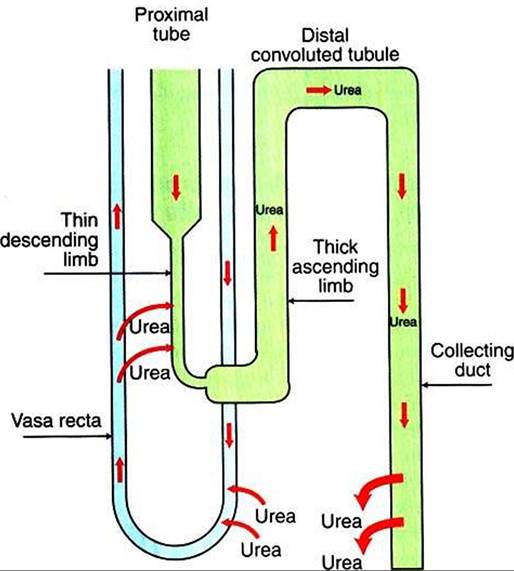
FIGURE 43-1 Urea recycling in the kidney. Filtered urea is reabsorbed in the inner medullary collecting duct by carrier-mediated, facilitated transport and diffuses down its concentration gradient into the vasa recta. It is believed that urea diffuses out of the fenestrated ascending vasa recta down its concentration gradient and returns to the tubule lumen by transport into the descending thin limbs of Henle's loop. Urea uptake in the descending thin limbs and descending vasa recta is enhanced by the presence of urea transporters.The accumulation of urea in the medullary interstitium contributes to the osmotic pressure and is an important component of renal regulation of water balance.
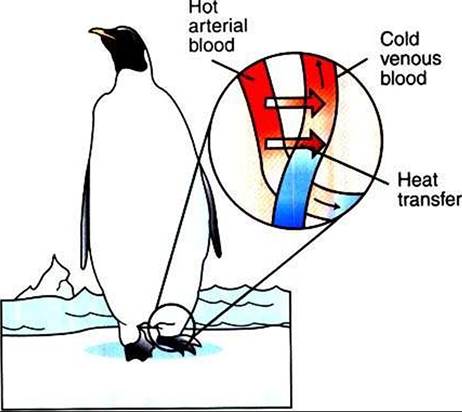
FIGURE 43-2 Countercurrent blood flow for conservation of heat.
In many cases, aquatic birds and aquatic mammals have a countercurrent arrangement of blood vessels in their extremities in order to conserve body heat despite constant exposure to cold ambient temperatures without the insulation provided by feathers or subcutaneous fat. Arteries carrying hot blood to the distal extremities, such as the penguin's foot, are closely intertwined with the veins returning cooled blood from the capillary bed. In this way the arterial blood entering the foot warms the returning venous blood.This arrangement minimizes the loss of heat (energy) to the cold environment and cooling of the body core by the return of chilled venous blood.The countercurrent flow provides efficient energy conservation by creating a temperature gradient between the arterial and venous systems at every level. (Redrawn from BerIT, Schrier RW: Disorders of water metabolism. In Schrier RW, editor: Renal and electrolyte disorders, ed 4, Boston, 1992, Little, Brown.)terminal IMCD are impermeable to urea, the urea that is reabsorbed from the terminal IMCD is recycled back to the IMCD. In mammals this system of urea recycling enhances the efficiency of the urine-concentrating mechanism. In birds, however, urea is nearly absent in the medullary interstitium; urates do not contribute appreciably to osmotic pressure because they have low water solubility. Thus, medullary hypertonicity in birds depends on single-solute (NaCl) recycling.